Table of Contents
Nobel Prize in Medicine or Physiology 2026
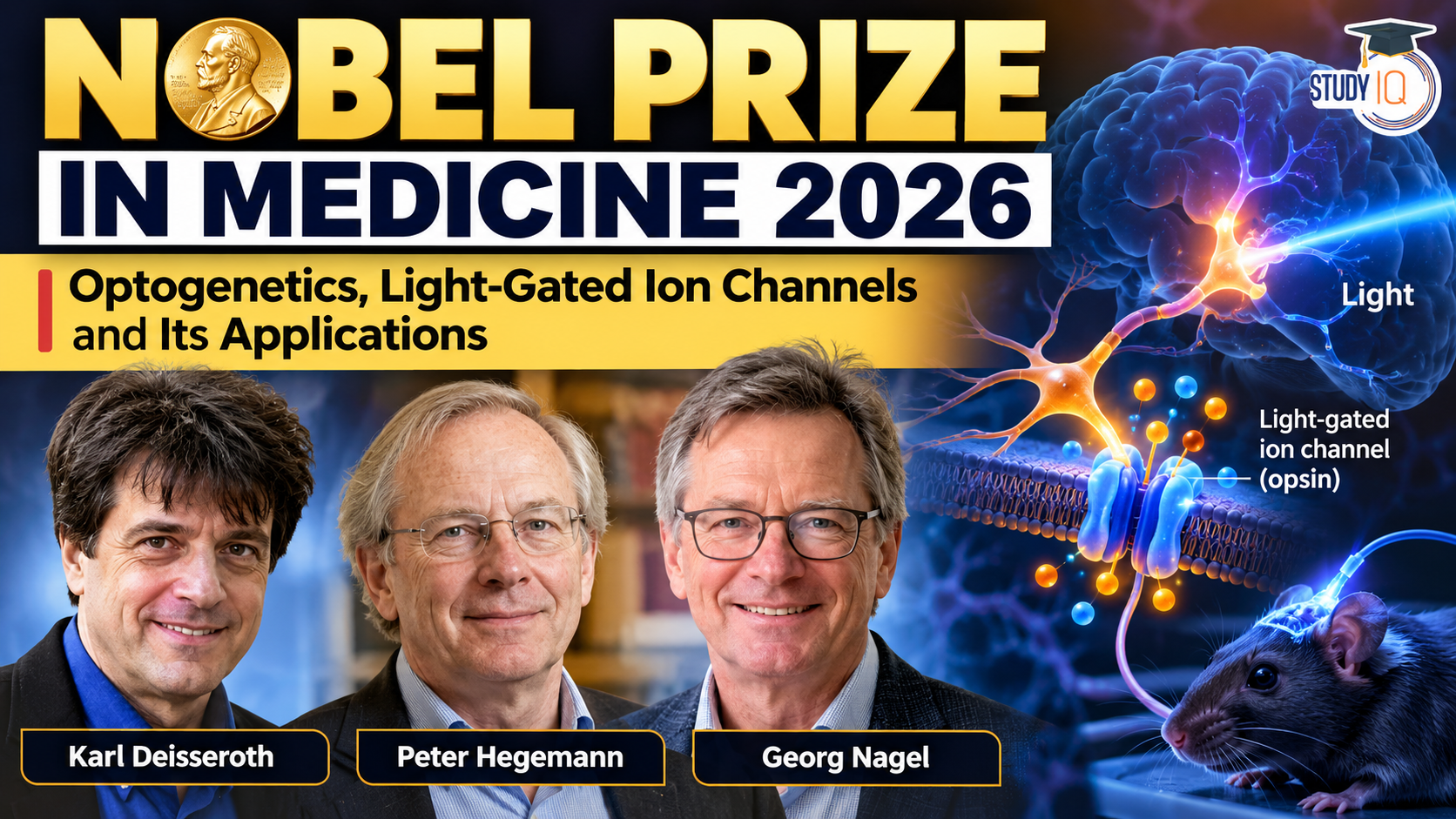
The Nobel Prize in Physiology or Medicine 2026 has been jointly awarded to Karl Deisseroth, Peter Hegemann and Georg Nagel for their pioneering discoveries concerning light-gated ion channels and optogenetics.
Their work has transformed neuroscience by enabling scientists to control specific nerve cells using light and investigate how neural circuits influence memory, emotions and behaviour.
Read Also: UPSC Daily Current Affairs 2026
What is Optogenetics?
Optogenetics is a biotechnology and neuroscience technique that combines genetic engineering and light to control the activity of specific cells, particularly neurons.
The technique uses genetically introduced light-sensitive proteins called opsins. When exposed to specific wavelengths of light, these proteins regulate ion movement across the cell membrane, thereby controlling neuronal activity.
In simple terms:
Genetic modification → Light-sensitive protein → Light stimulation → Ion movement → Neuronal activation/inhibition
This precision allows researchers to study individual neural circuits and establish causal relationships between neuronal activity and behaviour.
What are Light-Gated Ion Channels?
Light-gated ion channels are proteins that open or close in response to light.
One of the most important examples is channelrhodopsin, a light-sensitive protein discovered in the green alga Chlamydomonas.
When exposed to blue light, channelrhodopsin opens and allows charged ions to move through the cell membrane, producing an electrical response.
Major contributions of the laureates
Peter Hegemann and Georg Nagel studied light-sensitive proteins in algae and helped discover and characterise channelrhodopsins.
Karl Deisseroth subsequently demonstrated that these proteins could be used to control nerve cells. In 2005, his research showed that introducing channelrhodopsin into neurons allowed their activity to be controlled using blue light. Later, the technique was demonstrated in the brains of living mice.
This work laid the foundation for modern optogenetics.
Applications of Optogenetics
1. Neuroscience and Brain Mapping
Optogenetics allows researchers to identify specific neural circuits involved in memory, emotions, learning and behaviour.
2. Neurological Disorders
It is being used in experimental research on conditions such as:
- Parkinson’s disease
- Epilepsy
- Alzheimer’s disease
- Stroke
- Neuropathic pain
It helps researchers understand disease-associated neural circuits and identify potential therapeutic targets.
3. Psychiatric Disorders
Optogenetic studies are helping investigate the neural circuits underlying depression, anxiety, addiction and other psychiatric conditions.
4. Vision Restoration
One of the most promising medical applications is restoring vision in people with retinal degeneration.
Researchers are investigating ways to introduce light-sensitive proteins into surviving retinal cells, potentially allowing them to respond to light even after photoreceptors have been damaged.
5. Drug Discovery
Optogenetics can help researchers establish whether particular neural circuits are responsible for disease-related behaviours, supporting the development and validation of new therapeutic targets.
Why is the Discovery Important?
Traditional neuroscience techniques often show that a particular brain region is associated with a behaviour. Optogenetics allows researchers to manipulate specific neurons and ask whether their activity actually causes a particular response.
Thus, it provides an important bridge from correlation to causation in neuroscience.

 Daily Mains Articles 2026 – Updated Da...
 Daily Current Affairs PDF 2026: Download...
 Financial Stability in India: RBI’s 5 ...













 WhatsApp