
Table of Contents
Context
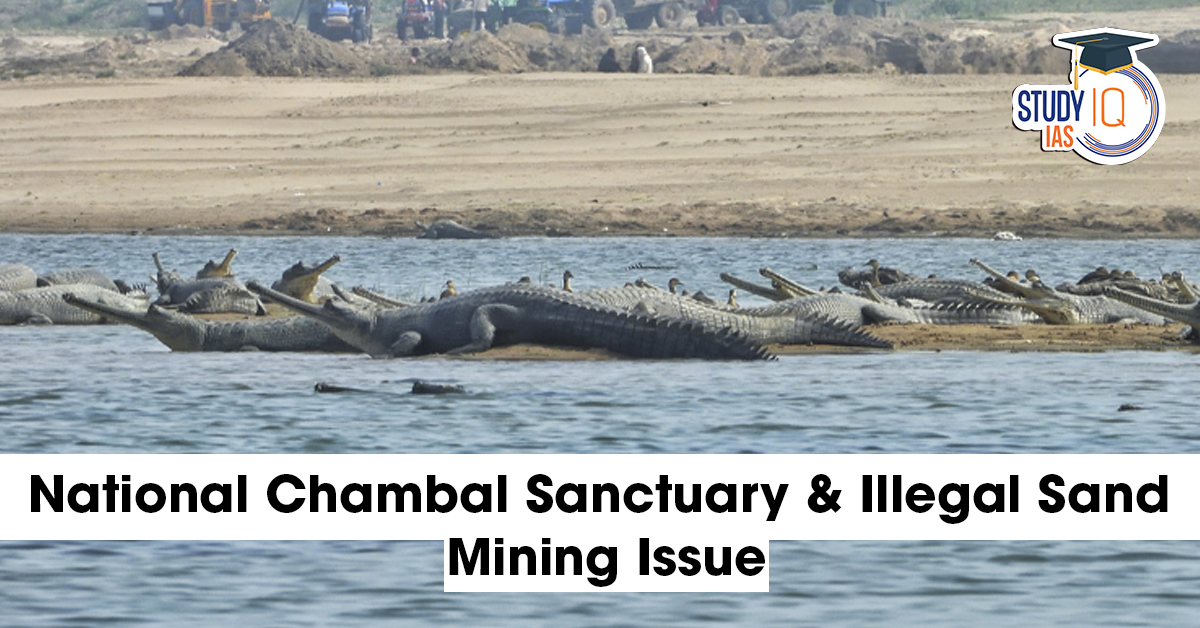
The Supreme Court has taken suo motu cognisance of rampant illegal sand mining in the National Chambal Sanctuary, emphasizing the threat to the critically endangered gharials and the river’s lotic ecosystem, labelling the mining mafia as “modern dacoits
National Chambal Sanctuary
The National Chambal Sanctuary is a protected riverine (lotic) ecosystem spanning three states: Rajasthan, Madhya Pradesh, and Uttar Pradesh. It is a critical habitat for three “flagship” species that depend on sandbars and sandbanks for nesting and basking.
- Location: Situated at the trijunction of Rajasthan, Madhya Pradesh, and Uttar Pradesh.
- Jurisdiction: It is India’s first and only tri-state riverine protected area.
- Length: Covers a 600-km stretch of the 960-km Chambal River.
- Eco-Sensitive Zone: Notified to protect the fragile riverine habitat.
Key Biodiversity
The sanctuary is a “lotic” (moving water) ecosystem and serves as a vital breeding spot for several threatened species:
- Gharials (Gavialis gangeticus): Critically Endangered (IUCN). It is the primary habitat for this fish-eating crocodile.
- Gangetic River Dolphins: Endangered (IUCN); India’s National Aquatic Animal.
- Red-Crowned Roof Turtle: Critically Endangered.
- Other Fauna: Marsh Crocodile (Muggers), Smooth-coated Otters, Indian Skimmer (Vulnerable), Sarus Crane, and Black-necked Storks.
Threats
- Habitat Destruction: Mining destroys the sand banks, which are essential nesting sites for gharials and turtles.
- River Morphology: It alters the river’s flow, degrades water quality, and reduces the water-retaining capacity of the riverbed.
- Ecological Impact: Even in areas where the government has attempted to “relocate” gharials for safety, the mining mafia has encroached upon the new habitats.
- Seasonal Aggravation: Unlike other rivers, the Chambal’s sand banks remain exposed nearly year-round due to low rainfall/floods, allowing the “sand mafia” to operate throughout the year.
| LOTIC ECOSYSTEMS |
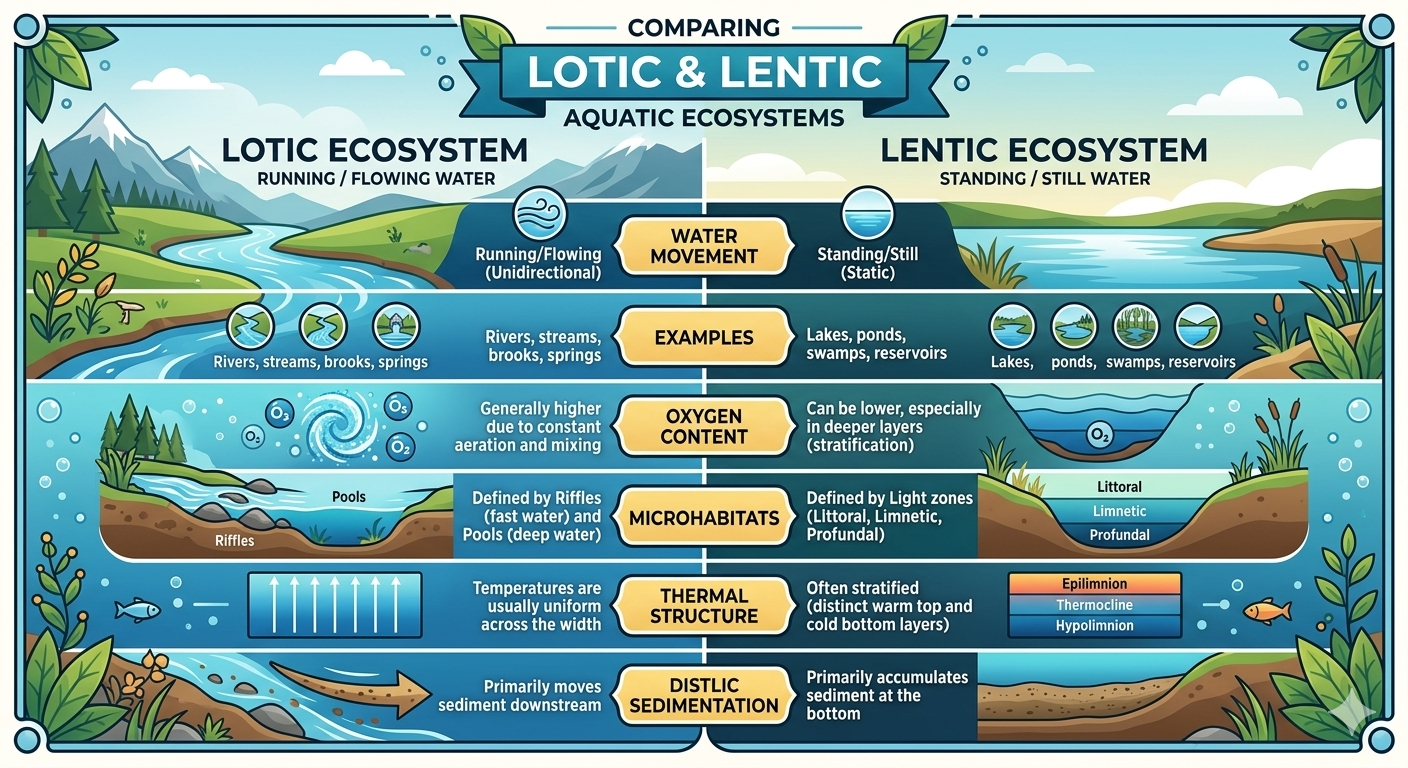
A lotic ecosystem refers to a freshwater habitat with continuously moving water flowing in a single direction, such as rivers, streams, and springs.
Key Characteristics
|
CROCODILES OF INDIA
| Feature | Gharial | Mugger (Marsh) | Saltwater (Estuarine) |
| IUCN Status | Critically Endangered | Vulnerable | Least Concern |
| WPA 1972 | Schedule I | Schedule I | Schedule I |
| Physical Feature | Long, thin snout; males have a bulbous “Ghara” at the tip. | Broad snout; looks most like a typical crocodile. | Largest reptile on Earth; very broad snout. |
| Primary Habitat | Clean, deep flowing rivers (Freshwater only). | Lakes, rivers, and even man-made tanks/reservoirs. | Brackish water, mangroves, and coastal areas. |
| Key Locations | Chambal River (stronghold), Girwa, Gandak, and Son rivers. | Found across India (e.g., Vishwamitri River, Gujarat). | Bhitarkanika (Odisha), Sundarbans, and A&N Islands. |
| Diet | Primarily Piscivorous (Fish-eater). | Opportunistic (Fish, birds, mammals). | Apex predator (Will hunt anything, including sharks). |
Key Challenges in National Chambal Sanctuary
- Jurisdictional Gaps: The sanctuary’s tri-state border allows mining syndicates to exploit administrative silos. When one state cracks down, miners slip across the border into another jurisdiction.
- Technological Warfare: Mining groups have evolved from local gangs into sophisticated syndicates using GPS, mobile tracking apps, and villagers as informants to monitor patrol movements.
- State Paralysis & Violence: Between 2017 and 2024, the region witnessed extreme violence, including the killing of forest guards and police. Syndicates are often better armed (using semi-automatic weapons) than local forest departments.
- The Legalization Gambit: In a move reflecting administrative frustration, Madhya Pradesh and Rajasthan recently attempted to legalise sand mining in certain districts within the sanctuary to regulate it. However, the National Green Tribunal (NGT) and the Supreme Court blocked these proposals to prevent ecological collapse.
- Socio-Economic Roots: The harsh geography of the Chambal ravines makes traditional agriculture difficult. Lack of alternate livelihoods pushes local youth to become “foot soldiers” for the sand mafia.
Way Forward
- Restoring Lawful Livelihoods: Lasting change requires providing the youth in the Gwalior-Chambal region with viable, legal employment alternatives to break the mafia’s recruitment cycle.
- Strengthening the Regulator: The Supreme Court’s role should focus on disciplining the existing regulators (State Forest Departments and the NGT) rather than replacing them. Ensuring these bodies have the equipment, personnel, and legal backing is crucial.
- Inter-State Coordination: Establishing a Unified Chambal Task Force involving Rajasthan, MP, and UP to synchronise patrols and intelligence sharing.
- Strict Legal Enforcement: Utilising stringent laws like the National Security Act (NSA) and state-specific Goonda Acts against kingpins, as suggested by the Supreme Court, to dismantle the syndicate hierarchy.
|
Read More Notes |
|
| Environment Notes | Art and Culture Notes |
| Science and Tech | History Notes |
| Geography Notes | Indian Polity Notes |
| General Knowledge | International Relation |
|
Explore StudyIQ Courses |
|
 Marine Spatial Planning (MSP): Meaning, ...
 Sustainable Aviation Fuel (SAF): Benefit...
 Microplastics in Sundarbans Delta: Sourc...













 WhatsApp





