Table of Contents
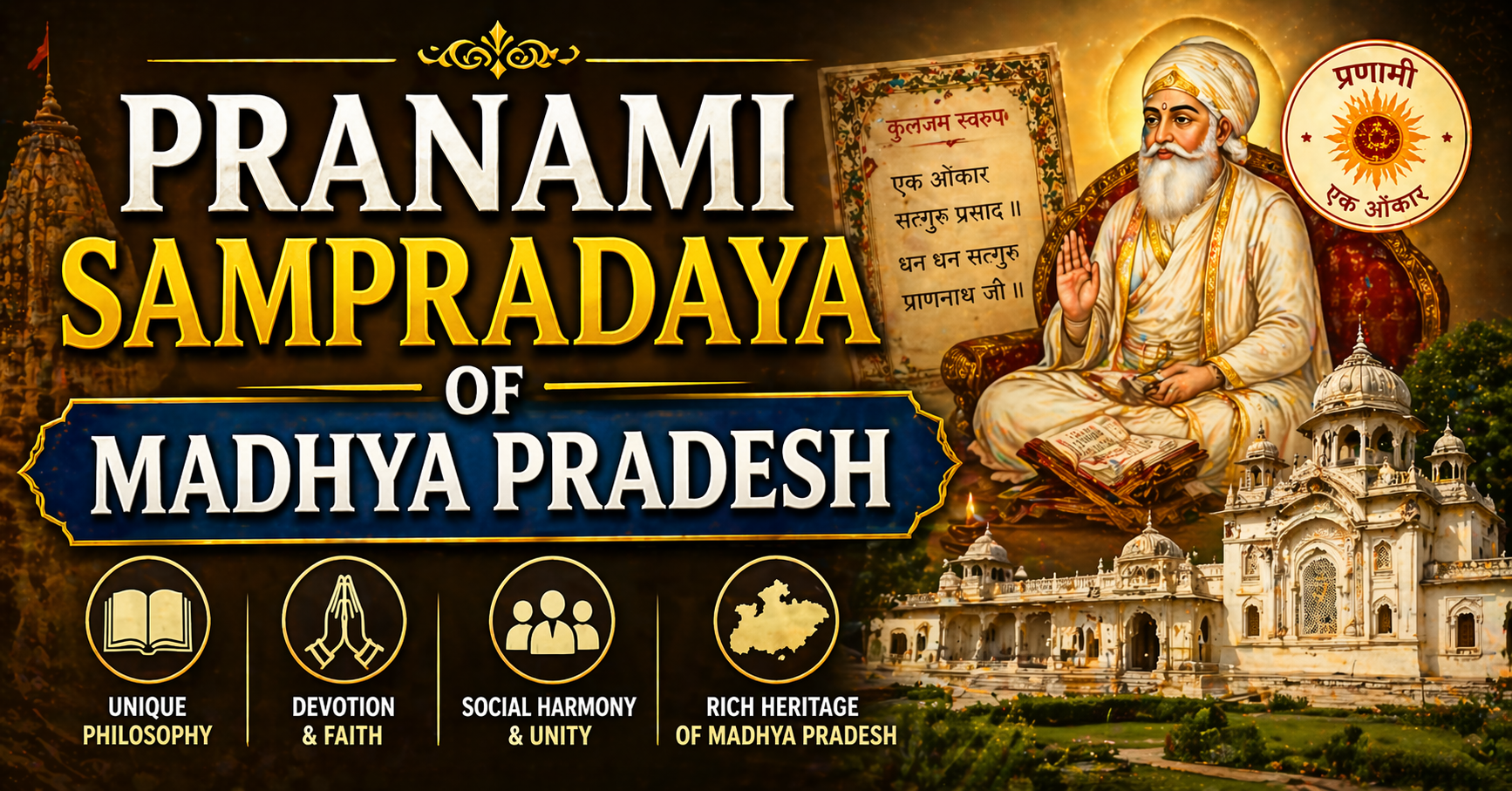
The Pranami Sampradaya is a significant syncretic religious movement that emerged during the medieval period, emphasizing a monotheistic philosophy known as Nijand Sampradaya. The sect focuses on the worship of the Supreme God (Aksharateet Purna Brahm) and promotes communal harmony by synthesising teachings from the Vedas and the Quran.
Philosophical Foundations of Pranami Sampradaya – Nijand Sampradaya
The sect was founded by Devchandra Singhji, but it was his disciple, Mahamati Prannath, who brought the movement to Bundelkhand.
- Core Philosophy: Known as Nijand Sampradaya or Kshara-Akshara-Aksharateet.
- Core Philosophy of Pranami Sampradaya:
-
- Kshara (Perishable): Refers to the material world, prone to change and destruction.
- Akshara (Imperishable): Spiritual foundation that supports the material world.
- Aksharateet (Beyond the Imperishable): By identifying the Supreme as Aksharateet, the sect positions God as existing beyond even the traditional spiritual heavens.
- Deity: Focuses on the worship of Aksharateet Purna Brahm (The Supreme Reality). Tartam Gyan is the specific tool used to reconcile the Vedas and the Quran.
- Theological Synthesis: It serves as a bridge between the Vedas and the Quran. By teaching that the “God of the East” and “God of the West” are one (Ekam Sat), the sect represents the pinnacle of the Bhakti-Sufi synthesis in Central India.
- Tartam Gyan: Defined as “Para-Vidya”—the supreme knowledge that allows the soul to awaken from the illusion of the material world. The word Tartam implies a comparison or a “bridge” (from Tar – to cross). Its primary purpose is to help the seeker differentiate between the three levels of reality Kshara, Akshara & Aksharateet.
- Metaphysics of Pranami Sampradaya: Sagar Shastra is one of the most vital books within the 14-volume Kuljam Swarup.
-
- Anatomy of the Soul (Atman): Provides a detailed “map” of the soul’s origin. It posits that the souls are Aangnas (divine parts) of the Supreme God who have “fallen” into the dream of the material world (Kshara).
-
- Doctrine of “Jagni” (Awakening): Sagar explains that the material world is a “Sapna“ (dream). Tartam Gyan is the alarm that triggers Jagni—the process of waking up to one’s true divine status.
- Cosmology: Provides an intricate description of Paramdham (supreme abode). Unlike the temporary heavens of traditional mythology, the Sagar describes a permanent, non-dual realm of pure consciousness and bliss.
Alliance of Prannath and Chhatrasal
The partnership between Mahamati Prannath and Maharaja Chhatrasal represents one of the most successful examples of “Spiritual Statecraft” in Indian history. It transformed a localized resistance into a sovereign, fiscally stable kingdom.
Legend states that Mahamati Prannath met Chhatrasal during a period of intense struggle against Aurangzeb. It is often cited in Bundeli folklore that Prannath gave Chhatrasal a sword and a blessing, famously predicting that diamonds would be found in the soil of Panna—which historically aligns with the rise of Panna’s prosperity and the establishment of the diamond mines.
Political Catalyst (Legitimacy)
- The Mau Meeting (1683 CE): This was the definitive turning point for Bundela sovereignty. In the 17th-century political landscape, “sanctification” was a prerequisite for kingship.
- Consolidation of Power: By accepting Prannath as his Guru, Chhatrasal received a spiritual “Sanad” (sanction) that elevated him above other local chieftains. This effectively ended debilitating internal clan rivalries and provided him with the authority to command the unified Bundela clans.
Ideological Support (Social Mobilization)
- The “Nijand” Framework: The philosophy acted as a nascent Bundela Nationalist ideology. It provided a powerful moral and social alternative to the Mughal imperial order.
- Collective Identity: By promoting an egalitarian spiritual path, it created a shared identity among a diverse military core—ranging from Rajput warriors to local farmers and tribal groups—forging a cohesive “People’s Army” capable of sustained resistance.
Economic Bedrock (Fiscal Statecraft)
- The Diamond Mines: This is a cornerstone of Panna’s administrative history. The “spiritual discovery” of the mines suggests that the Pranami network (with its roots in the mercantile hubs of Gujarat and Rajasthan) brought critical geographical and technical knowledge to the region.
- Fiscal Stability: The revenue from these mines allowed Chhatrasal to transition from a “predatory” guerrilla leader to a sovereign who could pay regular salaries to his troops. This financial foundation was the primary reason his rebellion survived while others in Central India collapsed.
Spiritual Intelligence Network (Information Warfare)
- Trans-Regional Reconnaissance: Because Pranami followers were spread across Mughal Subahs (Provinces) in Gujarat and Rajasthan, they functioned as an informal, invisible intelligence network.
- Kaithi Script: Information was often transmitted using the Kaithi script. As a cursive script commonly used by traders and low-level clerks, it was far less likely to be flagged as “military intelligence” if intercepted by Mughal authorities. This gave Chhatrasal a distinct advantage in asymmetric warfare, providing him with real-time updates on imperial logistics and troop movements.
Panna: The “Muktipuri” (Spiritual Capital) – Architecture of Pranami Sampradaya
Panna is often referred to as the “Lesser Gaya” or the “Kashi of the Pranamis”. The Sharada Devi Temple and the Jagannath Swami Temple in Panna also show the religious diversity of the region, but the Pranami temple remains the most distinct administrative and spiritual landmark of the Chhatrasal era.
- Global Headquarters: The Mahamati Prannathji Temple (Gummat Ji) is the central shrine.
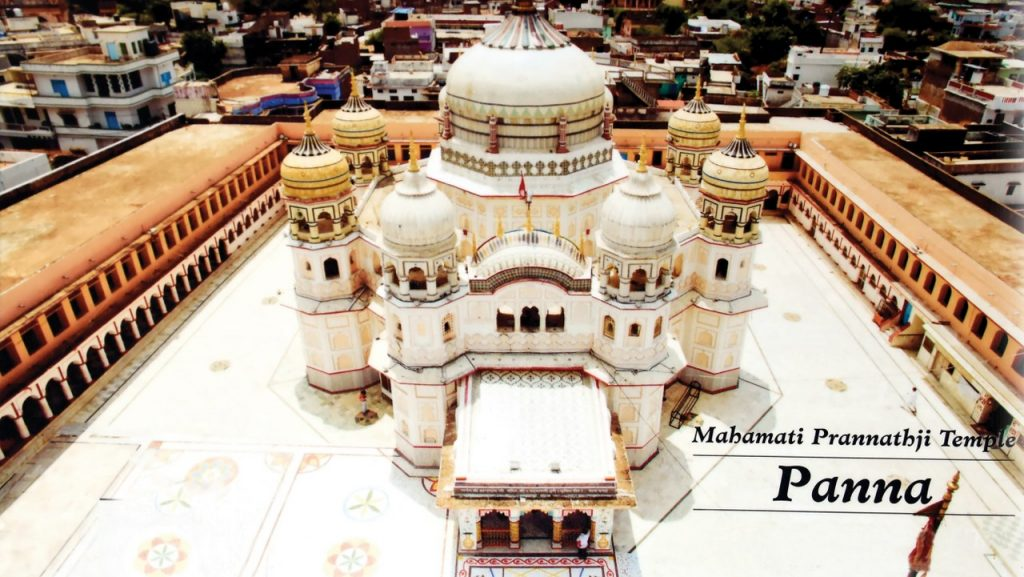
- “Gummat” (Dome) Silhouette: The primary feature is the large central dome (Gummat), surrounded by smaller domes and kiosks (chhatris). This blends the Indo-Islamic ribbed dome and pointed arch with the heavy, fortified stone masonry of the Bundela Rajput style.
- Architectural Fusion: The temple is a definitive example of Bundela-Islamic fusion, characterized by:
- External: Large domes (Gummats) and pointed arches reflecting Islamic motifs.
- Internal: Layout and motifs that follow traditional Hindu temple architecture.
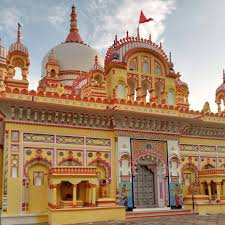
- The presence of lotus motifs alongside arched gateways perfectly illustrates your point on Bundela-Islamic fusion.
- Departure from the Garbhagriha: Unlike traditional temples with a dark, enclosed inner sanctum for an idol, Pranami architecture utilizes a large, open congregational hall. This reflects the shift from private ritual to collective Satsang and “Jagni” (spiritual awakening).
- “Gaddi” (Throne) System: The central focus is the Gaddi, a raised platform where the Kuljam Swarup (holy scripture) is placed under a canopy. This mirrors the architectural logic of a Sikh Gurdwara, prioritizing the “Word” over an image or idol.
- Syncretic Ornamentation: The decoration features Lotus motifs (Hindu) carved directly onto pointed arches and spandrels (Islamic). The aesthetic favours geometrical and floral patterns (monotheistic/Nirguna influence) rather than the figural deity sculptures found in traditional Mandirs.
- Sacred Urbanism (Muktipuri): The town of Panna was planned as a Mandala, with temples strategically placed to create a sacred geography. The use of large Khirkis (windows) and balconies symbolizes the transparency of knowledge, contrasting with the secretive, secluded designs of earlier Tantric temples like Jabalpur’s Bajna Math.
- Sanctum (Grantha Puja):
- In a radical departure from mainstream Vaishnavism, there is no idol. The Kuljam Swarup is placed on a throne (Gaddi), marking a historical shift from Murti Puja (image worship) to Grantha Puja (scriptural worship).
- It marks a transition toward Sikh-like veneration of the holy book, which was a progressive move away from traditional ritualistic idolatry during the late medieval period.
Cultural Contributions of Pranami Sampradaya
- Primary Text: The Kuljam Swarup (or Tartam Sagar), comprising 14 books and approximately 18,758 verses.
- Sagar (often referred to as the Sagar Shastra within the Kuljam Swarup) is arguably the most profound philosophical treatise in the Pranami tradition.”Sagar” (Ocean) reflects the vastness of the knowledge it contains. It deals with the concept of Tartam Gyan—the transformative knowledge that allows the soul to distinguish between the temporary and the eternal.
- Linguistic Strategy:
- Written in “Mishrit” (Mixed) language—incorporating Gujarati, Hindi, Sindhi, and Arabic/Persian terms. This was a deliberate attempt to democratize spiritual knowledge across the linguistic barriers of Western and Central India.
- The use of the Kaithi and Devanagari scripts to write these verses helped the sect cross the borders of Gujarat, Rajasthan, and Madhya Pradesh.
- Bundela Miniatures: The Pranami influence shifted the focus of Bundela art. Instead of just royal portraits or hunts, artists began depicting the “Nitya Golok“ and “Brij Lila“ as envisioned in the Kuljam Swarup.
- Folk Music: The Pranami Bhajans introduced a specific rhythmic structure to Bundelkhandi music. These are often characterized by the use of the Manjira and Dholak, with a focus on collective singing (Sankirtan). Even today, the “Pranami Vani” is sung during social gatherings in Panna and surrounding districts, acting as a vehicle for preserving the 17th-century linguistic blend.
Social Reforms under Pranami Sampradaya
- Pangat System – Syncretic Social Fabric: Mahamati Prannath introduced a system where followers from all castes and religions (including Muslims) ate together from the same plate (Pangat). This was a revolutionary social mobilization tool for Chhatrasal, allowing him to unite disparate groups under a single identity—a crucial factor in his successful guerrilla warfare.
- Environmental Administration (Khet-Pati System): Under Prannath’s guidance, Chhatrasal implemented the Khet-Pati (Tree-Patrimony) system. This strictly prohibited the cutting of fruit-bearing trees and protected sacred groves, viewing the local landscape as an extension of the divine “Brij.”
- Administration of Diamond Mining: Established a regulated, tripartite revenue system. Revenue was divided between the State, the Temple (for public welfare), and the Miners. This “divine partnership” remains a unique administrative hallmark of the Panna State.
- Bureaucratic Syncretism: Chhatrasal’s administration utilized a blend of traditional Rajput and Mughal-style administrative titles. This “linguistic syncretism” in bureaucracy directly reflected the “Mishrit” (mixed) language of the Kuljam Swarup.

 List Of Tribal Festivals In India: Compl...
 Buddha Purnima 2026: Date, Time, History...
 National Maritime Heritage Complex (NMHC...











 WhatsApp