
Table of Contents
Electoral democracy derives its legitimacy not merely from the conduct of free and fair elections but also from ensuring that voters have access to relevant information about candidates contesting elections. In modern democracies, transparency regarding a candidate’s background, financial status, educational qualifications, and criminal history has become an essential component of informed voting.
In India, the issue of criminal antecedents in politics has emerged as a major concern over the past three decades. The growing participation of individuals facing criminal charges in electoral politics has led courts, policymakers, and civil society organizations to advocate greater transparency in the electoral process. The Supreme Court has repeatedly emphasized the electorate’s “right to know” as a cornerstone of democratic governance.
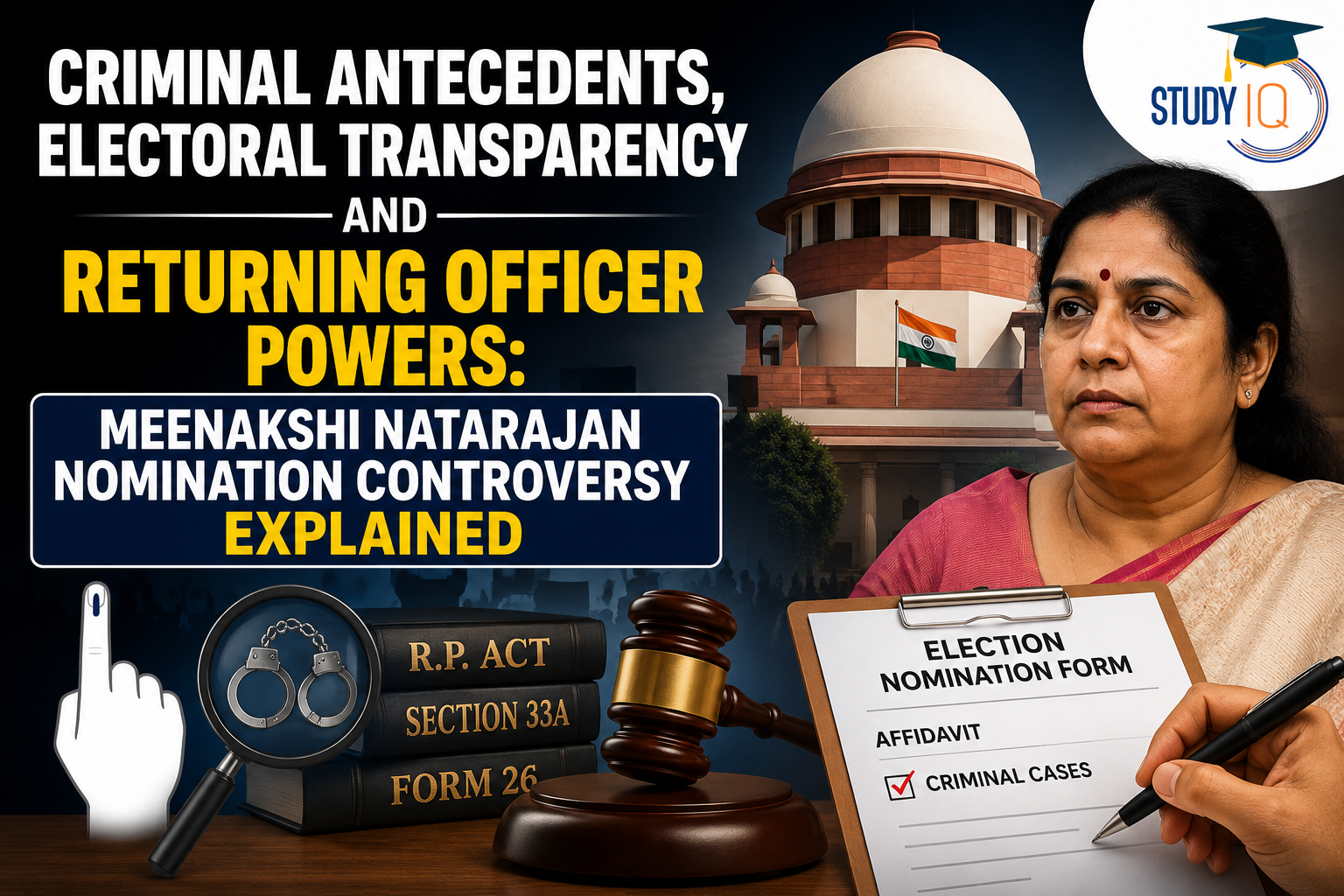
The recent controversy surrounding the rejection of Congress leader Meenakshi Natarajan’s Rajya Sabha nomination from Madhya Pradesh has reignited debate over criminal disclosures, electoral transparency, and the powers of Returning Officers. The case raises important questions about the interpretation of election laws, disclosure obligations of candidates, and the procedural safeguards that protect democratic participation.
What is the Meenakshi Natarajan Nomination Controversy?
The controversy arose during the Rajya Sabha elections in Madhya Pradesh when the Returning Officer rejected the nomination of Meenakshi Natarajan on the ground that she had allegedly failed to disclose a pending criminal complaint before a court in Hyderabad.
According to the Returning Officer, the non-disclosure amounted to a material defect in the nomination papers. However, Natarajan challenged the decision, arguing that the case in question was only at a pre-cognizance stage and therefore did not require disclosure under election laws.
Her legal team maintained that:
- The Hyderabad complaint had not progressed to the stage of cognizance by the court.
- No charges had been framed against her.
- She had merely received a summons under the proviso to Section 223 of the Bharatiya Nagarik Suraksha Sanhita (BNSS), 2023.
- Election laws require disclosure only when certain legal thresholds are crossed.
The matter eventually reached the Supreme Court. On June 12, the Court declined to entertain her writ petition under Article 32, observing that the appropriate remedy lay in filing an election petition after the election process.
Criminalisation of Politics in India
The issue of criminalisation of politics has long been a subject of concern in India’s democratic system.
Criminalisation of politics refers to the increasing participation of individuals with criminal backgrounds or pending criminal cases in electoral politics and legislative institutions.
The challenge is complex because two constitutional principles often come into conflict:
Right of Voters to Know
Citizens have a democratic right to access information about candidates seeking public office. Transparency enables informed voting and strengthens democratic accountability.
Presumption of Innocence
Every individual is presumed innocent until proven guilty. Mere allegations or politically motivated complaints cannot automatically disqualify a person from participating in elections.
Indian election law seeks to strike a balance between these competing principles by prescribing specific disclosure requirements rather than imposing blanket disqualifications.
Legal Framework Governing Criminal Disclosure in Elections
Section 33A of the Representation of the People Act, 1951
The principal statutory provision governing criminal disclosures is Section 33A of the Representation of the People Act (RP Act), 1951.
Under Section 33A, a candidate must disclose:
- Previous criminal convictions.
- Pending criminal cases where:
- The offence is punishable with imprisonment of two years or more.
- Charges have been framed by a competent court.
This provision represents Parliament’s attempt to distinguish between mere accusations and criminal proceedings that have crossed a judicial threshold.
The framing of charges signifies that a court has found sufficient grounds to proceed against the accused after examining available material.
Therefore, under the plain language of Section 33A, every complaint or FIR does not automatically require disclosure.
Evolution of Judicial Interpretation
Over time, the Supreme Court has expanded disclosure requirements through constitutional interpretation.
People’s Union for Civil Liberties v. Union of India (2003)
This landmark judgment recognized the voter’s “Right to Know” as part of the freedom of speech and expression guaranteed under Article 19(1)(a) of the Constitution.
The Court held that voters have a constitutional right to obtain information regarding:
- Criminal antecedents
- Educational qualifications
- Financial assets and liabilities
The judgment transformed electoral transparency from a statutory requirement into a constitutional mandate.
Resurgence India v. Election Commission of India (2013)
The Supreme Court emphasized that candidates must provide complete information in election affidavits.
The Court ruled that:
- Blank affidavit columns cannot be permitted.
- Returning Officers may reject nominations where mandatory information is deliberately omitted.
However, the Court also cautioned that scrutiny powers should be exercised carefully and only in cases of clear non-compliance.
Kisan Shankar Kathore v. Arun Dattatraya Sawant (2014)
The Court clarified that scrutiny of nominations is a summary proceeding.
Questions relating to:
- Accuracy of disclosures
- Truthfulness of information
- Alleged concealment
are generally matters to be adjudicated through election petitions after elections.
Satish Ukey v. Devendra Fadnavis (2021)
This judgment significantly expanded disclosure obligations.
The Supreme Court interpreted:
- Section 33A of the RP Act, and
- Form 26 under the Conduct of Election Rules
together and held that candidates must disclose criminal cases where a competent court has taken cognizance, even if charges have not yet been framed.
This broadened transparency obligations beyond the strict wording of Section 33A.
Public Interest Foundation Judgment and Electoral Reforms
A major milestone came in Public Interest Foundation v. Union of India (2018).
A Constitution Bench examined the growing criminalisation of politics and issued important directions to improve voter awareness.
The Court directed that:
- Candidates must disclose criminal antecedents in prescribed forms.
- Political parties must publish details of criminal cases involving candidates.
- Such information must be made available on party websites.
- Details must be publicized through newspapers and electronic media.
These directions sought to ensure that voters have sufficient information before casting their votes.
Following this judgment, Form 26 under the Conduct of Election Rules was amended to require more extensive disclosures.
Form 26 Amendment and Emerging Legal Debate
The revised Form 26 requires candidates to disclose pending criminal cases in greater detail.
However, differing interpretations have emerged.
Broad Interpretation
One view suggests that all pending criminal proceedings must be disclosed, regardless of their procedural stage.
This position was reportedly advanced by Senior Advocate Mukul Rohatgi during arguments related to the Meenakshi Natarajan case.
Narrow Interpretation
The opposing view argues that disclosure obligations remain governed primarily by Section 33A.
According to this interpretation:
- Complaints at the pre-cognizance stage need not be disclosed.
- Subordinate legislation such as Form 26 cannot override statutory provisions.
Senior Advocate Abhishek Manu Singhvi, representing Natarajan, relied on this argument.
The Supreme Court’s refusal to adjudicate the issue at this stage leaves the legal position unsettled.
Powers of the Returning Officer: What Does the Law Say?
A critical issue in the controversy concerns the authority of the Returning Officer.
Section 36(2) of the RP Act
Under Section 36(2), nominations may be rejected only on specific grounds such as:
- Statutory disqualifications.
- Non-compliance with nomination requirements.
- Failure to deposit security.
- Missing or invalid signatures.
The provision does not expressly authorize Returning Officers to conduct detailed inquiries into disputed criminal disclosures.
Election Commission Guidelines
The Election Commission has repeatedly clarified that:
- Returning Officers perform only summary scrutiny.
- They are not expected to conduct mini-trials.
- Disputes regarding truthfulness of affidavits are generally outside their jurisdiction.
Election Commission FAQs further state that:
- False information in affidavits is not by itself a ground for rejection.
- Such cases may attract prosecution under Section 125A of the RP Act.
Therefore, election law distinguishes between:
| Ground | Consequence |
|---|---|
| Failure to submit affidavit or leaving mandatory columns blank | Rejection possible |
| Allegedly incorrect or incomplete disclosure | Usually not a ground for rejection |
This distinction lies at the heart of the Meenakshi Natarajan controversy.
Constitutional Issues Raised by the Controversy
The dispute highlights broader constitutional questions regarding electoral governance.
Transparency vs Due Process
Democracy requires informed voting, but excessive disclosure obligations may expose candidates to politically motivated complaints.
Voter Rights vs Candidate Rights
Voters are entitled to know about criminal cases, but candidates also possess a right to participate in elections without facing arbitrary exclusion.
Administrative Efficiency vs Judicial Determination
Returning Officers must conduct scrutiny efficiently, while disputed factual questions are generally meant for judicial forums such as Election Tribunals.
Balancing these competing interests remains one of the most difficult challenges in Indian election law.
Conclusion
The Meenakshi Natarajan nomination controversy has reopened an important debate on electoral transparency, criminal antecedent disclosures, and the limits of Returning Officer powers under Indian election law.
While Section 33A of the Representation of the People Act clearly mandates disclosure of certain criminal cases, uncertainty remains regarding complaints that are still at the pre-cognizance stage. The relationship between Section 33A and the amended Form 26 continues to generate legal debate and may ultimately require authoritative judicial clarification.
Equally significant is the question of whether Returning Officers can reject nominations based on alleged non-disclosure. Existing statutory provisions, Supreme Court precedents, and Election Commission guidelines suggest that scrutiny powers are limited and do not ordinarily extend to resolving disputed questions of fact.
As India continues its efforts to combat the criminalisation of politics while preserving democratic participation, the resolution of these issues will play a crucial role in strengthening electoral integrity, constitutional governance, and public confidence in democratic institutions.
Read Also: Judiciary Current Affairs
 Supreme Court Dowry Enforcement Order 20...
 Supreme Court Modifies 3-Year Practice R...
 Doctrine of Per Incuriam Explained: Supr...







 WhatsApp





