Table of Contents
Context
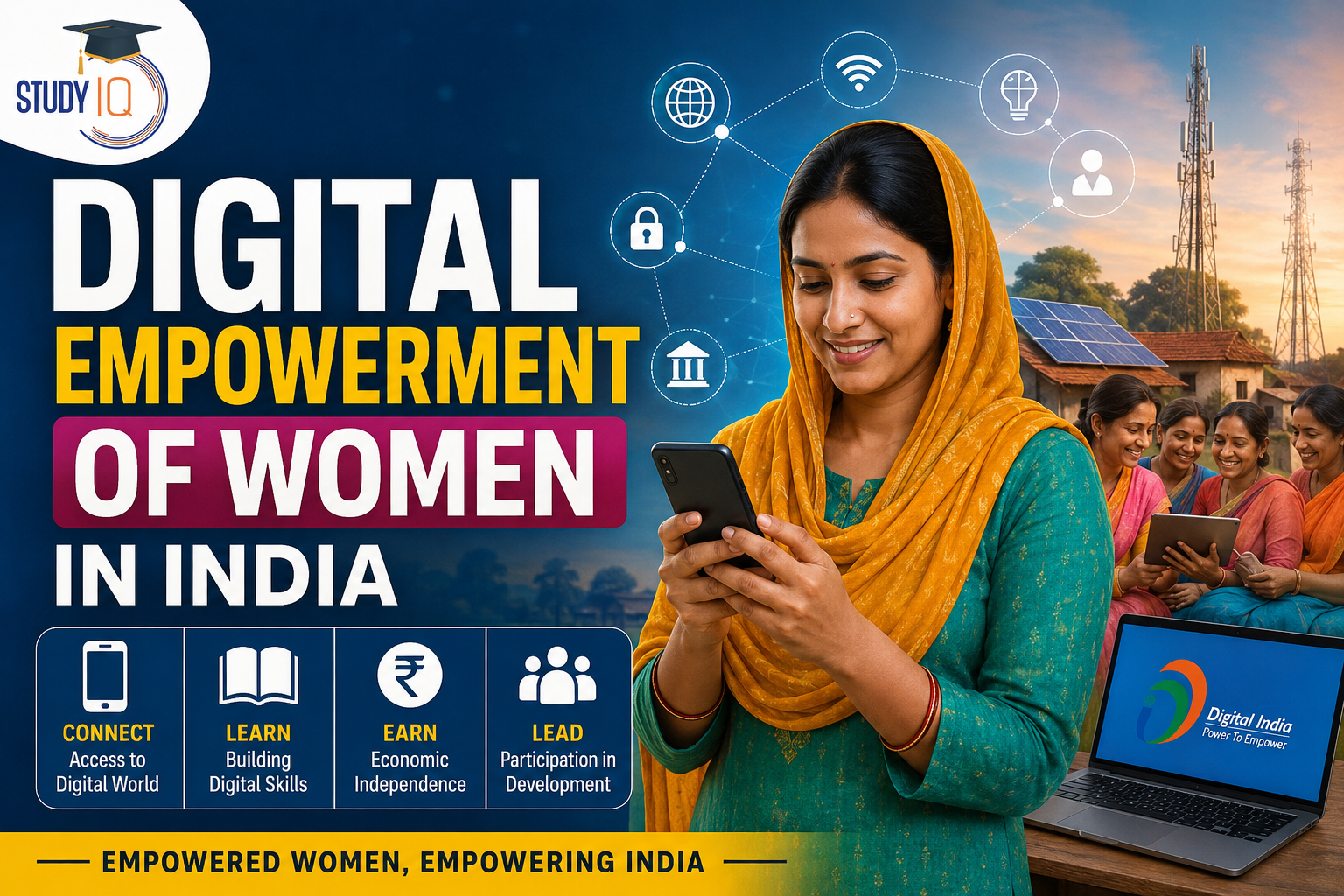
The release of NFHS-6 (2023–24) has renewed attention on India’s gender digital divide. While women’s internet usage has nearly doubled since NFHS-5, concerns remain over converting digital access into meaningful social, economic, and political empowerment.
Why Has Greater Digital Access Not Translated into Women’s Empowerment?
- Access Without Ownership: Having access to a mobile phone does not mean women can use it independently. Many rely on shared family phones, with usage controlled by male family members, limiting digital autonomy.
- g.: NFHS-5 shows many women use mobile phones but far fewer own one exclusively.
- Ownership Without Digital Capability: Owning a smartphone is not enough unless women have the skills and confidence to use digital services for learning, finance, and livelihoods.
- g.: PMGDISHA has improved digital literacy, but many women still rarely use digital banking or e-governance services.
- Capability Without Economic Agency: Digital skills create empowerment only when they translate into income, entrepreneurship, or employment opportunities.
- g.: Women’s participation in e-commerce, gig work, and digital entrepreneurship remains relatively low despite rising smartphone use.
- Economic Capability Without Household Autonomy: Even digitally skilled women may lack decision-making power if families control their phone use, finances, or online activities.
- g.: LIRNEasia surveys identify family restrictions as a major barrier to women’s internet use.
- Household Autonomy Without Safe Digital Spaces: Online harassment, cyberstalking, and abuse discourage women from using digital platforms for education, work, or public participation.
- g.: NCRB reports a rising number of cybercrimes against women, including cyberstalking and identity theft.
- Safe Access Without Inclusive Digital Design: Many digital platforms are designed for literate, English-speaking users, making them difficult for rural, low-literacy, and first-generation women users.
- g.: Voice-based platforms like Jugalbandi AI are often easier for rural women to use than text-heavy government applications.
How does digital agency transform women from beneficiaries of development into drivers of development?
- Strengthens Independent Decision-Making: Digital agency enables women to directly access government services, healthcare, education, legal rights, and market information, reducing dependence on family members for information and decisions.
- g.: Women independently accessing Ayushman Bharat, Poshan Tracker, or PM-KISAN information can make timely decisions on health, welfare, and livelihoods.
- Expands Women’s Participation in the Digital Economy: Digital platforms create opportunities for entrepreneurship, e-commerce, online work, and digital services, enabling women to generate income and contribute to economic growth.
- g.: Women SHGs using ONDC, GeM, and digital marketplaces expand businesses and reach wider markets.
- Enhances Financial Autonomy: Digital banking, UPI, and DBT enable women to receive, save, and manage money independently, increasing control over household finances.
- g.: Direct transfer of welfare benefits into women’s Jan Dhan accounts improves their financial independence.
- Builds Bridging Social Capital: Digital networks connect women with SHGs, producer groups, financial institutions, government agencies, and legal services, expanding opportunities beyond their immediate communities.
- g.: WhatsApp-based SHGs help women share business opportunities, financial advice, and information on government schemes.
- Improves Household and Community Development: Greater control over information and finances allows women to influence spending on education, healthcare, nutrition, and productive investments, improving long-term family welfare.
- g.: Income controlled by women is more likely to be invested in children’s education and family health.
- Promotes Leadership and Civic Participation: Digital agency enables women to participate in local governance, community organisations, and public discourse, strengthening their role as leaders and change-makers.
- g.: Women use digital platforms to participate in Gram Sabhas, community initiatives, and local entrepreneurship networks.
How Can India Build an Inclusive Digital Ecosystem for Women?
- Promote Affordable Device Ownership: Independent ownership of digital devices should be promoted through targeted subsidies, affordable credit, and integration with welfare schemes, particularly for low-income and vulnerable women.
- g.: Scale up initiatives like PMGDISHA to ensure universal digital literacy, secure digital access, and affordable smartphone ownership for women.
- Build Gender-Responsive Digital Literacy: Digital literacy should go beyond basic smartphone use to include digital finance, cybersecurity, e-governance, entrepreneurship, and AI literacy while addressing social norms through community participation.
- g.:Singapore’s Digital for Life Movement delivers community-based digital literacy through volunteers, NGOs, and public-private partnerships.
- Strengthen Women’s Digital Financial Inclusion: Digital financial services should be linked with personal bank accounts, mobile ownership, financial literacy, and access to credit to strengthen women’s economic independence.
- g.:Kenya’s M-Pesa revolutionized women’s financial inclusion by expanding mobile payments, savings, and entrepreneurship.
- Create Safe and Trustworthy Digital Spaces: Robust cyber laws, digital safety education, grievance redressal mechanisms, and platform accountability are essential to encourage women’s confident participation online.
- g.: Strengthen the National Cyber Crime Reporting Portal with faster grievance redressal, victim support, and gender-sensitive cyber policing to improve women’s online safety.
- Design Inclusive and Accessible Digital Platforms: Digital platforms should adopt vernacular languages, voice-enabled interfaces, assistive technologies, and user-centric design to improve accessibility for rural, low-literacy, and differently-abled women.
- g.: Scale up voice-enabled, multilingual platforms such as Jugalbandi AI to make government services more accessible for rural, low-literacy, and first-generation women users.
- Leverage Community Institutions for Digital Empowerment: Self-Help Groups (SHGs), Panchayats, and civil society organisations can provide peer learning, digital training, entrepreneurship support, and financial inclusion.
- g.:Bangladesh’s Grameenphone Village Phone Programme empowered rural women as mobile entrepreneurs, improving both income and digital inclusion.
Latest UPSC Updates
| Resource | Link |
|---|---|
| UPSC Prelims Result 2026 | Check Here |
| UPSC Exam Calendar 2027 | View Calendar |
| UPSC Question Paper 2026 | Download PDF |
| UPSC Prelims Answer Key 2026 | Check Answer Key |
| UPSC Cut Off 2026 | View Cut Off |
| UPSC Syllabus 2026 | Read Syllabus |
| Daily Current Affairs 2026 | Read Updates |
| StudyIQ UPSC IAS Foundation 2027 (English) | Join Course |
| StudyIQ UPSC IAS Foundation 2027 (Hindi) | Join Course |
| StudyIQ UPSC IAS Foundation 2027 (Bilingual) | Join Course |
 World Food Day 2026: Strengthening Nutri...
 International Day for the Eradication of...
 India’s Ramsar Sites Reach 103: Sukhna...













 WhatsApp