Table of Contents
Context: India and New Zealand are set to sign a landmark FTA marking one of India’s fastest trade negotiations and reflecting growing economic and strategic engagement.
India and New Zealand FTA
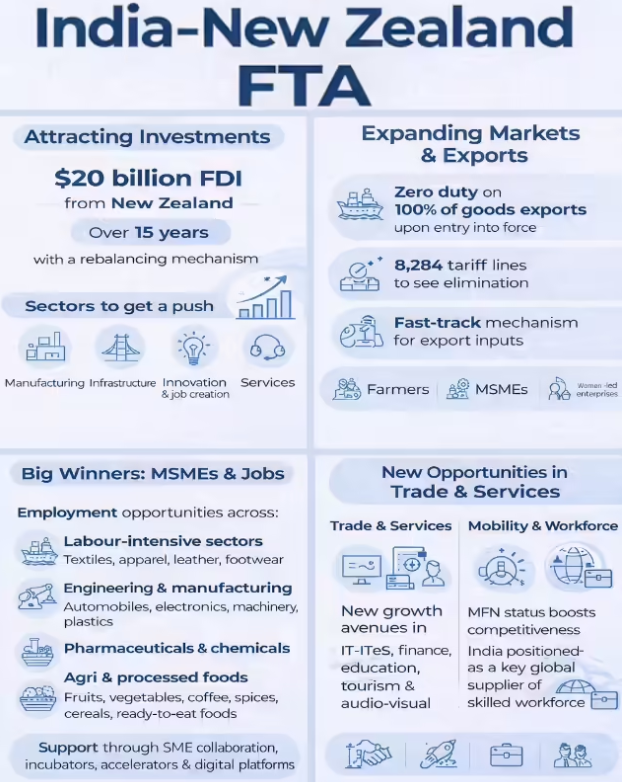
Benefits of India and New Zealand FTA
| Area | Key Benefits for India |
| Market Access (Goods) | Zero-duty access on 100% of New Zealand tariff lines (8,284) from entry into force; elimination of ~10% tariffs on ~450 Indian export lines; |
| Protection of Sensitive Sectors | India has excluded key sectors to protect domestic interests (e.g. dairy products, onions and pulses, sugar, edible oils, metals like copper and aluminium). |
| Services Trade | New Zealand’s best-ever offer: commitments in 118 services sectors; MFN treatment in 139 sectors |
| Health & AYUSH | First-ever Health & Traditional Medicine Annex; global promotion of AYUSH (Ayurveda, Yoga & Naturopathy, Unani, Siddha, Sowa-Rigpa, Homoeopathy); boost to medical value travel and wellness services |
| Education & Student Mobility | Students allowed 20 hrs/week work during study; protected against future policy changes; extended post-study work visas (STEM Bachelor: 3 yrs; Master’s: up to 3 yrs; Doctorate: up to 4 yrs) |
| Professional Mobility | 5,000 skilled visas (up to 3 years) for Indians in AYUSH, Yoga, Indian cuisine, music, IT, engineering, healthcare, education, and construction |
| Working Holiday Scheme | 1,000 Indian youth annually eligible for multiple-entry stays up to 12 months |
| Investment | USD 20 billion FDI commitment from New Zealand over 15 years |
| Regulatory Facilitation | Faster approvals for pharmaceuticals & medical devices; recognition of inspections from US, EU, UK, Canada regulators |
| Intellectual Property | Binding commitment to amend laws within 18 months for EU-level GI protection for Indian products |
| Customs & Trade Facilitation | Advance rulings, e-documentation, clearance within 48 hours ( 24 hours for perishables ) |
| Future-Proofing Clause: | Includes provisions ensuring New Zealand gets equal benefits if India offers better terms to other countries in future (e.g. in services or the wine sector) |
Overview of the India-New Zealand Relations: Areas of Cooperation
Historical Relation
- Early Indian Migration: Indians began arriving in New Zealand in the late 18th century on British East India Company ships.
- Early migrants were primarily from Gujarat and later from Punjab.
- Formation of the Auckland Indian Association in 1920 (centenary celebrated in 2020).
- Diplomatic Relations: Both countries became independent in 1947.
- India established diplomatic representation in 1950 with a Trade Commission, later upgraded to a High Commission.
- Shared Similarities:
- Commonwealth membership.
- Common law practices.
- Democratic governance focused on diverse communities.
Political, Defence, and Security Cooperation
- Parliamentary Engagement: Regular parliamentary delegation visits.
- Defence Collaboration: Increased participation in military exercises and staff college exchanges.
- Regular port calls by naval ships (e.g., Tarini at Lyttelton and HMNZS Te Kaha at Mumbai).
- Signing of the India-New Zealand MoU for Defence Cooperation to establish regular bilateral defence engagement.
- Maritime Security: NZ sees India as a safe bet to counter China’s assertive rise in the Indo-Pacific region.
- India’s participation in the Combined Maritime Forces and cooperation under Command Task Force 150.
| Combined Task Force (CTF) |
| Combined Task Force (CTF) 150 is a multinational naval task force working under Combined Maritime Forces and is based in Bahrain. Indian Navy has committed a contribution of 5 staff members to the CTF150 battle staff during the period RNZ Navy is leading the CTF150 from January 2025. |
- New Zealand’s interest in joining the Indo-Pacific Oceans Initiative (IPOI). PM Modi welcomed New Zealand into this partnership with like-minded countries.
- Discussions on maritime cooperation at the National Maritime Heritage Complex (NMHC) at Lothal.
- Capacity Building: Regular officer training exchanges at Defence Colleges.
Trade, Investment, and Financial Cooperation
- India and New Zealand’s merchandise bilateral trade: India’s exports to New Zealand grew 32.1% in 2024-25 to $711.1 million. Imports from New Zealand grew 75.2% to $587.1 million over the same period.
- Customs Cooperation:
- Authorized Economic Operators Mutual Recognition Arrangement (AEO-MRA): It facilitates smoother trade by easing the movement of goods between trusted traders.
- Customs Cooperative Arrangement: In August 2024, New Zealand and India signed it to enhance trade ties and intensify collaboration against transnational organized crime
- Sectoral Cooperation in Horticulture and Forestry: Memorandum of Cooperation on Horticulture to promote knowledge sharing and research exchanges.
- Development of post-harvest and marketing infrastructure.
- Letter of Intent on Forestry Cooperation for policy dialogues and technical exchanges.
- Tourism and Air Connectivity: Recognition of tourism’s role in enhancing economic ties and mutual understanding.
- Update to the India-New Zealand Air Services Agreement to support direct flights.
- Encouragement for airlines to commence non-stop flights between India and New Zealand.
Science, Technology, and Disaster Management
- Technology Partnerships: Strengthening collaboration in research, innovation, and commercialisation of technologies.
- Climate Change Cooperation:
- New Zealand’s membership in the International Solar Alliance (ISA) (since 2024).
- New Zealand’s membership in the Coalition for Disaster Resilient Infrastructure (CDRI).
- Earthquake Mitigation: Work towards an MoU on Earthquake Mitigation to enhance preparedness and response capacity.
Education, Mobility, and People-to-People Ties
- Education: India is the 2nd largest source of international students in NZ.
- Signing of a refreshed Education Cooperation Arrangement.
- Expansion of Indian student access to New Zealand education institutions.
- Skilled Migration: Agreement to negotiate skilled worker mobility under trade agreement.
- Addressing irregular migration issues.
- Sports: MoU on Sports Cooperation in cricket, hockey, and Olympic sports.
- Sporting Unity events in 2026 to celebrate 100 years of sporting ties.
- Traditional Medicine: Expert discussions on knowledge exchange and collaboration.
- Cultural Ties: Growing New Zealand interest in yoga, Indian music, dance, and festivals.
- Promotion of bilateral cultural exchange.

 War Powers Act: Origin, Purpose, Provisi...
 China–Pakistan Space Cooperation: Proj...
 Strait of Hormuz Crisis: Causes, History...













 WhatsApp