
Table of Contents
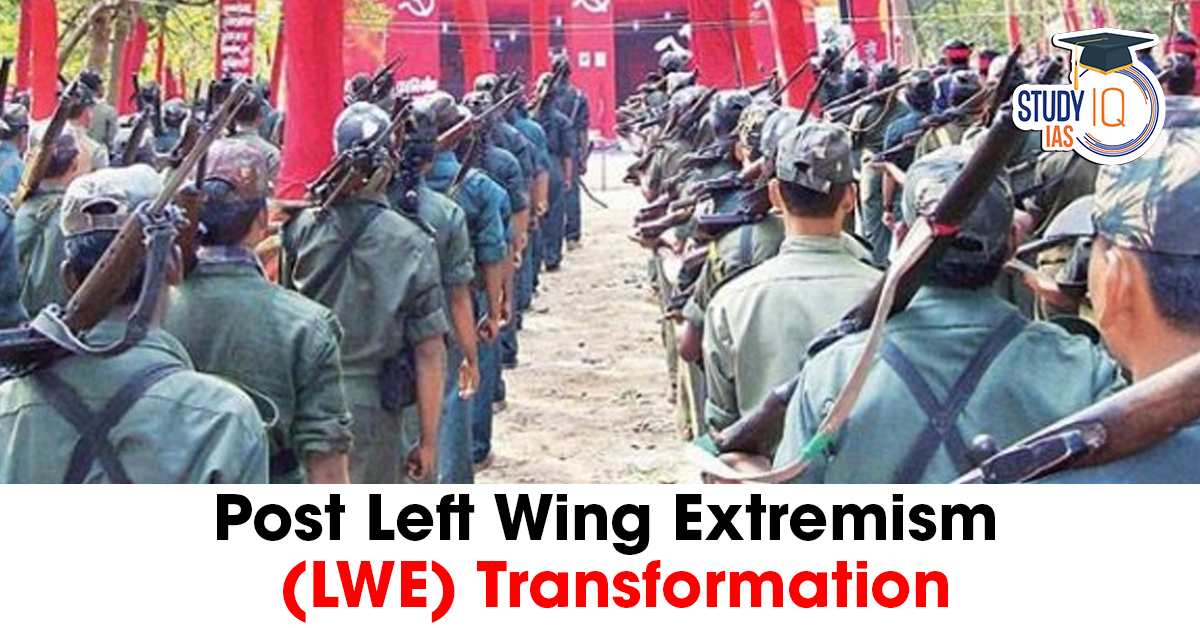
Context: With the sharp decline of Left Wing Extremism after years of security operations, the challenge now shifts to converting security gains into long-term peace.
Decline of Left Wing Extremism (LWE)
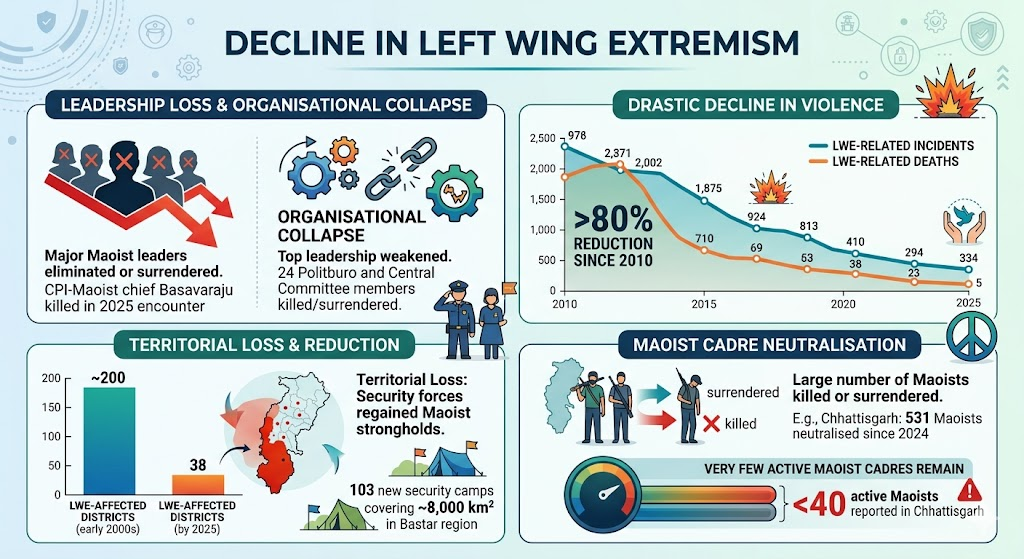
- Reduction in Violence: LWE incidents and fatalities have sharply declined due to sustained operations
- Geographical Shrinkage: The Red Corridor has reduced from multiple states to limited pockets
- Eg. now largely confined to Bastar (Chhattisgarh), parts of Jharkhand and Maharashtra.
- Decline in Local Recruitment: Local support has weakened significantly
- Eg. Only a few local recruits remain while the majority are declining with a shrinking grassroots support base.
- Improved State Presence: Expansion of governance infrastructure has reduced insurgent space
- Eg. roads, telecom towers and banking access in the Sukma–Bijapur belt.
Strategy Adopted by the Government
- Security-Centric Operations: Coordinated operations by central and state forces (e.g. CRPF, COBRA forces) focused on area domination, intelligence-based strikes and leadership targeting.
- SAMADHAN Doctrine: Multi-pronged strategy focusing on intelligence, technology and coordination
- Eg. use of drones, actionable intelligence and KPI-based monitoring.
- Development Initiatives: Implementation of schemes like the Integrated Action Plan and Aspirational Districts.
- Eg. infrastructure and welfare push in Malkangiri, Odisha
- Infrastructure Expansion: Building roads, telecom towers, schools and health centres to improve state reach
- Eg. Road connectivity projects in Sukma and Gadchiroli are opening remote areas.
- Youth Engagement & Capacity Building: Sports and education used as tools of integration
- Eg. Simdega hockey academy producing Salima Tete and footballer Mamta Hansda.
- Centre–State Coordination: Joint planning across political lines ensured effectiveness.
- Eg. coordinated operations across Chhattisgarh, Jharkhand and Odisha.
Also Read: Left Wing Extremism (LWE) in India
Limits of the Security-Centric Approach
- Temporary Suppression: Security operations reduce violence but do not address root causes.
- Eg. earlier gains in Jungle Mahal saw a relapse when governance lagged.
- Legitimacy Deficit: Excessive reliance on force may weaken trust between state and local communities, especially tribal populations.
- Eg. tribal communities in Bastar have historically been caught between Maoists and state forces.
- Governance Gaps: Areas cleared of insurgents often still lack sustained administrative presence and service delivery.
- Eg. remote villages in Abujhmad still face limited healthcare and schooling.
- Risk of Relapse: Without socio-economic transformation, there is a risk of re-emergence of insurgency in neglected regions.
- Eg. resurgence phases seen in parts of Jharkhand in past cycles.
- Human Rights Concerns: Security operations sometimes raise concerns about civil liberties and excesses, affecting state legitimacy.
- Eg. debates over encounters and arrests in LWE regions.
Structural Challenges in LWE-Affected Regions
- Historical Marginalisation: Tribal communities face long-term neglect (e.g. low Human Development Indicators in Bastar, Simdega).
- Resource Curse: Mineral-rich areas see extraction without local benefit, creating resentment. (e.g. mining belts of Jharkhand and Chhattisgarh).
- Weak Governance Infrastructure: Limited access to services (e.g. lack of schools, banks and PHCs in interior forest areas).
- Livelihood Insecurity: Lack of jobs leads to vulnerability (e.g. dependence on minor forest produce without value addition).
- Trust Deficit: Communities caught between state and insurgents (e.g. fear of both Maoist retaliation and police action).
- Justice Deficit: Delays in rights and legal processes (e.g. pending Forest Rights Act claims, undertrial tribal prisoners).
Also Check: Tackling Causes of Maoist Insurgency
Framework for Post-LWE Transformation
- Community-Centric Economy: Shift towards local value economies, ensuring community ownership and benefits.
- Eg. forests produce value chains like tendu leaves, lac processing, and eco-tourism in Bastar.
- Sustained Governance Presence: Ensure continuous service delivery (e.g. roads, schools, anganwadi centres and banking in remote blocks).
- Rights-Based Approach: Strengthen land and forest rights, treating citizens as stakeholders, not beneficiaries (e.g. implementation of Forest Rights Act and Tribal Sub Plan funding).
- Integrated Policy Framework: Focus on Accountability, Innovation, Evidence, Equity, Empathy and Efficiency (AIEEEE) for governance transformation.
- Convergence of Schemes: Align programmes like Aspirational Districts, PM-JANMAN, Tribal Sub Plan for last-mile delivery.
- Youth & Aspirations: Promote education, sports, skilling and entrepreneurship to channel youth aspirations (e.g. sports success like Simdega hockey, expansion to skilling and entrepreneurship).
- Justice & Trust Building: Ensure humane policing and grievance redress (e.g. faster case disposal and legal aid for tribal communities).
India’s success in reducing LWE marks a critical transition, but long-term peace depends on moving from security dominance to inclusive governance, rights-based development and trust-building, ensuring these regions become growth centres rather than conflict zones.

 Skyroot Vikram-1 Mission Aagaman: India'...
 Operation Sindoor Anniversary 2026: Indi...
 Oor Pare Prehistoric Site: Location, Roc...











 WhatsApp





