
Table of Contents
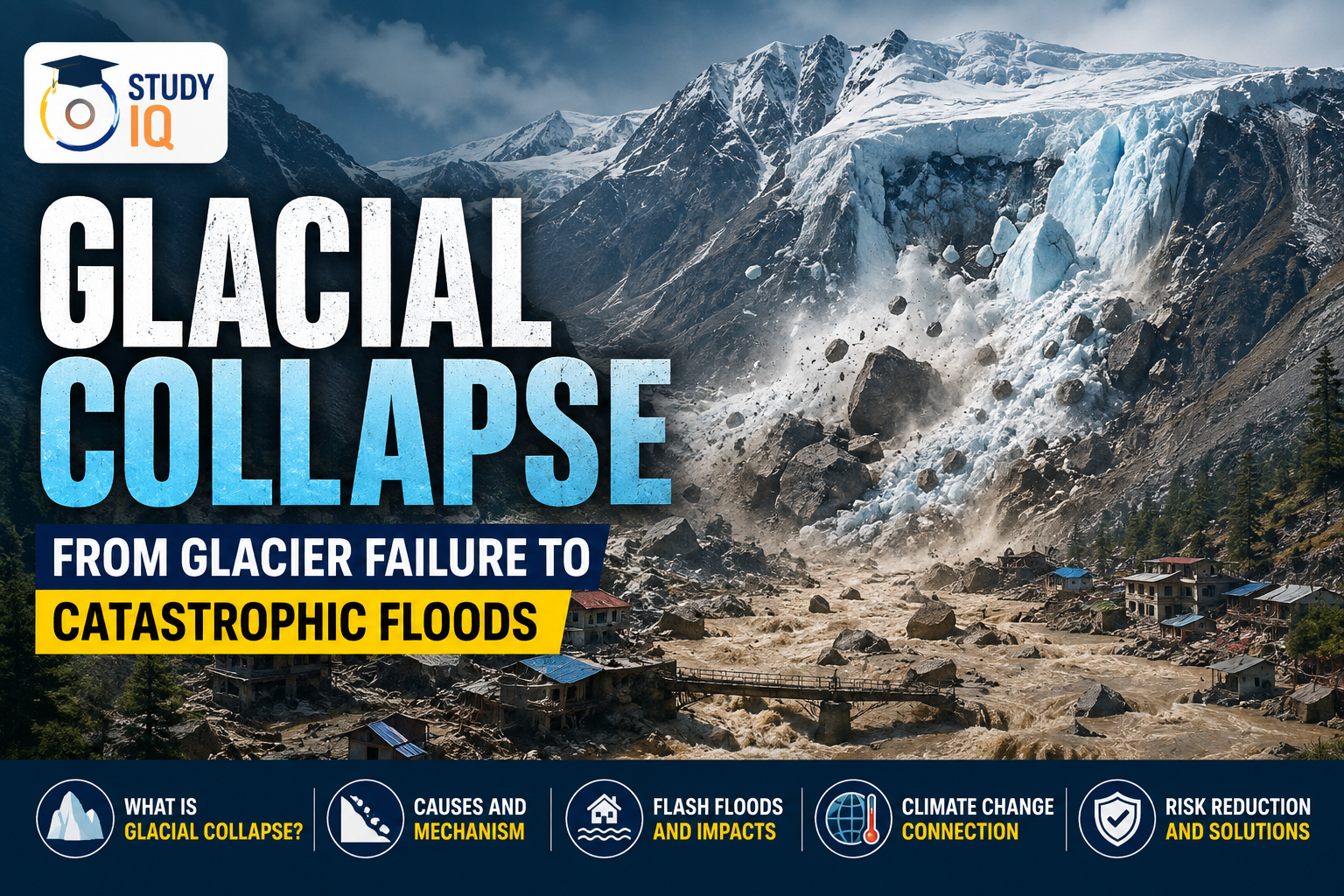
A glacial collapse is the sudden failure and downslope movement of a large mass of glacier ice, often mixed with rocks, snow and debris. In the Himalayas, such events can trigger a chain of hazards including ice-rock avalanches, debris flows, river blockages and flash floods. The recent Nepal–Tibet disaster highlights how a high-altitude glacial event can rapidly transform into a catastrophic downstream disaster.
Read Also: UPSC Daily Current Affairs 2026
How Does Glacial Collapse Cause Floods?
The process can be understood as a cascading chain:
Glacier instability → Ice-rock avalanche → Debris enters river → River blockage/displacement → Sudden water release → Debris flow → Catastrophic flooding
A collapsing glacier can release millions of tonnes of ice and rock. When this material enters a river, it may temporarily block the channel or violently displace water. The resulting surge can carry boulders, mud, sediment, trees and infrastructure debris, greatly increasing its destructive power.
This is different from a Glacial Lake Outburst Flood (GLOF), which occurs when water stored in a glacial lake is suddenly released due to failure of its natural dam. However, a glacier collapse can itself trigger or contribute to a GLOF or other flood mechanism.
Nepal–Tibet Disaster: A Case Study
The August 26, 2026 Nepal–Tibet floods demonstrate the complexity of Himalayan hazards. The seismic signal associated with the event was initially interpreted as an earthquake. Subsequent analysis by the U.S. Geological Survey (USGS) using nearby seismic stations, long-period seismic waves and satellite imagery concluded that the event was instead associated with a glacial collapse and debris flow, with no earthquake occurring.
The collapse generated a seismic signal equivalent to approximately magnitude 5.2, demonstrating that large gravitational mass movements can produce earthquake-like signals.
Preliminary analysis by the International Centre for Integrated Mountain Development (ICIMOD) suggested that an ice-rock avalanche from a high-altitude area deposited a large volume of material into the Lende Khola, a tributary of the Bhote Koshi River. Downstream water levels reportedly rose by 7–9 metres within about 30 minutes, illustrating the extremely rapid nature of such hazards.
Role of Climate Change
Climate change is an important risk multiplier, although it would be scientifically incorrect to automatically attribute every individual glacier collapse to global warming.
Rising temperatures can cause:
- glacier thinning and retreat;
- increased snow and ice melt;
- changes in meltwater drainage;
- degradation of permafrost;
- weakening of mountain slopes;
- expansion of unstable glacial lakes.
According to ICIMOD, glaciers across the Hindu Kush Himalaya have been losing ice at an accelerating rate, with glacier wastage roughly doubling since 2000. This changing cryosphere can increase the vulnerability of high-mountain environments.
The Himalayas are particularly exposed because rapid climatic change, active tectonics, steep slopes, fragile geology and intense monsoon rainfall interact with one another.
Challenges
Major challenges include:
- Limited high-altitude monitoring due to difficult terrain.
- Short warning times for sudden collapses and debris flows.
- Data gaps regarding glacier and permafrost conditions.
- Transboundary rivers, where an event in one country can affect another.
- Rapid infrastructure expansion in vulnerable valleys.
- Compound hazards, where glacier collapse, landslides and floods occur sequentially.
Way Forward
A comprehensive Himalayan disaster-management strategy should include:
- satellite-based glacier and slope monitoring;
- expanded seismic networks;
- automated river-level and flow sensors;
- detailed glacier and GLOF hazard mapping;
- community-based early-warning systems;
- climate-resilient infrastructure;
- scientific data sharing among Himalayan countries;
- multi-hazard rather than single-hazard disaster planning.
Conclusion
Glacial collapse represents the emerging cryosphere–climate–disaster nexus in the Himalayas. The key concern is not merely that glaciers are melting, but that changing glaciers, permafrost and mountain slopes can create cascading hazards. The Nepal–Tibet disaster demonstrates why Himalayan development must combine scientific monitoring, early-warning systems, climate adaptation and transboundary cooperation.

UPSC IAS Live GS P2I Foundation 2027 Pratigya August Evening Batch 2 (Basic)
 Supreme Court on Children's Right to Int...
 Daily Current Affairs PDF 2026: Download...
 Daily Mains Articles 2026 – Updated Da...














 WhatsApp





