Table of Contents
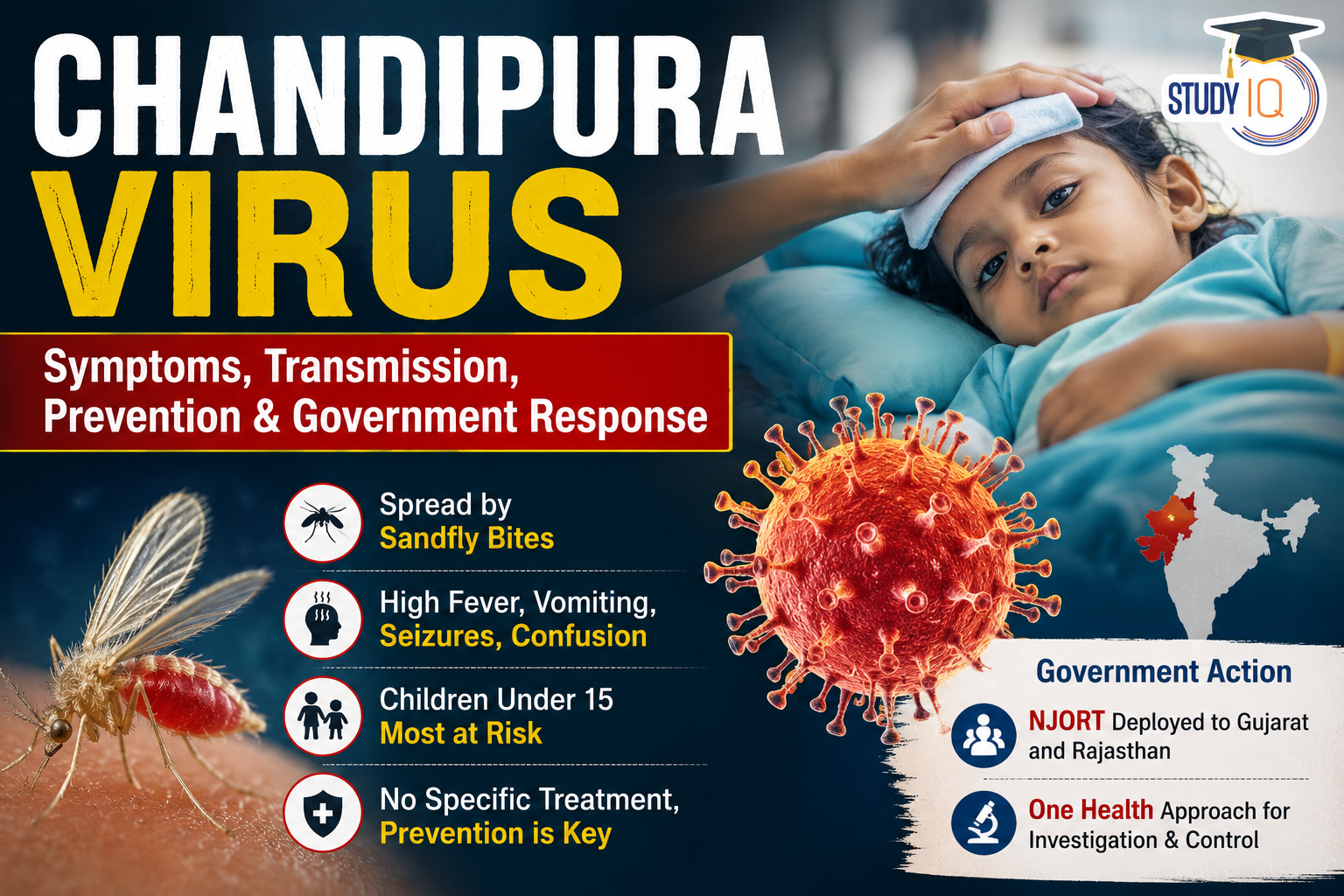
India is witnessing renewed concern over the Chandipura Virus Disease (CHPV) following a fresh outbreak in Gujarat and Rajasthan during the 2026 monsoon season. The outbreak has primarily affected children, prompting the Union Ministry of Health and Family Welfare to deploy a National Joint Outbreak Response Team (NJORT) and launch a multi-agency scientific investigation under the One Health framework.
Health authorities have reported 35 laboratory-confirmed Chandipura virus cases in Gujarat, with 22 child deaths linked to Acute Encephalitis Syndrome (AES). The rapid progression of the disease has made early detection and prompt medical care critical.
What is Chandipura Virus?
Chandipura Virus (CHPV) is a rare arbovirus belonging to the Rhabdoviridae family, the same family as the rabies virus, although it causes an entirely different disease.
The virus was first identified in 1965 in Chandipura village, Maharashtra, from where it derives its name. It is known to cause outbreaks of Acute Encephalitis Syndrome (AES), particularly among children.
| Feature | Details |
|---|---|
| Virus | Chandipura Virus (CHPV) |
| Family | Rhabdoviridae |
| First Identified | 1965 |
| Place of Discovery | Chandipura Village, Maharashtra |
| Disease | Acute Encephalitis Syndrome (AES) |
| Most Affected | Children below 15 years |
| Peak Season | Monsoon & Post-Monsoon |
Chandipura Virus Outbreak 2026: Latest Updates
According to the Ministry of Health:
- Gujarat has reported 35 laboratory-confirmed cases.
- 22 child deaths have been linked to the outbreak.
- Rajasthan has also reported confirmed infections.
- Seven children remain under treatment.
- The Centre has deployed the National Joint Outbreak Response Team (NJORT).
- A multi-disciplinary scientific investigation is underway using the One Health approach.
How Does Chandipura Virus Spread?
Unlike influenza or COVID-19, Chandipura Virus does not spread from person to person.
The infection is primarily transmitted through the bite of infected:
- Sandflies (primary vector)
- Certain mosquito species (under investigation)
- Other biting insects (possible vectors under study)
The disease becomes more common during the rainy season, when insect populations increase.
Why Are Children Most at Risk?
Children below 15 years of age are particularly vulnerable because:
- Their immune systems have little prior exposure to the virus.
- Viral encephalitis tends to be more severe in young children.
- The disease progresses rapidly in pediatric patients.
This explains why most reported deaths during outbreaks involve children.
Chandipura Virus Symptoms
The disease usually begins like a common viral fever but can rapidly progress to neurological complications.
Early Symptoms
- High fever
- Severe headache
- Vomiting
- Nausea
- Fatigue
- Body weakness
Severe Symptoms
- Convulsions
- Seizures
- Confusion
- Excessive sleepiness
- Loss of consciousness
- Coma
Medical experts warn that neurological symptoms can appear within 24–48 hours, making early hospitalization essential.
Diagnosis
Doctors confirm Chandipura Virus infection using:
- RT-PCR
- IgM ELISA
- Clinical evaluation
- Acute Encephalitis Syndrome surveillance
Is There Any Treatment?
Currently,
- No specific antiviral medicine exists.
- No licensed vaccine is widely available.
Treatment is mainly supportive and includes:
- Hospitalization
- Intravenous fluids
- Fever management
- Seizure control
- Respiratory support if required
- Intensive Care Unit (ICU) management in severe cases
Early treatment significantly improves survival.
Prevention of Chandipura Virus
Since no vaccine is available, prevention focuses on avoiding insect bites.
Personal Protection
- Wear full-sleeved clothing
- Use insect repellents
- Sleep under insecticide-treated mosquito/sandfly nets
- Install window screens
Environmental Measures
- Remove stagnant water
- Maintain household hygiene
- Repair cracks in mud walls
- Improve sanitation around homes
- Reduce insect breeding sites
Government Response to the Outbreak
The Union Government has intensified its response through several measures:
National Joint Outbreak Response Team (NJORT)
A specialized team has been deployed to Gujarat and Rajasthan to:
- Strengthen surveillance
- Support outbreak investigation
- Improve laboratory testing
- Coordinate disease control measures
One Health Investigation
The government has adopted a One Health strategy involving experts from:
- Human health
- Veterinary sciences
- Entomology
- Environmental health
The objective is to better understand the virus, vectors, and environmental factors influencing transmission.
Why is the Outbreak Happening During Monsoon?
Monsoon creates ideal conditions for vector breeding due to:
- High humidity
- Waterlogging
- Damp surroundings
- Increased sandfly and mosquito populations
These environmental conditions increase the risk of transmission.
Chandipura Virus vs Rabies Virus
| Feature | Chandipura Virus | Rabies Virus |
|---|---|---|
| Family | Rhabdoviridae | Rhabdoviridae |
| Spread | Sandflies/Insects | Animal bites |
| Human-to-Human Spread | No | Extremely rare |
| Vaccine | Not available | Available |
| Main Disease | Acute Encephalitis Syndrome | Rabies |
Key Takeaways
- Chandipura Virus is a rare but highly dangerous viral disease.
- Children under 15 years are the most vulnerable.
- The virus spreads mainly through infected sandflies.
- Symptoms can worsen within 24–48 hours.
- There is no specific treatment or vaccine.
- Prevention relies on vector control and early medical intervention.
- The Government of India has deployed NJORT and initiated a One Health investigation to contain the outbreak.
Read Also: UPSC Daily Current Affairs 2026
 Kathakali Festival 2026: Theme, History ...
 Kohat Attack 2026: What Happened in Khyb...
 World Bamboo Day 2026: Date, Theme, Hist...














 WhatsApp