Table of Contents
Context
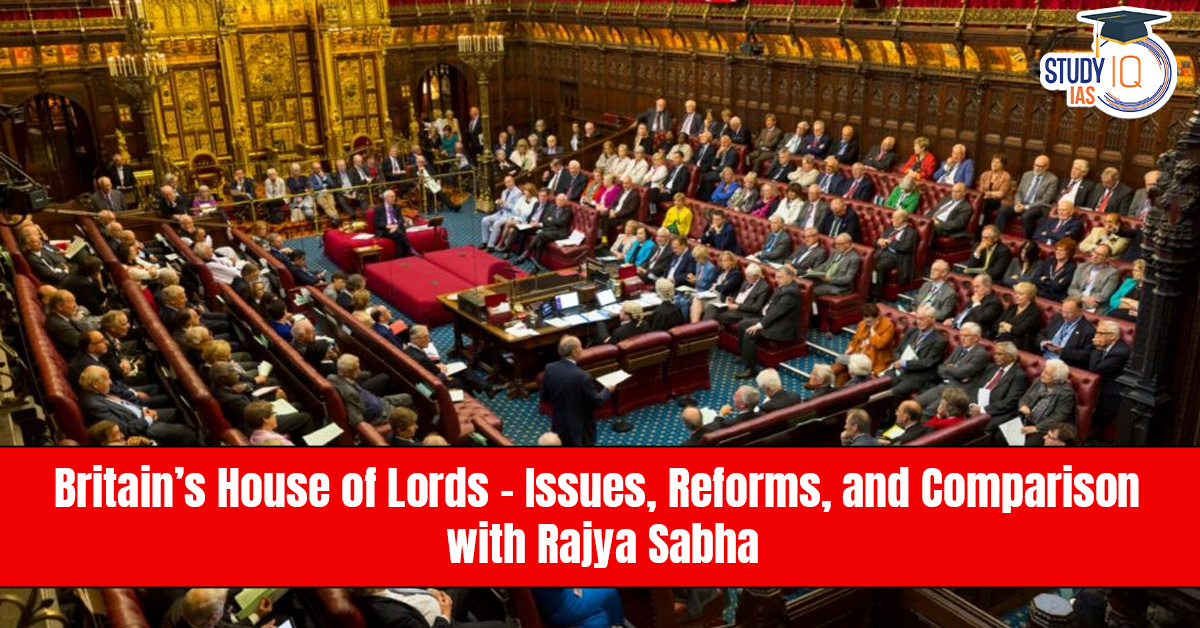
The House of Lords functions as the upper chamber of the Parliament of the United Kingdom. Unlike most bicameral systems where upper houses are elected, this chamber is predominantly unelected and operates mainly as a revising and scrutinising body. Over time, it has attracted criticism regarding democratic legitimacy, size, and representational character, which has led to a series of reform initiatives.
Britain’s House of Lords
| Composition and Structure | Key Institutional Characteristics |
| Membership of the House of Lords falls into three principal categories:
● Life Peers: Life peers are appointed by the Monarch, usually on the advice of the Prime Minister or an independent appointments commission. ○ They hold membership for life but cannot pass their title to descendants. ○ This category forms the largest segment of the chamber and includes individuals with experience in politics, academia, law, public service, and other fields. ● Hereditary Peers: Historically, membership was dominated by hereditary aristocrats. Following reforms, only a limited number remain. ○ These members are internally elected by hereditary peers themselves when vacancies arise, significantly reducing hereditary influence while retaining a symbolic continuity with tradition. ● Lords Spiritual: This group consists of senior bishops of the Church of England. ○ Their presence reflects the historical link between the British state and the established church, giving the chamber a unique religious representation not commonly found in modern legislatures. |
● Non-elective membership: Most members are appointed rather than elected, distinguishing it from democratic upper houses like the Rajya Sabha.
● Absence of fixed tenure: Life peers remain members permanently, contributing to institutional continuity but also to concerns about accountability. ● No territorial representation: Unlike federal upper houses, it does not represent regions or states. ● Primarily a revising chamber: Its central function is to examine legislation in detail and suggest improvements rather than determine final outcomes. |
| Powers and Functions of the House of Lords | Major Criticisms and Structural Concerns |
| ● Legislative Scrutiny: The chamber conducts detailed examination of bills passed by the House of Commons.
○ It proposes amendments, engages in expert debates, and often improves legislative clarity through clause-by-clause review. ● Power to Delay Legislation: The House of Lords may postpone the passage of ordinary (non-money) bills for a limited duration, typically up to one year. ○ However, it cannot permanently veto legislation approved by the elected chamber, ensuring the supremacy of democratic representation. ● Limited Role in Financial Legislation: With respect to Money Bills, its authority is significantly constrained. ○ It cannot amend or reject such bills and may only delay their passage briefly, thereby preserving financial control with the elected House of Commons. ● Historical Judicial Function: Until 2009, the House of Lords served as the highest court of appeal in the United Kingdom. ○ This function was transferred to the Supreme Court of the United Kingdom following constitutional reforms under the Constitutional Reform framework of 2005, reinforcing the separation of powers. |
● Democratic Deficit: Since most members are appointed rather than elected, critics argue that the chamber lacks democratic legitimacy and public accountability.
● Large Membership Size: It is one of the largest legislative bodies globally. The absence of a fixed cap on membership has raised concerns about efficiency, cost, and institutional effectiveness. ● Perceptions of Political Patronage: Appointments are sometimes viewed as political rewards for loyalty or service, generating debates about transparency and fairness in selection. ● Lack of Federal Representation: Unlike upper houses in federal systems—such as the Rajya Sabha representing Indian states—the House of Lords does not provide institutional representation to territorial units, limiting its federal character. |
Comparative analysis: House of Lords and Rajya Sabha
| Dimension | House of Lords (United Kingdom) | Rajya Sabha (India) |
| Institutional Nature | Predominantly appointive chamber; members include life peers, limited hereditary peers, and senior bishops. | Indirectly elected chamber; members are elected by State Legislative Assemblies through proportional representation. |
| Federal Representation | Does not represent territorial or regional units; operates within a unitary constitutional system. | Represents states and Union territories, reflecting India’s federal structure. |
| Size and Membership Structure | No constitutionally fixed strength; membership size varies over time. | Constitutionally prescribed maximum strength of 250 members, ensuring structural stability. |
| Tenure of Members | Life peers hold membership for life, providing continuity but limited turnover. | Members serve six-year terms; one-third retire every two years, ensuring periodic renewal. |
| Role in Financial Legislation | May delay Money Bills for a limited period but cannot amend or permanently block them. | Cannot amend Money Bills; may recommend changes which the lower house may accept or reject. |
| Democratic Legitimacy | Legitimacy debated due to non-elective composition and appointment-based membership. | Derives indirect democratic legitimacy through elected state legislatures. |
| Federal Character and Constitutional Position | Functions within a unitary constitutional framework without territorial representation. | Integral to the federal design; represents states in national law-making through proportional representation. |
| General Legislative Role | Primarily a revising and scrutinising chamber; suggests amendments and delays legislation where necessary. | Also functions as a revising chamber with legislative review powers within a federal parliamentary structure. |
| Special Constitutional Powers | Does not possess specific federal constitutional powers beyond scrutiny and delay functions. | May authorise Parliament to legislate on State List matters in national interest and can facilitate creation of All India Services. |
| Democratic Accountability and Institutional Character | Expertise-oriented deliberative body with limited electoral accountability due to life tenure and appointments. | Combines continuity with accountability through fixed tenure, eligibility norms, and electoral linkage to states. |
|
Read More Notes |
|
| Environment Notes | Art and Culture Notes |
| Science and Tech | History Notes |
| Geography Notes | Indian Polity Notes |
| General Knowledge | International Relation |
|
Explore StudyIQ Courses |
|
 India–Poland Relations 2026: Strategic...
 Supreme Court on Children's Right to Int...
 Daily Current Affairs PDF 2026: Download...














 WhatsApp