Table of Contents
Context
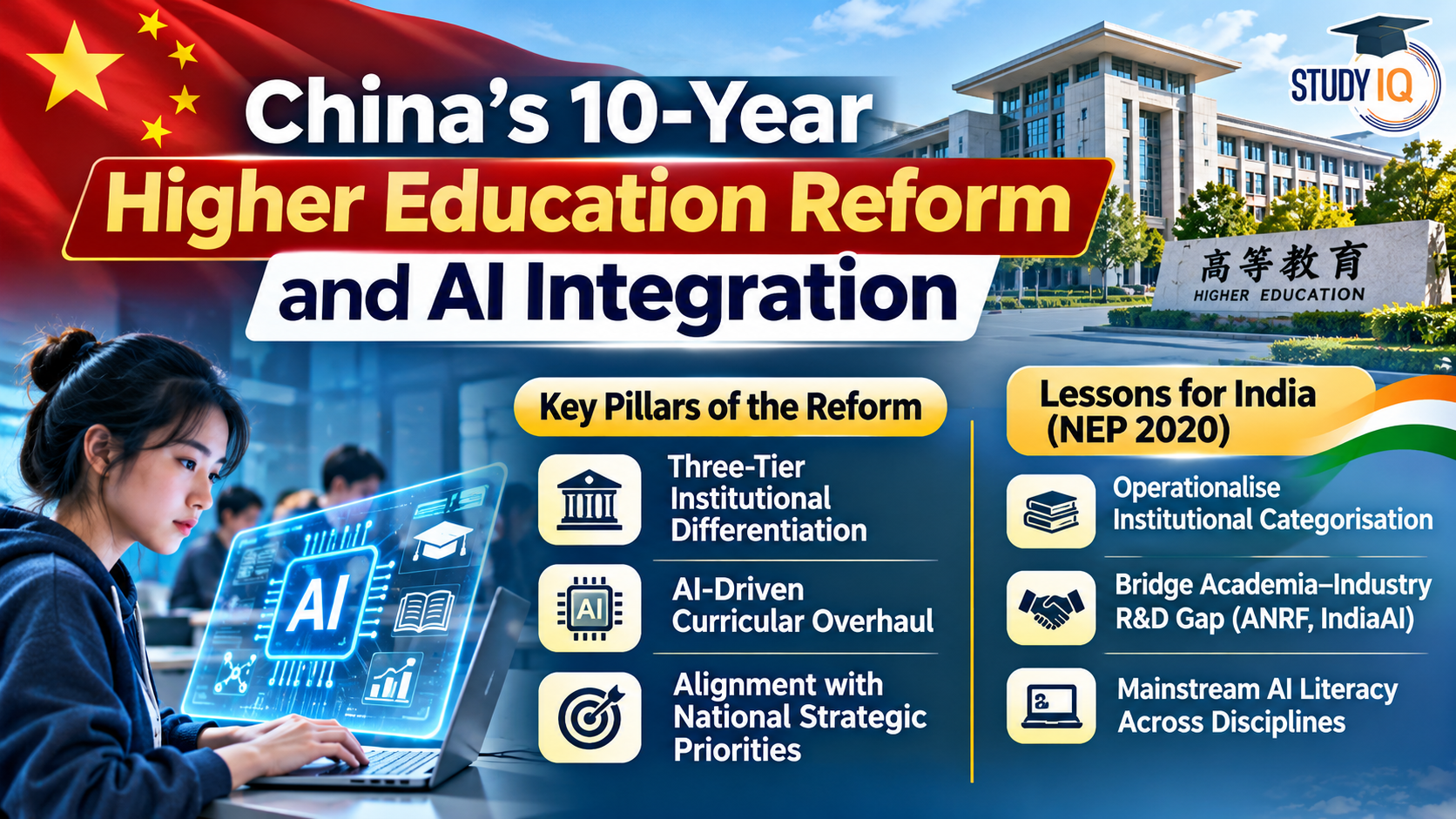
China has unveiled a 10-year strategic reform plan to restructure over 3,000 higher education institutions around artificial intelligence (AI), differentiated institutional mandates, and strategic technological self-reliance.
What Are the Core Pillars of China’s Higher Education Reform?
- Three-Tier Institutional Differentiation: Categorising over 3,000 universities by core mission rather than a one-size-fits-all ranking model:
- Research-Oriented Universities: Focused on fundamental scientific breakthroughs, frontier R&D, and deep-tech innovation.
- Application-Oriented Institutions: Geared toward regional industrial needs, applied engineering, and technology transfer.
- Vocational & Skills Colleges: Dedicated to high-precision technical training and workforce readiness.
- AI-Driven Curricular Overhaul: Embedding generative AI and computational thinking across both STEM and humanities disciplines while establishing interdisciplinary AI research hubs.
- Alignment with National Strategic Priorities: Linking university funding and evaluation metrics directly to breakthroughs in semiconductors, biotechnology, green energy, and advanced manufacturing.
What Lessons Does This Hold for India’s Higher Education Ecosystem (NEP 2020)?
- Operationalising Institutional Categorisation: Similar to the National Education Policy (NEP) 2020’s vision of classifying institutions into Research-Intensive Universities, Teaching-Intensive Universities, and Autonomous Degree-Granting Colleges, India must align funding and regulatory autonomy with distinct institutional missions.
- Bridging the Academia–Industry R&D Gap: Through the Anusandhan National Research Foundation (ANRF) and the IndiaAI Mission, India should tie research grants to measurable translational outcomes in critical sectors like semiconductors, MedTech, and clean energy.
- Mainstreaming AI Literacy Across Disciplines: Integrating AI tools and data literacy into non-engineering curricula alongside skilling programmes (such as Skill India Digital) can prepare India’s demographic dividend for an AI-augmented global economy.
Way Forward
- Accelerate ANRF Implementation: Channel public and private CSR/industry R&D funds toward state universities—not just premier IITs/IIScs—to broaden India’s research base.
- Strengthen Vocational–Higher Education Mobility: Operationalise the National Credit Framework (NCrF) to enable seamless entry, exit, and industry apprenticeships between vocational institutes and universities.
- Invest in Sovereign Academic Compute Infrastructure: Expand shared GPU clusters and open datasets for university researchers under the IndiaAI Mission to democratise indigenous AI innovation.
 Balancing Economic Growth and Air Qualit...
 SUPER ICE Cruise Missile: Features, Warh...
 NITI Aayog Report on Impact Assessment o...







 WhatsApp