
Table of Contents
Context
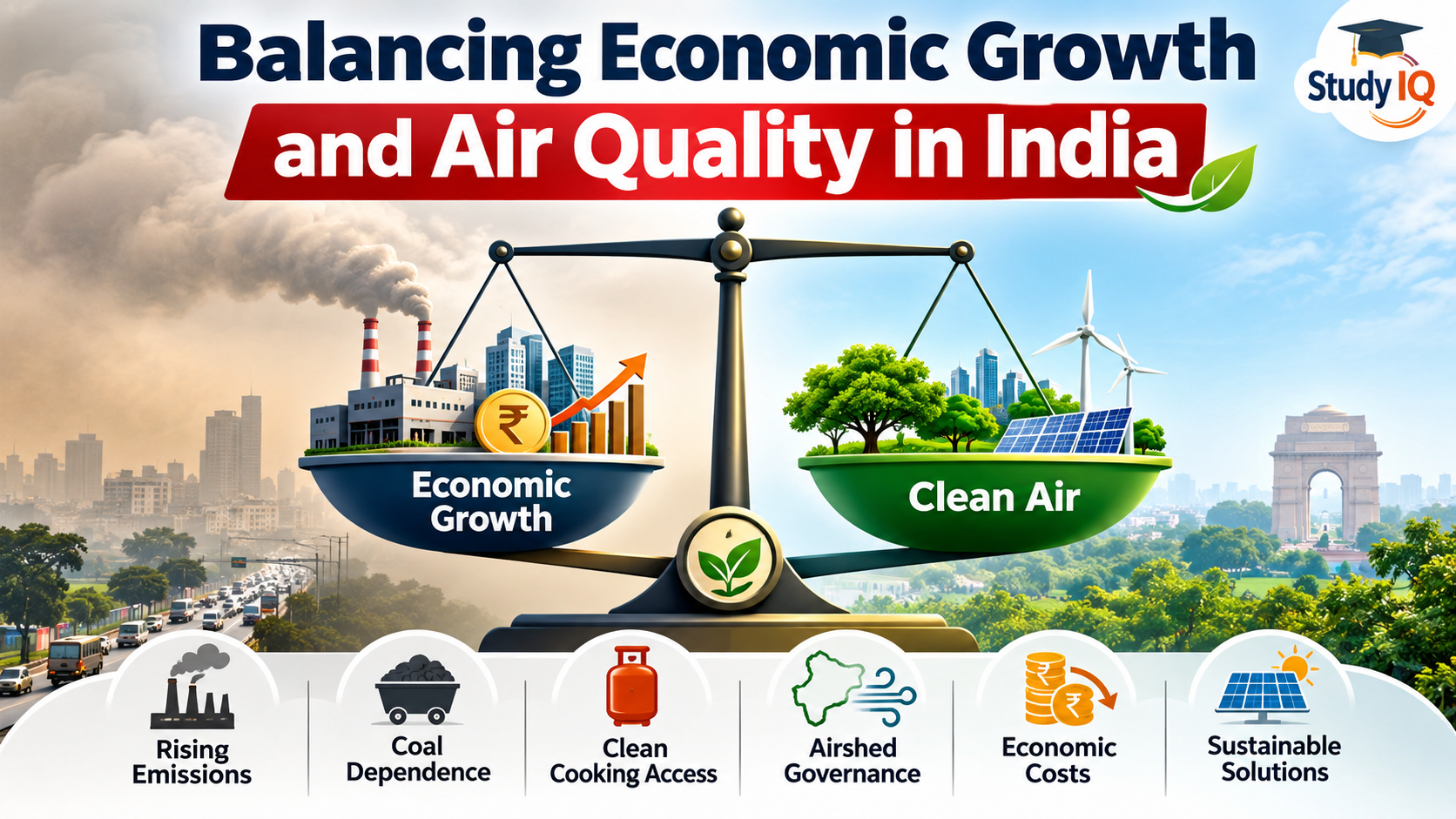
India’s rank of 176th out of 177 countries (175th in air quality) in the 2026 Environmental Performance Index underscores the tension between rapid economic growth and clean air, as aerosol pollution cut solar generation by 9.6% (Nature Sustainability) and caused over 20 lakh deaths in 2023 (State of Global Air 2025).
What Are the Key Challenges in Balancing Growth with Air Quality?
- The Energy–Emission Paradox: According to the International Energy Agency (IEA), India’s electricity demand will grow at ~6.4% annually through 2030. While renewables will meet roughly half of this incremental demand, coal will still account for at least 25%, locking in high baseline emissions.
- Policy Dilution Over Cost Trade-Offs: Installing abatement systems like Flue-Gas Desulphurisation (FGD) raises capital and tariff costs. In July 2025, mandatory SO2 emission norms were relaxed for several coal-fired plants to contain power tariffs and water usage, even though SO2 is a major precursor to toxic secondary PM2.5.
- The “Sustained Use” Behavioural Gap: Infrastructure access alone does not ensure clean transitions. Under the Pradhan Mantri Ujjwala Yojana (PMUY), high LPG refill costs relative to rural incomes frequently push households back to burning solid biomass.
- Fragmented City-Centric Governance vs. Airshed Reality: Air pollution moves across administrative boundaries, yet interventions remain siloed by city (e.g., Delhi vs. neighbouring NCR states) rather than managing contiguous meteorological zones like the Indo-Gangetic Plain as a single airshed.
- Hidden Economic Costs of Pollution: A Dalberg Advisors–Clean Air Fund study estimates that air pollution cost India USD 260 billion (~6% of GDP) in 2024 through healthcare expenditure, premature mortality, and “presenteeism” (lower worker productivity), alongside a 9.6% loss in solar generation due to haze.
- Over-Focus on PM10 Over PM2.5: While 108 of 130 National Clean Air Programme (NCAP) cities reduced coarse road dust (PM10) by FY 2025–26, fine toxic PM2.5—driven by industrial combustion, vehicles, and secondary aerosols—remains dangerously elevated (with 261 of 267 cities breaching WHO daily norms in October 2026, per CREA).
What Measures Are Needed to Reconcile Economic Growth with Clean Air?
- Adopt Regional Airshed Governance: Establish statutory inter-state airshed authorities—starting with the Indo-Gangetic Plain—to coordinate action across thermal power, industry, transport, and crop-residue management.
- Transition to Outcome-Linked NCAP Funding: Tie 16th Finance Commission and MoEFCC clean-air grants strictly to verified reductions in PM2.5 and toxic precursors (SO2, NOx) rather than PM10 dust control alone.
- Prioritise High-Co-Benefit Interventions: Enforce FGD and Perform, Achieve and Trade (PAT) efficiency norms in thermal/industrial clusters, expand targeted LPG refill subsidies under PMUY to curb indoor biomass burning, and scale biomethanation under SBM-Urban 2.0 and GOBARdhan to eliminate open waste burning.
- Capitalise on the Economic Return of Clean Air: Achieving even a 20% reduction in PM2.5 can avert an estimated USD 85 billion in annual economic losses by 2030, making clean-air investments growth-enhancing rather than growth-constraining.

 China's 10-Year Higher Education Reform ...
 SUPER ICE Cruise Missile: Features, Warh...
 NITI Aayog Report on Impact Assessment o...














 WhatsApp






