
Table of Contents
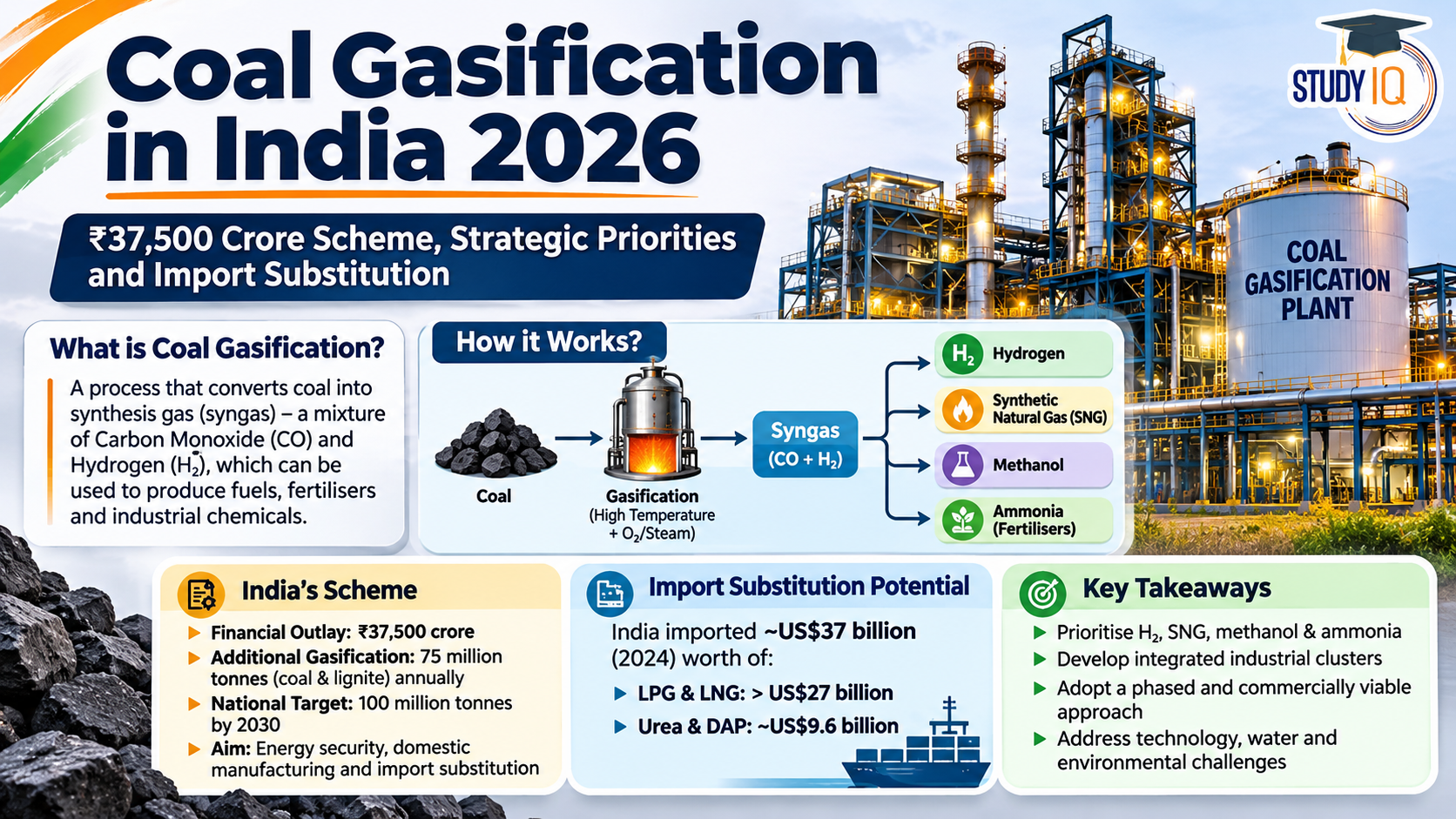
India’s Coal Gasification Scheme 2026 is gaining importance following a new C-DEP–CWS study that recommends prioritising hydrogen, synthetic natural gas, methanol and ammonia to reduce import dependence. The initiative aims to achieve 100 million tonnes of coal gasification capacity by 2030, strengthen domestic chemical manufacturing and improve India’s energy security.
Coal Gasification in India: Why Is It in the News?
Coal gasification has emerged as an important component of India’s energy security and industrial development strategy.
A joint study conducted by the Centre for Domestic Economy Policy Research (C-DEP) and the Centre for WTO Studies (CWS), titled Coal-to-Chemicals Policy in India: A Strategic Framework for Product Prioritisation under the National Coal Gasification Mission, has identified 23 coal-derived products and recommended prioritising those offering the greatest potential for import substitution and economic returns.
The study identifies the following four products as the leading priorities:
- Hydrogen
- Synthetic Natural Gas (SNG)
- Methanol
- Ammonia
The recommendations come amid the government’s ₹37,500-crore scheme for promoting surface coal and lignite gasification projects.
The broader objective is to transform India’s domestic coal resources into valuable industrial feedstock, reduce dependence on imported fuels and fertilisers, and develop a stronger domestic coal-to-chemicals industry.
Another important development is that the Ministry of Coal opened the third round of applications under the scheme on November 10, 2026, with the application deadline set for January 11, 2027.
What Is Coal Gasification?
Coal gasification is a thermochemical process that converts coal into a combustible gas mixture known as synthesis gas or syngas.
Syngas primarily consists of:
- Carbon Monoxide (CO)
- Hydrogen (H₂)
The process involves reacting coal with controlled quantities of oxygen, air or steam at high temperatures, generally under pressurised conditions.
Unlike conventional coal combustion, which primarily produces heat through the burning of coal, gasification converts coal into a gaseous feedstock that can subsequently be processed into various fuels and industrial chemicals.
How Does Coal Gasification Work?
The coal gasification process involves several stages:
1. Coal Preparation
Coal is crushed, processed and prepared for feeding into the gasification reactor.
2. Gasification Reaction
Coal reacts with controlled quantities of oxygen and steam at high temperatures. The process involves partial oxidation and other chemical reactions that convert solid coal into gaseous products.
3. Syngas Formation
The gasification process produces synthesis gas containing primarily carbon monoxide and hydrogen, along with other gases and impurities.
4. Gas Cleaning and Conditioning
The raw syngas is cleaned to remove contaminants such as particulate matter, sulphur compounds and other unwanted substances.
5. Downstream Chemical Production
The cleaned syngas can be processed further to manufacture hydrogen, synthetic natural gas, methanol, ammonia and other industrial products.
Coal Gasification: Important Chemical Reactions
Understanding the underlying chemical reactions is important for understanding the technological significance of coal gasification.
Some important reactions include:
1. Partial Oxidation
2C + O₂ → 2CO
Carbon reacts with a limited supply of oxygen to produce carbon monoxide.
2. Steam-Carbon Reaction
C + H₂O → CO + H₂
Carbon reacts with steam to produce carbon monoxide and hydrogen.
3. Water-Gas Shift Reaction
CO + H₂O ⇌ CO₂ + H₂
Carbon monoxide reacts with steam to produce additional hydrogen and carbon dioxide.
4. Methanation Reaction
CO + 3H₂ → CH₄ + H₂O
Carbon monoxide reacts with hydrogen to produce methane, which is the primary component of natural gas.
These reactions demonstrate how coal can be converted into different industrial products through appropriate gasification and downstream processing technologies.
India’s National Coal Gasification Mission
India has substantial coal and lignite reserves, making coal gasification an important option for diversifying the country’s industrial feedstock base.
The government has established a broader objective of achieving 100 million tonnes of coal gasification capacity by 2030.
₹37,500 Crore Scheme for Coal Gasification
On May 13, 2026, the Union Cabinet approved the Scheme for Promotion of Surface Coal/Lignite Gasification Projects with a total financial outlay of ₹37,500 crore.
Important features include:
- Financial Outlay: ₹37,500 crore.
- Additional Gasification Target: Approximately 75 million tonnes of coal and lignite.
- National Target: 100 million tonnes of coal gasification capacity by 2030.
- Expected Investment Mobilisation: ₹2.5–3 lakh crore.
- Employment Generation: Approximately 50,000 direct and indirect employment opportunities.
- Project Incentive: Financial support of up to 20% of the cost of plant and machinery, subject to scheme conditions.
The scheme seeks to encourage private-sector participation, promote technological development and facilitate the establishment of domestic coal-to-chemicals manufacturing facilities.
Latest Development: Round 3 of the Scheme Opens
On November 10, 2026, the Ministry of Coal announced the conclusion of the second round of applications under the scheme.
Two applications were received from NTPC Limited:
- Urea production.
- Methanol and Dimethyl Ether (DME) production.
The third round of applications commenced on November 10, 2026, and the last date for submission is January 11, 2027.
This development indicates the government’s efforts to attract investment and encourage the commercial adoption of coal gasification technologies.
C-DEP–CWS Study: Which Products Should India Prioritise?
The C-DEP–CWS study evaluates 23 coal-derived products across eight economic, industrial and strategic parameters.
Its central recommendation is that India should prioritise products based on import dependence, strategic importance, economic viability and the potential to strengthen domestic manufacturing.
1. Hydrogen
Hydrogen has emerged as the highest-priority product in the study.
It has important applications in:
- Petroleum refining.
- Ammonia and fertiliser manufacturing.
- Industrial chemical production.
- Steel manufacturing.
- Emerging clean-energy technologies.
Coal gasification can produce hydrogen through syngas processing and the water-gas shift reaction.
However, hydrogen produced from coal is generally classified as coal-based or brown hydrogen. Its environmental performance depends on carbon capture, utilisation and storage (CCUS) and the overall production pathway.
2. Synthetic Natural Gas (SNG)
Synthetic Natural Gas is primarily methane produced through chemical conversion of syngas.
It can potentially substitute natural gas in selected industrial applications and reduce dependence on imported natural gas.
Its production involves methanation, where carbon monoxide or carbon dioxide reacts with hydrogen to produce methane.
3. Methanol
Methanol (CH₃OH) is an important industrial chemical produced from synthesis gas.
Its applications include:
- Chemical manufacturing.
- Production of formaldehyde and acetic acid.
- Petrochemical industries.
- Potential alternative fuel applications.
- Production of other industrial chemicals.
Domestic methanol production can strengthen India’s chemical manufacturing ecosystem and reduce import dependence.
4. Ammonia
Ammonia (NH₃) is a strategically important chemical, particularly for fertiliser production.
It is an essential feedstock for manufacturing urea and several other nitrogen-based fertilisers.
Coal-derived hydrogen can be combined with nitrogen, generally obtained from air, through the Haber-Bosch process to manufacture ammonia.
Developing domestic ammonia production could help strengthen India’s fertiliser supply security.
Other Products Identified
The study also identifies several other products with potential strategic and industrial applications:
- Dimethyl Ether (DME): A potential alternative fuel and industrial chemical.
- LNG: Liquefied Natural Gas.
- LPG: Liquefied Petroleum Gas.
- Urea: A major nitrogenous fertiliser.
- DAP: Diammonium Phosphate, an important phosphatic fertiliser.
How Can Coal Gasification Reduce India’s Import Dependence?
India’s dependence on imported fuels, fertilisers and industrial chemicals creates economic vulnerabilities.
The C-DEP–CWS study estimates that India imported nearly US$37 billion worth of LPG, LNG, urea and DAP in 2024.
The estimated import composition was:
- LPG and LNG: More than US$27 billion.
- Urea and DAP: Approximately US$9.6 billion.
Developing domestic coal-based production could help substitute a portion of these imports.
The potential economic benefits include:
1. Reduced Energy Import Dependence
Domestic production of synthetic natural gas and other fuels could diversify India’s energy supply.
2. Fertiliser Security
Domestic production of ammonia and urea could strengthen agricultural input availability.
3. Industrial Self-Reliance
Methanol, hydrogen and other chemicals can support downstream manufacturing industries.
4. Protection Against Global Price Volatility
Greater domestic production could reduce exposure to international energy and chemical price fluctuations.
5. Stronger Domestic Supply Chains
Integrated coal-to-chemicals facilities could create linkages between mining, energy, fertiliser and chemical industries.
However, import substitution will depend on the commercial competitiveness, production costs and environmental performance of domestic projects.
Lessons from China’s Coal-to-Chemicals Industry
China provides an important example of large-scale coal-to-chemicals industrial development.
The country has developed integrated industrial clusters that use coal gasification facilities to supply feedstock to fertiliser, methanol and downstream chemical manufacturing industries.
These integrated facilities offer several advantages:
- Shared infrastructure.
- Economies of scale.
- Improved utilisation of gasification facilities.
- Greater integration between upstream and downstream industries.
- Reduced duplication of infrastructure.
However, China’s experience also highlights important risks.
Major Lessons for India
1. Risk of Underutilised Capacity
Excessive investment without adequate market demand can result in industrial plants operating below their installed capacity.
2. High Capital Requirements
Coal gasification and downstream chemical manufacturing require substantial investment.
3. Water Stress
Coal gasification and associated chemical processes can require significant quantities of water, creating challenges in water-stressed regions.
4. Environmental Concerns
Coal-based chemical production can generate substantial carbon emissions and other pollutants unless appropriate mitigation technologies are adopted.
Therefore, India should adopt a phased and commercially driven investment strategy rather than pursuing rapid, uncoordinated capacity expansion.
Major Challenges Associated with Coal Gasification in India
Despite its strategic potential, coal gasification faces several technological, economic and environmental challenges.
1. Commercial Viability
Coal gasification projects involve high capital expenditure, operating costs and technological complexity.
Their commercial success will depend on whether coal-derived products can compete with imported alternatives.
2. Suitability of Indian Coal
Indian coal generally has high ash content and different characteristics from coal used in several established international gasification projects.
Therefore, gasification technologies must be tested and adapted to Indian coal conditions.
3. Water Requirements
Coal gasification and downstream chemical production can be water-intensive.
The availability of water and efficient recycling systems will be important factors in project selection.
4. Carbon Emissions
Although gasification is different from conventional coal combustion, it is not inherently a low-carbon process.
The conversion of coal into hydrogen, fuels and chemicals can generate carbon dioxide emissions.
Carbon Capture, Utilisation and Storage (CCUS) can help reduce emissions, but its cost, infrastructure requirements and technological feasibility need careful assessment.
5. Technology and Infrastructure
India needs reliable gasification technology, skilled manpower, efficient gas-cleaning systems and integrated downstream infrastructure.
6. Market Demand and Price Competitiveness
Projects must have reliable buyers and long-term demand for their products.
Without adequate demand and competitive production costs, even technically successful projects may remain financially unviable.
Coal Gasification and India’s Energy Transition: A Strategic Dilemma
Coal gasification presents an important policy dilemma for India.
On one hand, India possesses substantial domestic coal resources and continues to depend on imported fuels, fertilisers and industrial chemicals.
On the other hand, coal-based production can create significant carbon emissions and environmental pressures.
Therefore, coal gasification should not automatically be considered a clean-energy solution.
Its long-term relevance will depend on:
- Adoption of efficient gasification technologies.
- Carbon capture and storage.
- Water conservation and recycling.
- Strict pollution-control standards.
- Commercially viable production pathways.
- Integration with India’s broader clean-energy transition.
India must balance energy security, industrial development and climate commitments.
Way Forward
A product-focused and phased strategy is essential for the successful development of India’s coal-to-chemicals industry.
1. Prioritise High-Value Products
Investment should initially focus on products such as hydrogen, synthetic natural gas, methanol and ammonia, based on market demand and commercial viability.
2. Develop Integrated Industrial Clusters
Common gasification facilities should supply multiple downstream industries to improve infrastructure utilisation and reduce costs.
3. Promote Indigenous Technology
Research and development should focus on developing technologies suitable for Indian coal, particularly high-ash coal.
4. Strengthen Environmental Safeguards
Carbon capture, efficient water management and pollution-control technologies should be incorporated into project planning.
5. Encourage Private-Sector Participation
Stable policy support, transparent bidding and long-term investment certainty can attract domestic and international investors.
6. Adopt a Phased Investment Approach
Projects should be expanded after demonstrating technological reliability, market demand and commercial feasibility.
7. Integrate Coal Gasification with Industrial Policy
Coal-derived feedstock should support the development of fertilisers, chemicals, steel and other strategically important manufacturing sectors.
Conclusion
India’s ₹37,500-crore Coal Gasification Scheme represents an important attempt to transform domestic coal resources into higher-value industrial products.
The C-DEP–CWS study provides a strategic framework for prioritising investments in hydrogen, synthetic natural gas, methanol and ammonia based on their economic and strategic importance.
However, the success of this initiative will depend not merely on expanding gasification capacity but on establishing commercially viable, technologically reliable and environmentally sustainable projects.
India’s challenge is to balance energy security and industrial self-reliance with water conservation, pollution control and its long-term climate commitments.
The objective should be to build a competitive domestic coal-to-chemicals industry without compromising environmental sustainability.

 International Day for Tolerance 2026: Da...
 Mawmluh Cave in Meghalaya: Climate Chang...
 WHO Global TB Report 2026: India’s TB ...














 WhatsApp






