
Table of Contents
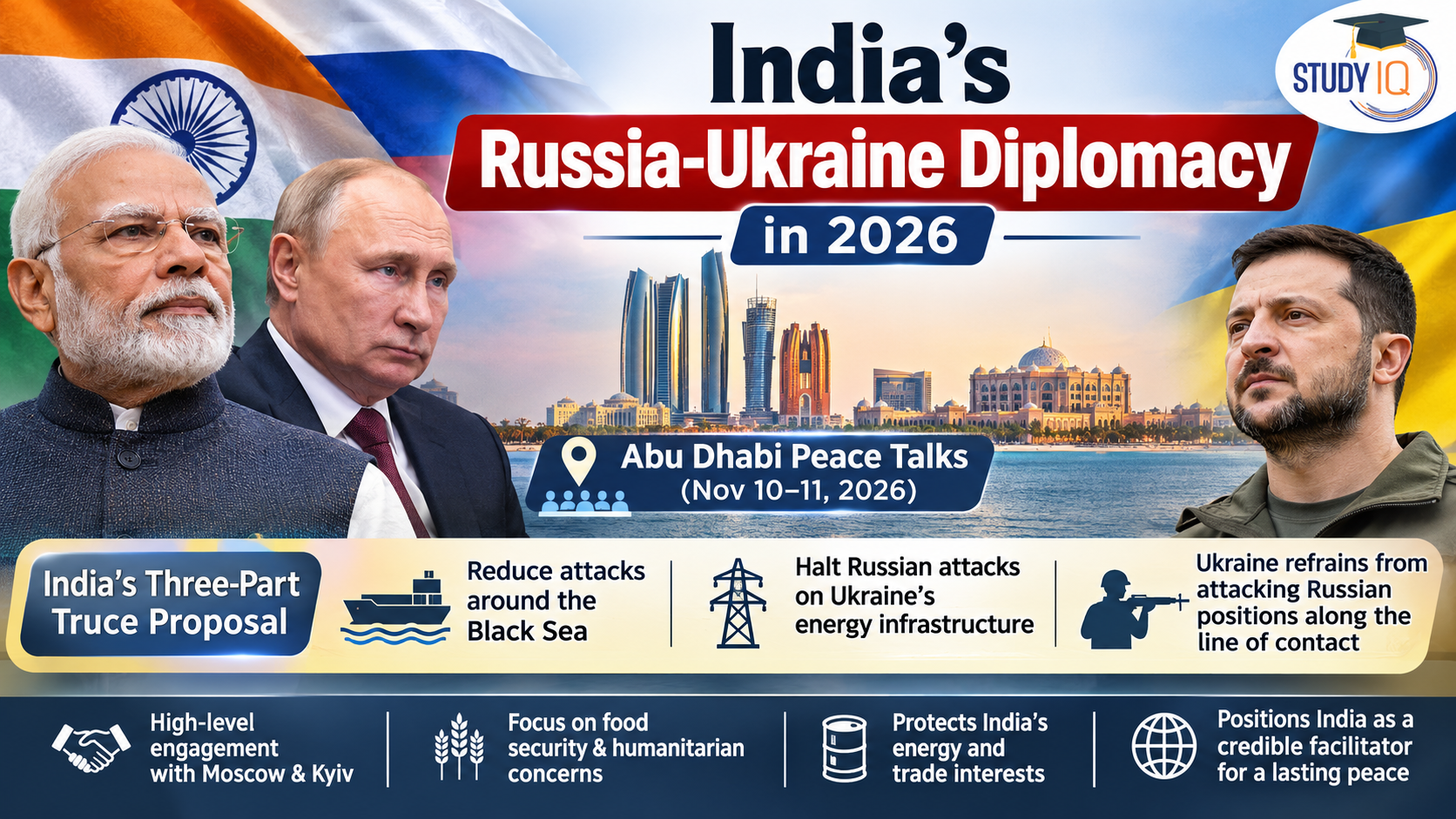
India’s Russia-Ukraine diplomacy has gained momentum in November 2026 as the United States, Russia and Ukraine hold renewed peace negotiations in Abu Dhabi. India has emerged as an important diplomatic facilitator by maintaining high-level engagement with both Moscow and Kyiv and proposing practical measures to reduce hostilities.
India’s approach reflects its commitment to strategic autonomy, humanitarian concerns, energy security and the protection of global trade routes.
India’s Russia-Ukraine Diplomacy: Latest News
-
On November 10–11, 2026, delegations from the US, Russia and Ukraine participated in the third round of US-mediated peace talks in Abu Dhabi.
-
Prime Minister Narendra Modi held discussions with Ukrainian President Volodymyr Zelenskyy ahead of the negotiations.
-
External Affairs Minister S. Jaishankar also spoke with Russian Foreign Minister Sergey Lavrov.
-
India proposed a three-part truce focusing on Black Sea security, protection of Ukraine’s energy infrastructure and reducing attacks along the line of contact.
-
Ukraine welcomed India’s diplomatic engagement, while Russian President Vladimir Putin appreciated Modi’s proposals.
Background of Russia-Ukraine Peace Negotiations
The Russia-Ukraine war began on February 24, 2022, when Russia launched a full-scale military invasion of Ukraine. Since then, several diplomatic initiatives have attempted to end the conflict.
Major rounds of negotiations include:
-
Istanbul Talks (2025): Direct negotiations between Russia and Ukraine resumed. Disagreements over Ukraine’s NATO membership, military capabilities and security guarantees prevented a breakthrough.
-
Geneva Talks (February 2026): Russia demanded that Ukraine withdraw from the entire Donbas region, while Ukraine called for an unconditional ceasefire.
-
Abu Dhabi Talks (November 2026): The US, Russia and Ukraine resumed negotiations to address territorial disputes, security guarantees and the future European security framework.
Despite repeated diplomatic efforts, territorial disagreements and mutual security concerns remain major obstacles to a comprehensive peace agreement.
Major Issues in the Abu Dhabi Peace Talks
The negotiations involve three major areas of disagreement:
1. Territorial Disputes
-
Russia controls Crimea, which it annexed in 2014, and occupies parts of eastern and southern Ukraine.
-
Moscow claims the Ukrainian regions of Donetsk, Luhansk, Zaporizhzhia and Kherson.
-
Russia wants Ukraine to withdraw from the Donbas region.
-
Ukraine rejects territorial concessions and considers its territorial integrity non-negotiable.
2. Security Guarantees for Ukraine
-
Ukraine wants credible international security guarantees to prevent future Russian aggression.
-
It has previously sought NATO membership as a long-term security arrangement.
-
Russia opposes NATO’s expansion towards its borders.
-
The disagreement over Ukraine’s security arrangements remains a major obstacle to peace.
3. European Security Architecture
-
Russia wants broader European security arrangements to be discussed as part of the negotiations.
-
European countries favour addressing the immediate conflict through a ceasefire before discussing the wider security framework.
-
European governments, the EU and NATO remain involved in parallel diplomatic consultations.
India’s Role in Russia-Ukraine Peace Diplomacy
India has traditionally advocated dialogue and diplomacy rather than military confrontation.
Its diplomatic approach is based on maintaining relations with both Russia and Western countries while supporting Ukraine’s sovereignty and territorial integrity.
India’s expanding diplomatic engagement includes:
-
High-level engagement: PM Narendra Modi has maintained direct communication with President Zelenskyy and President Putin.
-
Diplomatic outreach: External Affairs Minister S. Jaishankar has engaged with Russian and Ukrainian leadership.
-
Peace facilitation: India has proposed practical measures to reduce military escalation.
-
Humanitarian concerns: India has highlighted food security, maritime safety and protection of civilians.
-
Strategic autonomy: India has avoided joining military blocs or adopting an exclusively Western or Russian position.
India’s Three-Point Truce Proposal
India has proposed three practical measures to reduce hostilities between Russia and Ukraine.
1. Reduce Attacks in the Black Sea
Limit military attacks around the Black Sea to ensure safe maritime navigation and facilitate Ukrainian agricultural exports.
2. Protect Energy Infrastructure
Halt Russian attacks on Ukrainian energy infrastructure to prevent disruptions to electricity supplies and essential civilian services.
3. Reduce Attacks Along the Line of Contact
Ukraine should refrain from attacking Russian positions along the line of contact to reduce military escalation.
The proposal focuses on achievable confidence-building measures rather than attempting to resolve all territorial and political disagreements immediately.
Why Is the Black Sea Important?
The Black Sea is strategically important for international trade, agricultural exports, energy transportation and maritime security.
Its importance includes:
-
Ukrainian agricultural exports: The ports of Odesa, Chornomorsk and Pivdennyi are essential for Ukraine’s grain and agricultural exports.
-
Russian grain trade: Russia also depends on the Azov-Black Sea region for a substantial share of its grain exports.
-
Global food security: Disruptions in Black Sea shipping can increase food prices and threaten food supplies, particularly in Africa, West Asia and Asia.
-
Maritime trade: The region connects Europe, the Caucasus and West Asia through important shipping routes.
India’s Strategic Interests in the Black Sea
-
Five Indian seafarers have reportedly been killed and two remain missing in Black Sea-related attacks, according to the supplied report.
-
India imports substantial quantities of Russian crude oil, making the safety of maritime transportation important.
-
Disruptions to shipping can increase freight, insurance and energy costs.
-
Agricultural supply disruptions can affect global food prices and India’s economic interests.
Impact of US Midterm Elections on Peace Negotiations
The 2026 US midterm elections could influence Washington’s approach towards the Russia-Ukraine conflict.
-
Democratic gains in Congress could increase pressure for greater military assistance to Ukraine.
-
Lawmakers may also push for stronger sanctions against Russia.
-
However, the US administration retains control over immediate diplomatic negotiations and foreign policy implementation.
-
Any major policy shift will depend on executive decisions and legislative support.
India’s Broader Strategic Concerns
India’s diplomatic engagement extends beyond the Russia-Ukraine conflict.
-
Strait of Hormuz: India supports safe and uninterrupted navigation through this critical maritime route.
-
Energy security: Instability in West Asia and the Black Sea region can disrupt global oil supplies.
-
Protection of Indian nationals: Maritime security is important for Indian seafarers working in international shipping.
-
Global trade: India has an interest in preventing disruptions to international supply chains.
India’s engagement with Iran, Israel, the US and Gulf countries reflects its broader effort to protect national interests amid geopolitical instability.
Challenges to India’s Diplomatic Role
Despite its growing diplomatic engagement, India faces several challenges:
-
Limited leverage: India has strong relations with Moscow and Kyiv but cannot independently compel either side to accept a peace agreement.
-
Territorial disagreements: Russia and Ukraine continue to hold fundamentally different positions on territorial sovereignty.
-
Western pressure: India’s continued energy and defence cooperation with Russia creates differences with some Western countries.
-
Security concerns: Russia’s opposition to NATO expansion and Ukraine’s demand for security guarantees remain difficult to reconcile.
-
Uncertain negotiations: A comprehensive settlement requires political compromises that neither side may currently be willing to make.
What Happens If Peace Talks Fail?
If the Abu Dhabi negotiations fail to produce an agreement:
-
Russia may continue its military operations in Ukraine.
-
Western countries may continue providing military and financial assistance to Kyiv.
-
Diplomatic engagement may continue through prisoner exchanges and humanitarian arrangements.
-
Black Sea shipping disruptions could affect global agricultural trade.
-
Energy prices, international trade and food security may face further uncertainty.
Way Forward
-
Promote an immediate and mutually agreed ceasefire as the first step towards peace.
-
Strengthen confidence-building measures between Russia and Ukraine.
-
Ensure the protection of civilians and critical infrastructure.
-
Guarantee safe navigation through the Black Sea.
-
Encourage constructive participation by the US, European countries and other international stakeholders.
-
Use multilateral platforms such as the United Nations to support a sustainable diplomatic settlement.
Conclusion
India’s Russia-Ukraine diplomacy in 2026 reflects an evolution from general calls for dialogue to proposing practical confidence-building measures. Its three-point truce proposal demonstrates an attempt to address maritime security, energy infrastructure and military escalation.
Although India is not a formal participant in the Abu Dhabi negotiations, its diplomatic relations with both Moscow and Kyiv provide opportunities to facilitate dialogue. India’s approach also highlights the importance of strategic autonomy, humanitarian diplomacy and national interest in an increasingly uncertain geopolitical environment.

 Swachh Survekshan Awards 2025-26: Cleane...
 World Pneumonia Day 2026: Date, Theme, H...
 Public Service Broadcasting Day 2026: 12...











 WhatsApp






