Table of Contents
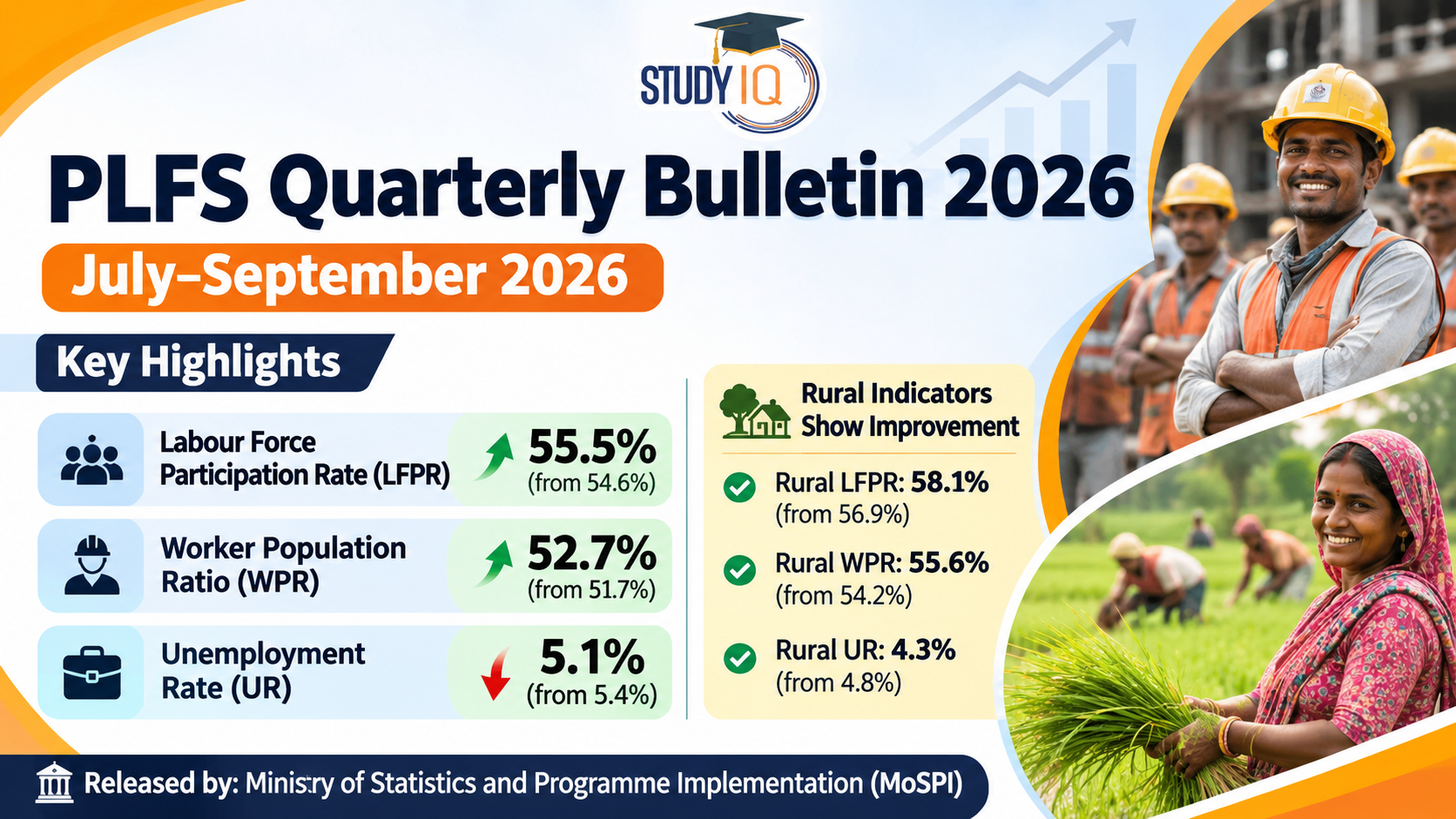
The Periodic Labour Force Survey (PLFS) Quarterly Bulletin for July–September 2026, released by the Ministry of Statistics and Programme Implementation (MoSPI) on 10 November 2026, highlights improvements in India’s labour market. According to the report, the overall Labour Force Participation Rate (LFPR) increased to 55.5%, the Worker Population Ratio (WPR) reached 52.7%, and the Unemployment Rate (UR) declined to 5.1%.
The findings indicate improving employment indicators, particularly in rural India. However, challenges relating to employment quality, informalisation, agricultural dependence and urban unemployment continue to affect India’s labour market.
Key Findings of PLFS July–September 2026
The survey provides important insights into employment and unemployment trends among people aged 15 years and above.
| Indicator | April–June 2026 | July–September 2026 |
|---|---|---|
| Overall LFPR | 54.6% | 55.5% |
| Rural LFPR | 56.9% | 58.1% |
| Urban LFPR | 50.2% | 50.4% |
| Overall WPR | 51.7% | 52.7% |
| Rural WPR | 54.2% | 55.6% |
| Urban WPR | 46.8% | 46.9% |
| Overall UR | 5.4% | 5.1% |
| Rural UR | 4.8% | 4.3% |
| Urban UR | 6.7% | 6.8% |
The overall unemployment rate declined, primarily due to improvements in rural employment indicators. However, urban unemployment increased marginally.
Improvement in Female Labour Force Participation
Female Labour Force Participation Rate increased from 33.2% to 34.7% during the reporting period.
Similarly, the female Worker Population Ratio increased from 31.3% to 32.8%.
This improvement is significant because women’s participation in economic activities is essential for inclusive growth, gender equality and India’s demographic dividend.
However, challenges such as unpaid care responsibilities, wage inequality, workplace safety and limited access to formal employment continue to restrict women’s economic participation.
Rising Agricultural Employment: A Major Concern
One of the important findings is the increasing share of agricultural employment in rural India.
The percentage of rural workers engaged in agriculture increased from 52.9% in April–June 2026 to 56.7% in July–September 2026.
During the same period, the share of employment in the secondary sector declined from 24.4% to 21.9%, while the tertiary sector declined from 22.7% to 21.4%.
This raises concerns about India’s structural transformation. Agriculture generally has lower labour productivity compared with several manufacturing and modern service activities.
However, the increase should also be interpreted in the context of seasonal agricultural employment, particularly the Kharif season.
Major Challenges in India’s Employment Sector
Despite improvements in labour market indicators, India faces several structural challenges:
- Informal Employment: A large section of workers lacks adequate social security and employment protection.
- Skill Mismatch: Educational qualifications and industry requirements often remain disconnected.
- Disguised Unemployment: Excessive dependence on agriculture reduces labour productivity.
- Gender Gap: Women’s participation in formal and remunerative employment remains limited.
- Urban Unemployment: Urban unemployment remains higher than rural unemployment.
- Job Quality: Low wages, underemployment and job insecurity continue to affect workers.
Government Initiatives to Promote Employment
Several government initiatives aim to improve employment opportunities and workforce productivity.
- MGNREGA: Provides a legal guarantee of wage employment to rural households.
- Skill India Mission: Promotes skill development and vocational training.
- PMKVY: Improves employability through industry-oriented skill training.
- Make in India: Encourages domestic manufacturing and investment.
- Startup India: Promotes entrepreneurship and employment generation.
- PM Vishwakarma: Supports traditional artisans and craftspeople.
- National Career Service: Facilitates connections between employers and job seekers.
Way Forward
India needs to move beyond employment generation towards creating productive, secure and decent jobs.
Key measures include promoting labour-intensive manufacturing, strengthening MSMEs, expanding vocational education, encouraging women’s workforce participation and improving social security coverage.
Greater investment in rural non-farm activities, food processing, infrastructure and services can also reduce excessive dependence on agriculture.
PLFS and UPSC Examination Relevance
The topic is important for UPSC Civil Services Examination under General Studies Paper 3, particularly the Indian Economy section.
Important Prelims Facts:
- PLFS is conducted by the National Statistical Office (NSO) under MoSPI.
- It was launched in 2017.
- LFPR measures the proportion of the population participating in the labour force.
- WPR measures the proportion of employed persons in the population.
- Unemployment Rate is calculated as a percentage of the labour force.
- Revised PLFS methodology came into effect in January 2025.
Conclusion
The PLFS Quarterly Bulletin July–September 2026 reflects improvements in India’s employment indicators, particularly in rural areas and female workforce participation. Nevertheless, rising agricultural dependence, urban unemployment and employment-quality concerns highlight the need for structural reforms. India’s long-term economic growth will depend not merely on creating more jobs but on generating productive, inclusive and sustainable employment opportunities.

 Access Equality Index 2026: Goa Ranks Fi...
 World Science Day 2026: Theme, History, ...
 COP31 Climate Summit 2026: Key Issues, I...














 WhatsApp