Table of Contents
COP31 Climate Summit 2026 is a crucial opportunity to strengthen global climate cooperation amid rising temperatures, growing climate-related disasters and widening gaps between international commitments and actual implementation. The summit places climate finance, the 1.5°C temperature target, adaptation, technology transfer and the Loss and Damage Fund at the centre of global negotiations.
The central challenge is no longer merely setting ambitious climate targets but ensuring that countries have the financial and technological capacity to implement them.
What is COP31?
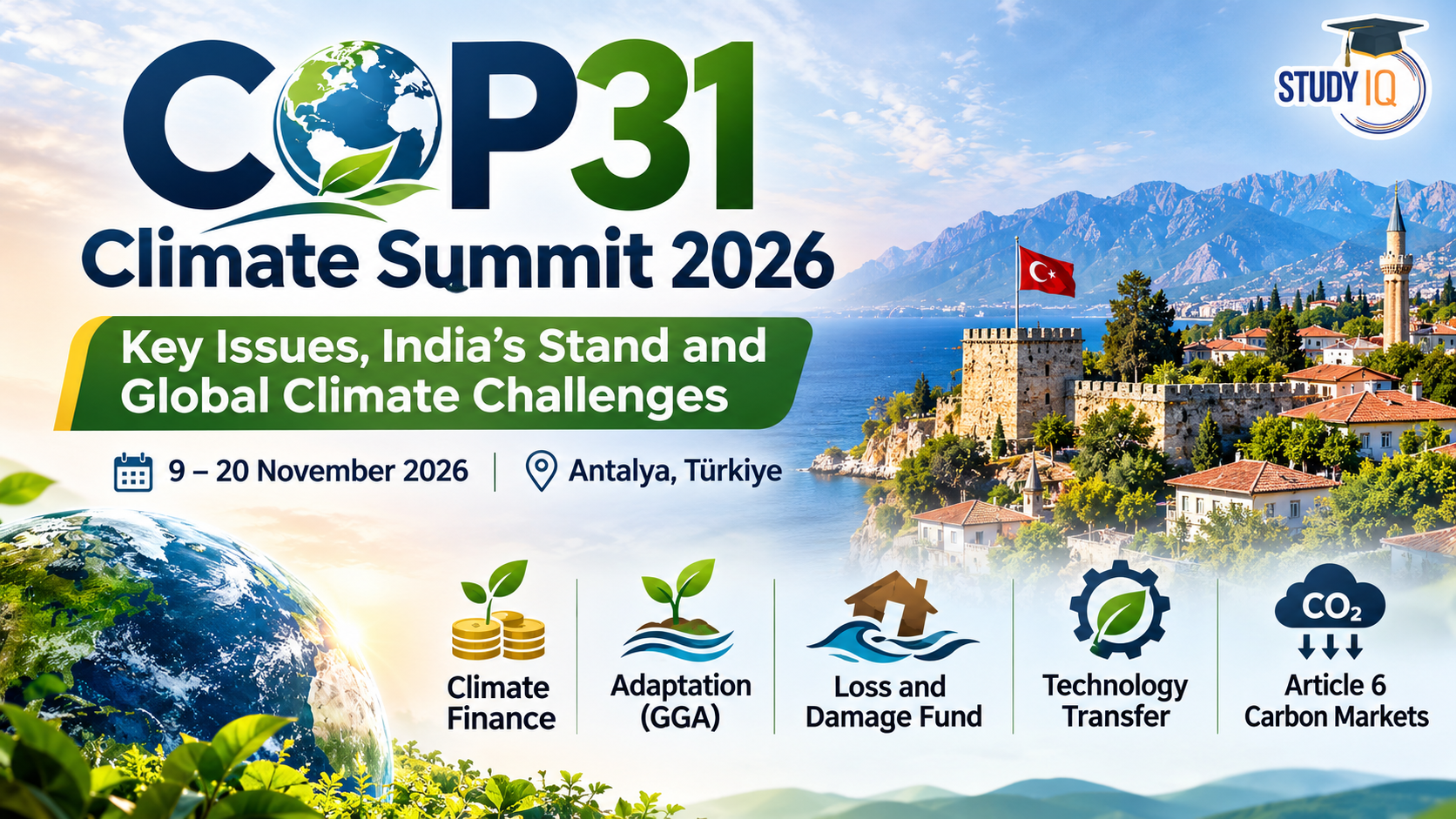
COP31 is the 31st Conference of the Parties to the United Nations Framework Convention on Climate Change (UNFCCC). It is being held in Antalya, Türkiye, from 9 to 20 November 2026.
The conference brings together governments, international organisations, scientists, civil society groups and climate experts to negotiate collective responses to climate change.
-
Host country: Türkiye
-
Venue: Antalya
-
Dates: 9–20 November 2026
-
Organising framework: UNFCCC
-
Key objective: Strengthening global climate action through mitigation, adaptation and climate finance.
Türkiye is hosting the conference, with Murat Kurum nominated as COP31 President, while Australia’s Chris Bowen is serving as President of Negotiations.
Why is COP31 Important? The 1.5°C Challenge
The Paris Agreement (2015) aims to limit global warming to well below 2°C above pre-industrial levels while pursuing efforts to restrict it to 1.5°C.
However, the latest scientific assessments highlight the widening gap between climate commitments and actual progress.
According to the UNEP Emissions Gap Report 2025:
-
Current national climate policies could result in approximately 2.8°C of global warming by 2100.
-
Full implementation of existing Nationally Determined Contributions (NDCs) could limit warming to approximately 2.3–2.5°C.
-
Global greenhouse gas emissions must decline substantially to align with the Paris Agreement temperature goals.
-
The world is likely to temporarily exceed the 1.5°C threshold within the next decade.
This makes COP31 important for accelerating emission reductions and strengthening the implementation of existing climate commitments.
UNEP – UN Environment Programme+1
Major Issues on the COP31 Agenda
A. Climate Finance
Climate finance remains one of the most contentious issues in international climate negotiations.
Developing countries require substantial financial resources to transition towards low-carbon economies, strengthen climate resilience and address climate-related disasters.
At COP29 (Baku, 2024), countries agreed on the New Collective Quantified Goal (NCQG), which includes:
-
Mobilising at least $300 billion annually by 2035, with developed countries taking the lead.
-
Scaling up global climate finance from all sources to at least $1.3 trillion annually by 2035.
India and other developing countries emphasise predictable, accessible and concessional public finance rather than excessive dependence on private investment and debt-creating mechanisms.
B. Global Goal on Adaptation (GGA)
Climate adaptation involves adjusting human and natural systems to minimise the adverse impacts of climate change.
Key priorities include:
-
Climate-resilient agriculture and food security.
-
Flood and drought management.
-
Early warning systems for extreme weather events.
-
Protection of coastal regions and vulnerable ecosystems.
-
Climate-resilient infrastructure.
Developing countries are seeking adequate adaptation finance and greater support for implementing national adaptation plans.
C. Loss and Damage Fund
The Loss and Damage Fund addresses the economic and non-economic consequences of climate change that cannot be avoided through mitigation or adaptation.
It is particularly important for vulnerable developing countries, Small Island Developing States (SIDS) and Least Developed Countries (LDCs).
The fund’s support for Nepal following devastating floods demonstrates its potential to assist countries facing irreversible climate impacts. However, the scale of available assistance remains inadequate compared with reconstruction requirements.
D. Technology Transfer
Developing countries require affordable access to clean technologies, including:
-
Solar and wind energy systems.
-
Battery storage and green hydrogen.
-
Carbon capture technologies.
-
Climate-resilient agricultural technologies.
-
Electric mobility and energy-efficient infrastructure.
Technology transfer must address financial barriers, intellectual property concerns and unequal access to innovation.
E. Article 6 of the Paris Agreement
Article 6 provides a framework for voluntary international cooperation through carbon markets and non-market approaches.
Its major mechanisms include:
-
Article 6.2: Cooperative approaches involving internationally transferred mitigation outcomes (ITMOs).
-
Article 6.4: A UN-supervised carbon crediting mechanism.
-
Article 6.8: Non-market approaches supporting climate cooperation.
Transparent accounting, environmental integrity and avoidance of double counting are essential for effective carbon markets.
India’s Position and Priorities at COP31
India advocates climate justice, equity and the principle of Common but Differentiated Responsibilities and Respective Capabilities (CBDR-RC).
According to India’s Environment Minister, Bhupender Yadav, the country’s approach at COP31 focuses on practical and equitable climate action.
India’s major priorities include:
1. Predictable Climate Finance: Developed countries should provide predictable, largely public and concessional finance without increasing developing countries’ debt burdens.
2. Climate Justice: Climate responsibilities must reflect historical emissions, national circumstances and respective capabilities.
3. Adaptation Support: Greater financial and technical assistance is required for vulnerable communities and developing economies.
4. Technology Transfer: Affordable access to clean technologies must be strengthened by addressing intellectual property and trade barriers.
5. Just Transition: The transition towards a low-carbon economy must protect livelihoods, ensure affordable energy access and respect the right to development.
6. Party-Driven Climate Action: Mitigation commitments and the Global Stocktake process should remain nationally determined, facilitative and non-punitive.
India also intends to coordinate with the G77 and China, BASIC and Like-Minded Developing Countries (LMDC).
Press Information Bureau
Major Challenges to Global Climate Cooperation
Despite growing international awareness, climate negotiations face several structural and political challenges:
-
North-South Divide: Developed and developing countries disagree over financial responsibilities and historical accountability.
-
Implementation Gap: Climate commitments frequently lack adequate financing, institutional capacity and monitoring.
-
Geopolitical Tensions: International conflicts and economic uncertainties weaken multilateral cooperation.
-
Fossil Fuel Dependence: Many economies continue to rely heavily on coal, oil and natural gas.
-
Climate Inequality: Countries most vulnerable to climate change often have the least financial capacity to respond.
-
Adaptation Finance Gap: Existing financial support remains significantly below developing countries’ estimated requirements.
Way Forward
COP31 must prioritise implementation over the announcement of new targets.
-
Establish clear roadmaps for delivering existing climate finance commitments.
-
Strengthen the accessibility and effectiveness of the Loss and Damage Fund.
-
Accelerate renewable energy deployment and energy efficiency.
-
Promote technology sharing and international research cooperation.
-
Strengthen climate-resilient infrastructure and disaster preparedness.
-
Ensure meaningful participation of developing countries and vulnerable communities.
-
Align national climate policies with measurable emission-reduction pathways.
Conclusion
COP31 represents an important opportunity to rebuild trust in international climate cooperation. The success of climate diplomacy should not be measured merely by declarations, financial pledges or ambitious targets, but by measurable improvements in emission reductions, climate resilience and financial support.
For India and other developing countries, climate action must remain rooted in equity, climate justice and the right to sustainable development.
The real test of COP31 is whether the international community can transform climate commitments into accessible finance, technological cooperation and tangible action on the ground.

 Malabar Tree Toad: Karnataka’s State A...
 National Legal Services Day 2026: Histor...
 Global Innovation Index 2026: India Rank...














 WhatsApp