
Table of Contents
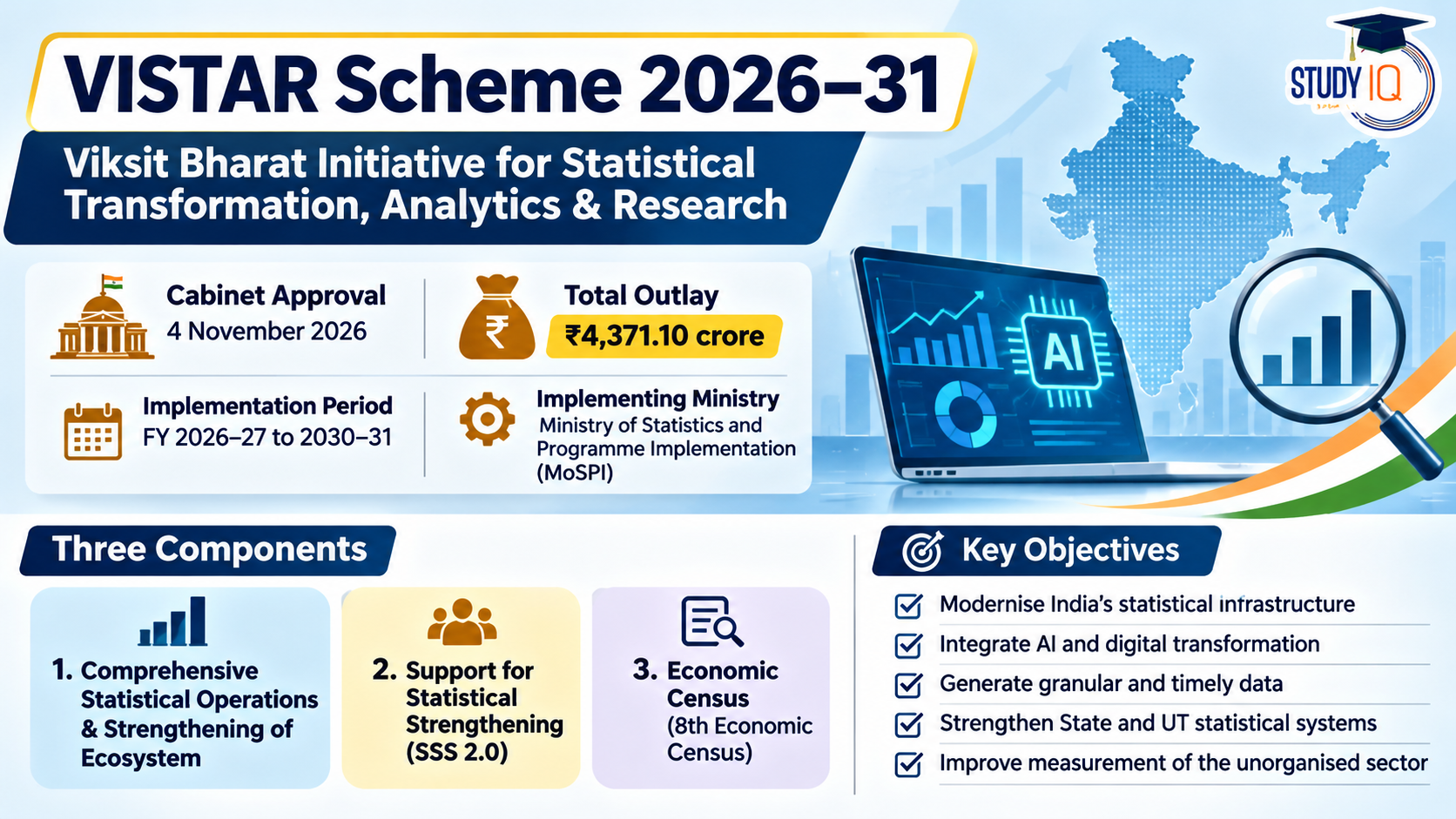
The Union Cabinet, chaired by Prime Minister Narendra Modi, approved the Viksit Bharat Initiative for Statistical Transformation, Analytics & Research (VISTAR) Scheme on 4 November 2026. The scheme has a total financial outlay of ₹4,371.10 crore and will be implemented over five years, from FY 2026–27 to FY 2030–31.
The initiative aims to modernise India’s official statistical system through digital transformation, Artificial Intelligence (AI), improved data governance and stronger statistical infrastructure. It is aligned with the broader vision of Viksit Bharat 2047 and seeks to make reliable, timely and granular data available for evidence-based policymaking.
VISTAR Scheme 2026–31: Key Highlights
| Particulars | Details |
|---|---|
| Full Form | Viksit Bharat Initiative for Statistical Transformation, Analytics & Research |
| Approved By | Union Cabinet |
| Approval Date | 4 November 2026 |
| Implementing Ministry | Ministry of Statistics and Programme Implementation (MoSPI) |
| Scheme Type | Central Sector Scheme |
| Implementation Period | 2026–27 to 2030–31 |
| Total Budget | ₹4,371.10 crore |
| Major Initiative | 8th Economic Census |
| Total Components | Three |
| Long-term Vision | Viksit Bharat 2047 |
Objectives of the VISTAR Scheme
The scheme seeks to transform India’s statistical ecosystem into a modern, technology-driven and integrated system.
Its major objectives include:
1. Modernising Statistical Infrastructure: Digitising the entire statistical process, including data collection, processing, validation and dissemination.
2. Promoting Evidence-Based Governance: Providing reliable and timely statistical information to support policymaking, planning and evaluation.
3. Strengthening Data Quality: Improving accuracy, consistency, interoperability and comparability of official statistics.
4. Expanding Statistical Coverage: Generating granular data at national, state, district and local levels.
5. Leveraging Emerging Technologies: Integrating AI, Machine Learning (ML) and alternative data sources into statistical operations.
6. Strengthening Cooperative Federalism: Enhancing the statistical capabilities of State and Union Territory Governments.
Three Major Components of the VISTAR Scheme
The scheme comprises three major components covering national statistical operations, state-level capacity building and economic data collection.
1. Comprehensive Statistical Operations and Strengthening of Ecosystem
This component aims to expand national statistical operations and improve the overall statistical ecosystem.
Under this initiative, MoSPI proposes conducting 59 surveys during the 16th Finance Commission cycle, compared with 43 major surveys conducted previously.
Key initiatives include:
-
End-to-end digitalisation of statistical data collection, processing and dissemination.
-
Integration of AI and ML for data validation, analysis and processing.
-
Introduction of new statistical indicators, including the Headline Index of Services Production and Index of Unincorporated Sector Enterprises.
-
Integration of alternative data sources such as mobile phone, scanner and e-commerce data.
-
Development of harmonised, machine-readable and interoperable datasets.
-
Adoption of privacy-by-design principles for responsible data governance.
-
Promotion of research proposals, academic collaborations and internship opportunities.
2. Support for Statistical Strengthening (SSS 2.0)
The second component focuses on strengthening the statistical capabilities of State and Union Territory Governments through a redesigned, deliverable-linked framework called Support for Statistical Strengthening (SSS 2.0).
Its major focus areas include:
-
Improving State and District Gross Domestic Product (GDP) estimation.
-
Strengthening State-level Index of Industrial Production (IIP) compilation.
-
Developing district-level and million-plus city-level statistical estimates.
-
Building indigenous data-processing capabilities.
-
Improving the availability of granular socioeconomic data.
It will also strengthen three major national surveys:
-
PLFS: Periodic Labour Force Survey.
-
HCES: Household Consumption Expenditure Survey.
-
ASUSE: Annual Survey of Unincorporated Sector Enterprises.
3. Economic Census
Under this component, MoSPI will conduct the 8th Economic Census in collaboration with State and Union Territory Governments.
The census will collect detailed information about non-farm establishments and the workers employed in them, covering geographical areas up to Gram Panchayat and Ward levels.
Its major objectives include:
-
Mapping non-farm economic establishments across the country.
-
Assessing the size and structure of the unorganised sector.
-
Developing a baseline for the National Statistical Business Register (SBR).
-
Supporting targeted enterprise surveys and policy interventions.
-
Improving the estimation of the unorganised sector’s contribution to GDP.
Significance of the VISTAR Scheme
The VISTAR Scheme represents an important step towards strengthening India’s statistical governance and institutional capacity.
1. Evidence-Based Policymaking: Reliable statistical information will help governments formulate targeted policies and assess development outcomes.
2. Digital Governance: AI, ML and digital infrastructure can improve the speed, efficiency and accuracy of statistical operations.
3. Stronger Cooperative Federalism: Improved statistical capabilities at the State and district levels will support decentralised planning and resource allocation.
4. Better Economic Measurement: The Economic Census will provide valuable information about non-farm establishments and the unorganised sector.
5. Improved Data Accessibility: Harmonised and interoperable datasets can strengthen research, institutional coordination and public policy evaluation.
Challenges and the Way Forward
Despite its potential, successful implementation will require addressing concerns relating to data privacy, digital infrastructure gaps, statistical capacity and inter-agency coordination.
The government must ensure strong data protection safeguards, standardised statistical methodologies, adequate technical training and transparent quality-control mechanisms. Greater collaboration between central and state statistical agencies, universities and research institutions will also be essential.

 Draft National Steel Policy 2047: Vision...
 World Tsunami Awareness Day 2026: 5 Nove...
 Chidambaram Nataraja Temple: History, Ar...














 WhatsApp






