Table of Contents
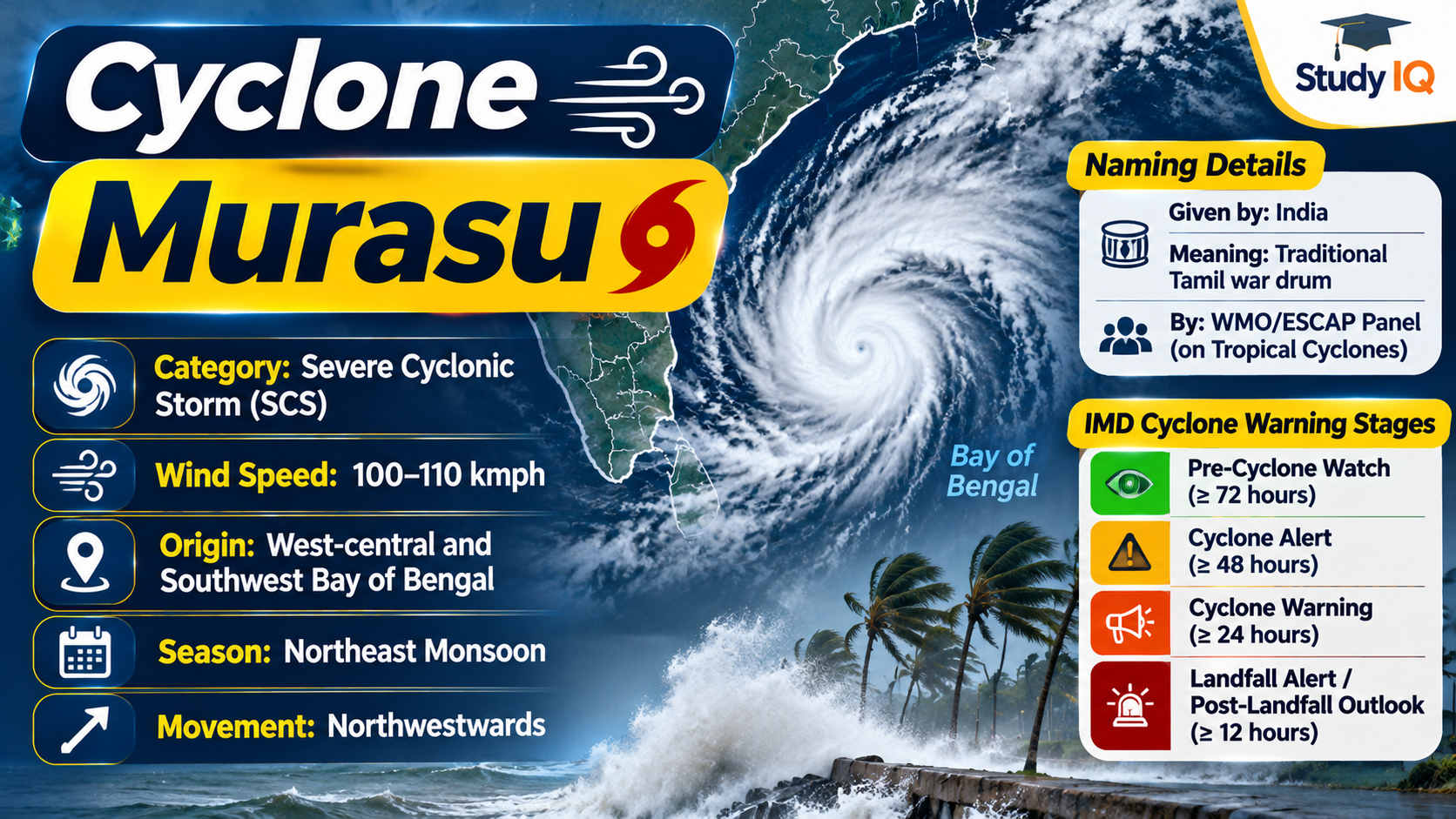
Cyclone Murasu developed over the Bay of Bengal after a deep depression intensified into a Severe Cyclonic Storm (SCS). Moving northwestwards with wind speeds of 100–110 kmph, the cyclone raised concerns about flooding, crop damage and coastal safety in Andhra Pradesh and Tamil Nadu.
About Cyclone Murasu
-
Origin: Bay of Bengal.
-
Formation: West-central and southwest Bay of Bengal.
-
Season: Northeast Monsoon.
-
Category: Severe Cyclonic Storm (SCS).
-
Wind Speed: 100–110 kmph.
-
Movement: Northwestwards.
Naming of Cyclone Murasu
-
Name contributed by: India.
-
Meaning: Murasu is a Tamil word referring to a traditional war drum.
-
Naming Organisation: WMO/ESCAP Panel on Tropical Cyclones.
-
Naming List: Adopted in 2020.
-
Previous Name: Arnab (Bangladesh).
-
Next Name: Akvan (Iran).
IMD Classification of Cyclones
| Cyclone Category | Wind Speed |
|---|---|
| Depression | 31–49 kmph |
| Deep Depression | 50–61 kmph |
| Cyclonic Storm | 62–88 kmph |
| Severe Cyclonic Storm | 89–117 kmph |
| Very Severe Cyclonic Storm | 118–165 kmph |
| Extremely Severe Cyclonic Storm | 166–220 kmph |
| Super Cyclonic Storm | 221 kmph or more |
IMD Cyclone Warning Stages
1. Pre-Cyclone Watch (72 hours): Issued when a low-pressure system or depression develops and has the potential to intensify.
2. Cyclone Alert (48 hours): Advises people to remain aware of the approaching cyclone.
3. Cyclone Warning (24 hours): Provides information about expected landfall, wind speed and storm surge. People are advised to remain prepared.
4. Post-Landfall Outlook (12 hours): Provides information on expected impacts and advises people to take necessary action.
Significance and Potential Impact
-
Flood Risk: Heavy rainfall may cause flooding in coastal Andhra Pradesh and Tamil Nadu.
-
Agriculture: Standing crops may suffer damage due to strong winds and waterlogging.
-
Disaster Management: Tests the preparedness of NDRF and SDRF teams.
-
Infrastructure: May disrupt electricity, transportation and communication networks.
-
Coastal Safety: Requires timely evacuation, emergency shelters and fishing restrictions.

 Pranos Fusion: PRAGYA and PRANIK – Ind...
 Digi Yatra International Flights: 7 Airp...
 National Social Security Board for Unorg...














 WhatsApp