Table of Contents
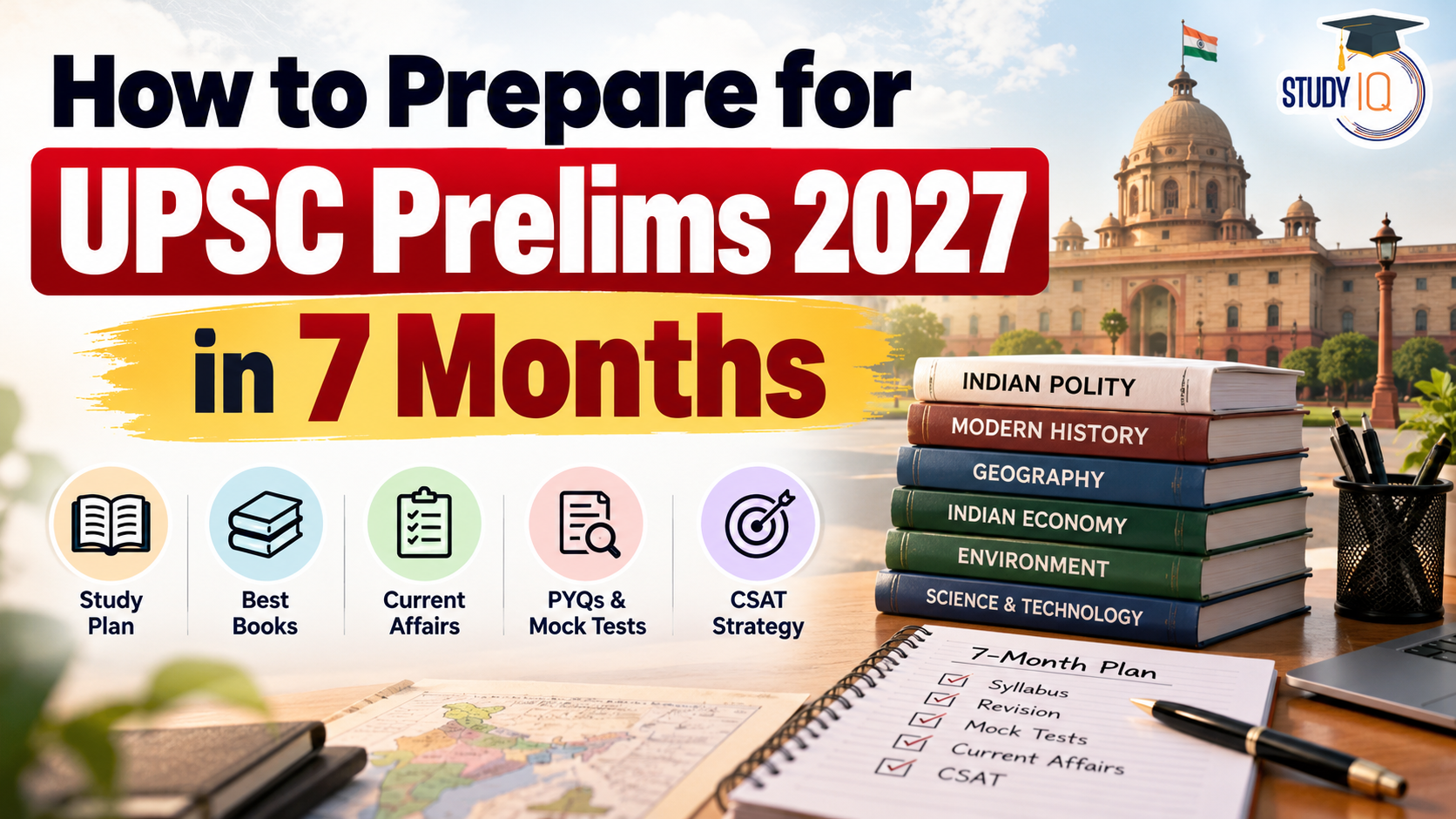
Preparing for UPSC Prelims 2027 in seven months is challenging, especially for beginners who have not completed the syllabus. However, a focused plan can help aspirants build strong fundamentals, practise previous years’ questions, and revise key topics before the exam.
The biggest mistake is assuming you can master every subject in a few weeks. UPSC preparation requires repeated reading, factual recall, conceptual understanding and the ability to eliminate incorrect options.
Rather than following an unrealistic 12-hour timetable, aspirants should create a sustainable routine based on their available time, preparation level and daily responsibilities.
Understand the UPSC Prelims Exam Pattern
The Civil Services Preliminary Examination consists of two objective-type papers:
- General Studies Paper I: 200 marks, covering history, geography, polity, economy, environment, science and technology, and current affairs.
- CSAT Paper II: 200 marks, qualifying with a minimum of 33%.
Both papers have a duration of two hours. Negative marking applies to incorrect answers.
Before buying books or joining a test series, download the official syllabus and solve at least one previous year’s paper. This will help you understand the examination’s difficulty and identify your strengths and weaknesses.
A Realistic Seven-Month Preparation Strategy
The following month-wise plan is designed for aspirants starting in October 2026 and preparing for UPSC Prelims 2027. It balances syllabus coverage, revision, current affairs, PYQs, mock tests and CSAT without assuming that every subject can be mastered in a single reading.
| Month / Phase | Main Focus | Subject-Wise Targets | PYQs & Practice | Revision & Current Affairs | Realistic Monthly Outcome |
|---|---|---|---|---|---|
| Month 1: Late Oct–Nov 2026 | Build fundamentals | Start Polity and Modern History; cover basic Geography and Economy concepts | Solve selected PYQs after each topic; attempt one diagnostic CSAT paper | Read current affairs daily; revise weekly | Establish a routine and build a foundation in 2 major subjects |
| Month 2: December 2026 | Core syllabus coverage | Continue Polity and History; cover Indian Geography and basic Economy | Practise topic-wise MCQs; analyse incorrect answers | Revise Month 1 topics; maintain concise notes | Complete substantial portions of Polity, History and Geography |
| Month 3: January 2027 | Broaden subject coverage | Cover Environment, remaining core topics, and selected Ancient and Medieval History; continue Economy | Solve subject-wise PYQs and short sectional tests | Revise completed subjects; connect current affairs with static concepts | Achieve broad first-reading coverage of the essential syllabus |
| Month 4: February 2027 | First serious revision | Revisit Polity, History, Geography, Economy and Environment; address unfinished topics | Attempt sectional tests; classify conceptual and factual errors | Revise short notes and current affairs from previous months | Complete a first structured revision of major subjects |
| Month 5: March 2027 | PYQ-driven preparation | Focus on weak subjects and frequently tested concepts rather than adding many resources | Solve previous years’ papers systematically; practise mixed MCQs | Revise mistakes, maps, constitutional provisions and key facts | Improve retention, accuracy and familiarity with UPSC question patterns |
| Month 6: April 2027 | Mock tests and consolidation | Revise all major subjects, focusing on weak areas | Take full-length GS tests regularly; practise timed CSAT papers and analyse every test | Revise current affairs compilations and error notes | Improve time management, question selection and exam readiness |
| Month 7: May 2027 | Final revision | Prioritise familiar books, short notes, important facts and weak areas | Take selected tests early in the month; avoid exhausting practice immediately before the exam | Revise PYQs, current affairs and mistakes; maintain sleep and routine | Consolidate knowledge and enter the examination with a clear strategy |
Planning note: The months overlap slightly with the late-October starting point. Adjust the sequence to your actual start date and the official UPSC examination schedule.
Detailed Weekly Execution Plan
| Day | Primary Task | Supporting Task |
|---|---|---|
| Monday | Study a new static topic | Solve 15–25 topic-related MCQs |
| Tuesday | Continue the subject | Revise Monday’s concepts |
| Wednesday | Study a second subject | Practise relevant PYQs |
| Thursday | Continue the second subject | Review current affairs linked to both subjects |
| Friday | Complete pending topics | Revise the week’s difficult concepts |
| Saturday | Subject revision and MCQs | Practise CSAT |
| Sunday | Weekly revision or sectional test | Analyse mistakes and plan the next week |
The number of MCQs is a flexible target, not a daily quota to meet at the expense of understanding.
Daily Study-Time Allocation
For an aspirant who can devote six focused hours daily:
| Activity | Time | Priority |
|---|---|---|
| Static subject study | 2 hours | High |
| Second subject or backlog | 1 hour | High |
| PYQs and MCQs | 1 hour | High |
| Current affairs | 45 minutes | High |
| CSAT practice | 45 minutes | Essential |
| Quick revision | 30 minutes | High |
| Total | 6 hours |
Monthly Progress Checkpoints
At the end of each month, assess your progress using measurable indicators.
| Checkpoint | Questions to Ask |
|---|---|
| Syllabus | Which topics have I actually understood, not just read? |
| Revision | Can I recall important concepts without reopening the book? |
| PYQs | Can I explain why the correct option is right and the others are wrong? |
| Current affairs | Can I connect important news to static syllabus topics? |
| CSAT | Am I consistently clearing the qualifying threshold in timed practice? |
| Consistency | How much of my planned study did I realistically complete? |
| Backlog | Which unfinished topics must be prioritised next month? |
How Many Hours Should You Study Daily?
Your schedule should reflect your circumstances.
| Aspirant Type | Practical Daily Target |
|---|---|
| Full-time aspirant | 6–8 focused hours |
| Working professional | 3–5 focused hours |
| College student | 4–6 focused hours |
| Repeat aspirant with strong basics | 4–6 focused hours, prioritising revision and tests |
These are planning ranges, not guarantees of success. Quality, consistency and effective revision matter more than the number of hours recorded.
A full-time aspirant might divide six hours between static subjects, revision, current affairs, PYQs and CSAT. Working aspirants can spread the same activities across weekdays and longer weekend sessions.
Do Not Ignore CSAT
CSAT is qualifying, but failing it can end your attempt even if your GS Paper I performance is strong. Practise comprehension, reasoning, numeracy and data interpretation throughout the seven months.
Start with a previous year’s CSAT paper to assess your baseline. If you struggle to reach the qualifying threshold comfortably in timed practice, allocate more time to CSAT instead of postponing it.
Common Mistakes to Avoid
- Trying to finish the entire syllabus without revision.
- Reading multiple books for the same subject.
- Ignoring PYQs until the final months.
- Collecting excessive current affairs notes.
- Taking mock tests without analysing errors.
- Following another aspirant’s timetable without considering your own circumstances.
 UPSC CDS 2 Result 2026 Out: Download Wri...
 UPSC Mains Directive Words 2010–2026: ...
 UPSC NDA 2 Result 2026 Out: Download Mer...





 WhatsApp