Table of Contents
Social security is essential for ensuring economic security, decent working conditions and dignity for workers. The Employees’ Provident Fund Organisation (EPFO) plays a crucial role in providing retirement savings, pension benefits and insurance protection to eligible employees in India.
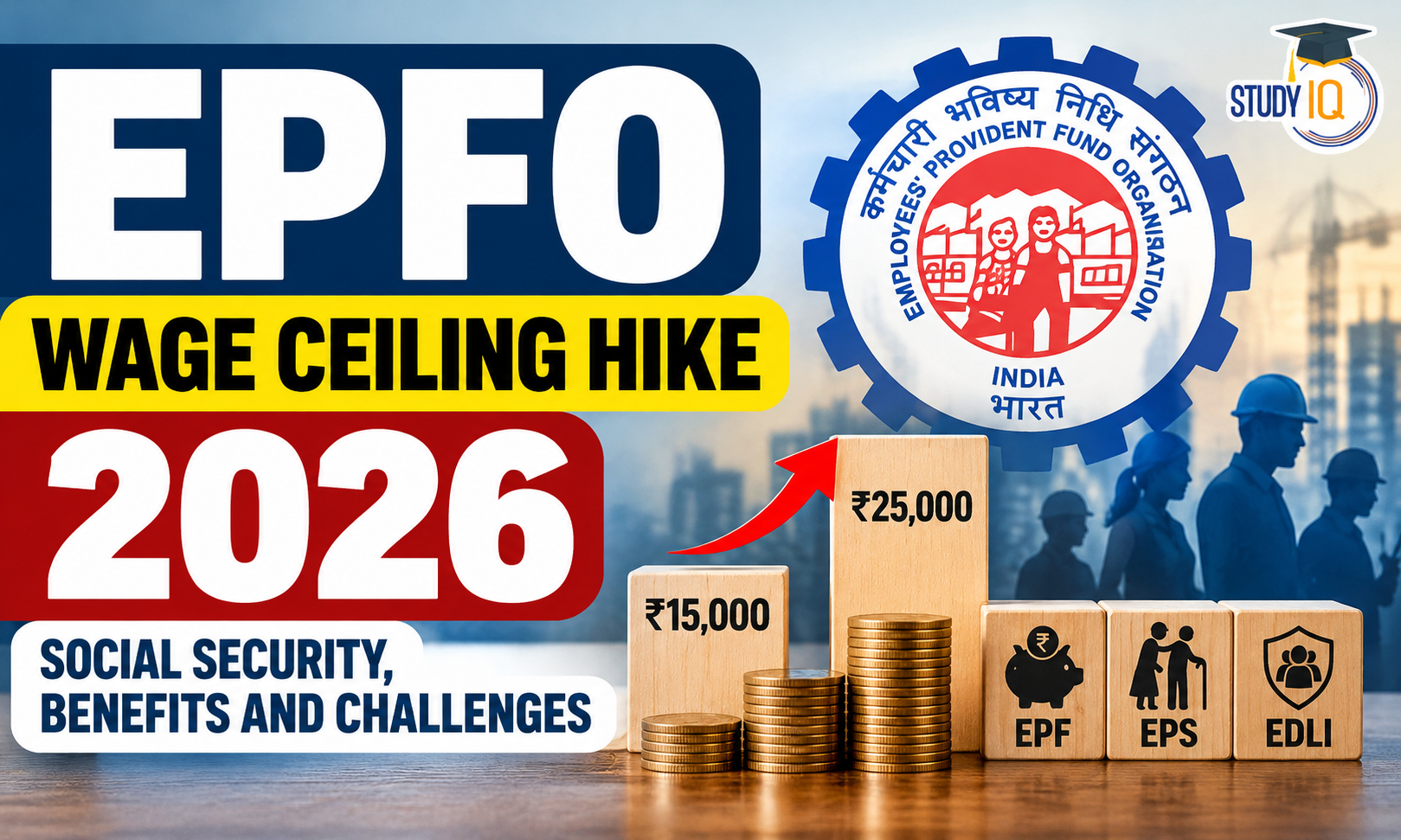
According to the reported October 2026 update, the government has raised the EPFO wage ceiling for mandatory coverage from ₹15,000 to ₹25,000 per month after a gap of 12 years. The move aims to expand social security coverage and align the eligibility threshold with changing wage levels.
Read Also: UPSC Daily Current Affairs 2026
What Is the EPFO Wage Ceiling Hike?
-
Wage ceiling: The threshold used to determine mandatory coverage under applicable EPFO provisions.
-
Reported revision: From ₹15,000 to ₹25,000 per month.
-
Key schemes: Employees’ Provident Fund (EPF), Employees’ Pension Scheme (EPS) and Employees’ Deposit Linked Insurance (EDLI).
-
Expected beneficiaries: Around 51 lakh additional workers, according to the supplied report.
-
Objective: Expand formal social security coverage and strengthen retirement protection.
Note: The reported notification and its effective date should be verified against official EPFO or Ministry of Labour and Employment documents before publication.
Benefits of the EPFO Wage Ceiling Hike
1. Expansion of Social Security
-
Extends mandatory coverage to more eligible workers earning between ₹15,000 and ₹25,000.
-
Reduces the social protection gap for low- and middle-income salaried employees.
-
Strengthens the institutional framework for worker welfare.
2. Improved Retirement Security
-
Higher eligible contribution bases can increase retirement savings where contributions are calculated on the revised ceiling.
-
Helps workers build long-term financial resilience.
-
Reduces excessive dependence on family support or public assistance during old age.
3. Strengthening Pension and Insurance Protection
-
EPFO-linked arrangements provide retirement savings, pension benefits and insurance protection, subject to the rules governing each scheme.
-
Broader coverage can reduce the vulnerability of workers and their families to old age and income shocks.
4. Promoting Formalisation of Employment
-
Strengthens the link between employment and institutional social protection.
-
Encourages compliance with labour and social security regulations.
-
Can improve the documentation of employment relationships and wage payments.
5. Advancing Inclusive Growth
-
Social security improves economic resilience among vulnerable households.
-
Greater protection against old age and other risks can reduce inequality.
-
Supports the broader objectives of decent work under Sustainable Development Goal 8.
Challenges and Concerns
1. Reduced Take-Home Salary
Higher employee contributions, where applicable, may reduce monthly disposable income. This can particularly affect households already facing high housing, education and healthcare expenses.
2. Higher Compliance Costs for Employers
-
Employers may face increased contribution liabilities for affected employees.
-
Labour-intensive sectors and micro, small and medium enterprises (MSMEs) may experience greater cost pressures.
-
Some businesses could respond by adjusting hiring, compensation structures or employment arrangements.
3. Adequacy of the Revised Ceiling
Although the reported increase is significant, inflation and rising living costs may gradually erode its adequacy. Trade unions have argued for a higher threshold, including a proposed ceiling of ₹30,000.
4. Coverage Gaps in the Informal Sector
A large proportion of India’s workforce remains outside regular formal employment arrangements. Raising the wage ceiling alone cannot ensure universal social security for informal workers, casual labourers and many self-employed individuals.
5. Implementation and Compliance
Effective implementation requires accurate wage records, employer compliance, accessible grievance-redressal mechanisms and awareness among workers regarding their entitlements.
Way Forward
-
Periodic revision: Link the wage ceiling to inflation, wage growth and changes in minimum wages.
-
Universal social security: Strengthen suitable protection mechanisms for informal, gig and platform workers.
-
Support for MSMEs: Simplify compliance and consider appropriate transitional support for smaller employers.
-
Worker awareness: Improve access to information about EPF balances, pension eligibility, insurance and grievance redressal.
-
Digital governance: Use interoperable digital systems to improve registration, contribution tracking and portability.
-
Tripartite consultation: Engage government, employers and trade unions through institutional mechanisms such as the EPFO’s Central Board of Trustees.
Conclusion
The reported EPFO wage ceiling hike represents a potential step towards a more inclusive social security system by extending formal protection to additional workers. However, its long-term success will depend on effective implementation, sustainable employer compliance and the inclusion of workers outside conventional formal employment.
For India, the broader objective should be to move from fragmented and reactive welfare measures towards a comprehensive, portable and adequately funded social security framework that supports the constitutional vision of social and economic justice.

 Circular Economy in India: Benefits, Cha...
 Daily Mains Articles 2026 – Updated Da...
 Daily Current Affairs PDF 2026: Download...














 WhatsApp