Table of Contents
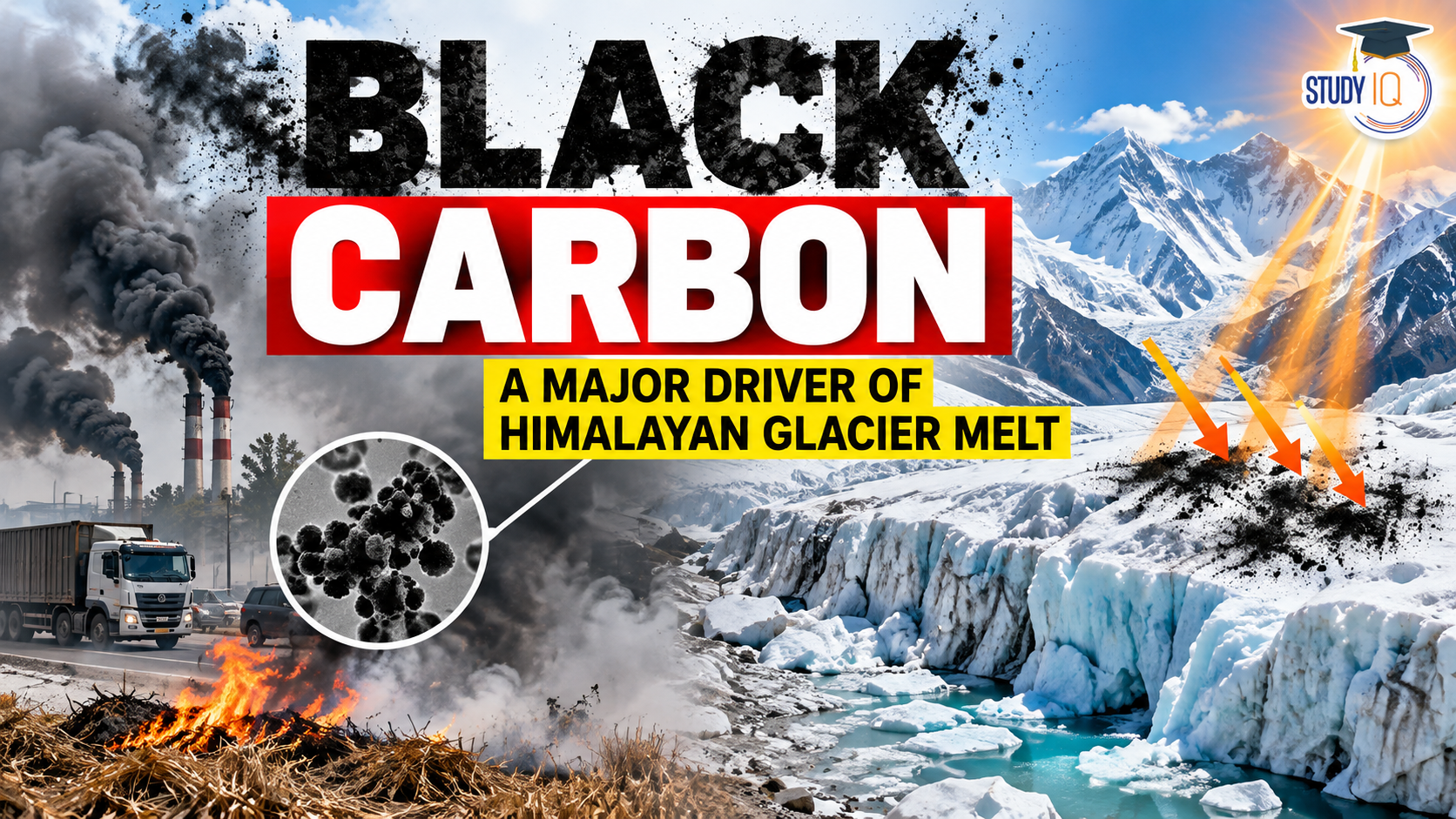
A recent report has highlighted black carbon as a significant contributor to Himalayan glacier melt. Its deposition on snow and ice reduces surface reflectivity and increases the absorption of solar radiation, accelerating melting.
What is Black Carbon?
Black carbon (BC) is a fine, dark-coloured particulate matter produced through the incomplete combustion of fossil fuels, biofuels and biomass.
- It is a component of PM2.5.
- It is a Short-Lived Climate Pollutant (SLCP).
- It generally remains in the atmosphere for days to weeks.
- It strongly absorbs solar radiation and contributes to atmospheric warming.
Major Sources of Black Carbon
Key sources include:
- Diesel engines and vehicles
- Coal-fired power plants
- Biomass-burning cookstoves
- Brick kilns
- Forest fires
- Crop-residue burning
- Open burning of waste
How Does Black Carbon Accelerate Glacier Melt?
Black carbon can be transported over long distances and deposited on Himalayan snow and ice.
Deposition → Reduced Albedo → Greater Solar Absorption → Surface Warming → Faster Snow & Glacier Melt
Snow and ice normally reflect a large proportion of incoming solar radiation. When black carbon settles on their surface, it darkens the surface and reduces albedo, causing greater absorption of solar energy.
Impacts of Black Carbon
1. Himalayan Glaciers
- Accelerates snow and glacier melting.
- Can alter the timing and quantity of meltwater.
- Has implications for downstream water resources.
2. Climate
- Absorbs solar radiation and contributes to atmospheric warming.
- Can influence atmospheric circulation, clouds and precipitation.
3. Human Health
- Fine particles containing black carbon can penetrate deep into the respiratory system.
- Exposure is associated with respiratory and cardiovascular health risks.
4. Agriculture & Ecosystems
- Changes in temperature and precipitation can affect agricultural systems and ecosystems.
- Glacier and snowmelt changes can influence mountain and downstream environments.
5. Water Security
- Himalayan glaciers are important sources of freshwater for millions of people.
- Changes in snow and glacier melt can affect seasonal water availability.
Why is Black Carbon Important for India?
The Himalayan region is particularly sensitive because changes in snow and glacier dynamics can affect major river systems and downstream populations.
Reducing black-carbon emissions can therefore provide climate, health and environmental benefits, particularly because black carbon is short-lived compared with long-lived greenhouse gases.
Black Carbon vs CO₂
| Feature | Black Carbon | CO₂ |
|---|---|---|
| Nature | Fine carbonaceous particle | Greenhouse gas |
| Main source | Incomplete combustion | Fossil-fuel use, land-use change, etc. |
| Atmospheric lifetime | Days to weeks | Much longer |
| Climate effect | Strongly absorbs solar radiation | Traps outgoing infrared radiation |
| Glacier impact | Directly reduces snow/ice albedo | Contributes to long-term warming |

UPSC IAS Live GS P2I Foundation 2027 Fast Track Batch (Basic)
 Anti-Goonda Bill 2026 Explained: Why Pre...
 Cool Leaders Award 2026: Winners, Global...
 AFSPA Extended Till March 2027: Manipur,...













 WhatsApp