Table of Contents
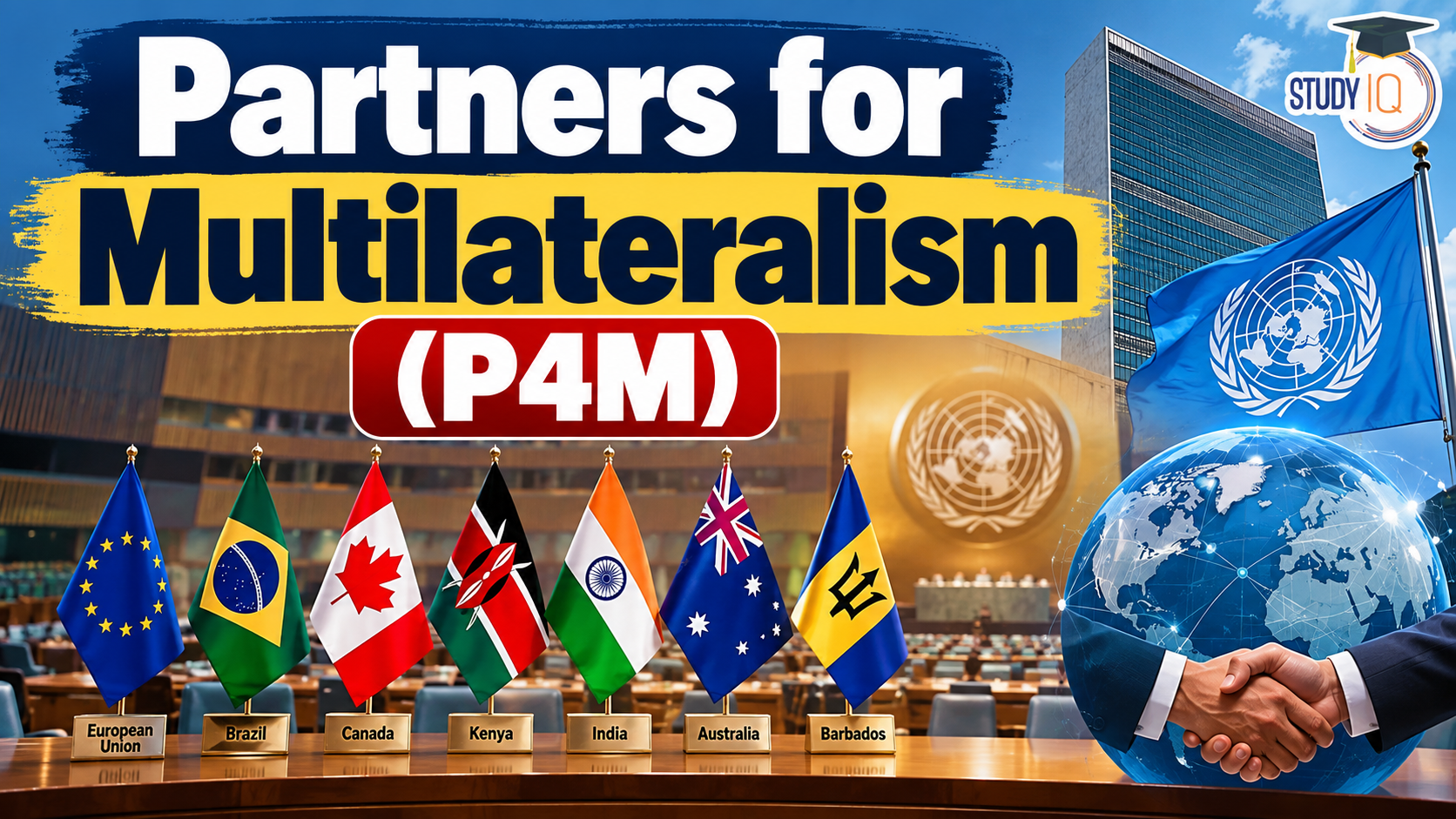
India joined the inaugural Partners for Multilateralism (P4M) Summit held in New York on 21 September 2026, on the sidelines of the 81st United Nations General Assembly (UNGA).
The initiative brings together the European Union, Australia, Barbados, Brazil, Canada, India and Kenya as initial co-sponsors. It seeks to strengthen multilateral cooperation, uphold international law and promote peace, sustainable development and shared prosperity.
Read Also: UPSC Daily Current Affairs 2026
What is Partners for Multilateralism (P4M)?
- P4M stands for Partners for Multilateralism.
- It is an open and flexible international platform, rather than a formal treaty-based alliance.
- It brings together countries from different regions and political traditions.
- The initiative focuses on multilateralism, international law, peace and prosperity.
- The platform aims to make global institutions more effective, representative, inclusive and responsive.
P4M: Initial Co-Sponsors
The initial co-sponsors are:
- 🇪🇺 European Union
- 🇦🇺 Australia
- 🇧🇧 Barbados
- 🇧🇷 Brazil
- 🇨🇦 Canada
- 🇮🇳 India
- 🇰🇪 Kenya
The grouping therefore brings together countries and a regional organisation representing different geographical regions and political perspectives.
Key Objectives of P4M
1. Reform of Multilateral Institutions
P4M supports reforms to make institutions such as the United Nations more representative, effective and capable of responding to contemporary challenges.
The declaration specifically supports efforts to reform and strengthen the UN, including initiatives such as UN80.
2. Upholding International Law
The initiative reaffirms principles of the UN Charter, including:
- Sovereign equality
- Territorial integrity
- Peaceful settlement of disputes
- Prohibition of the threat or use of force
- International humanitarian law
- Human rights and fundamental freedoms
3. Addressing Global Challenges
P4M seeks greater cooperation on issues that cannot be effectively handled by individual countries alone, including:
- Artificial Intelligence
- Climate change
- Global health and pandemics
- Digital transformation
- Biodiversity and pollution
- Sustainable development
- International security
4. Economic and Supply-Chain Resilience
The platform also focuses on strengthening:
- Global supply chains
- International financial cooperation
- Multilateral trade
- Economic resilience
- Food and energy security
At the P4M summit, India’s External Affairs Minister S. Jaishankar highlighted concerns around the interconnected food, fuel, fertiliser and finance vulnerabilities and the need for stronger global safeguards.
Why is P4M Important for India?
For India, P4M provides another platform to advance its long-standing position on reformed multilateralism.
India has consistently advocated for greater representation of developing countries in global institutions and more participatory and transparent decision-making.
At the summit, Jaishankar emphasised the importance of international law, rules and norms, along with more participative deliberations and transparent decision-making in multilateral institutions.
P4M and India’s Foreign Policy
P4M fits into India’s broader diplomatic approach of engaging with multiple groupings and institutions simultaneously.
It provides India with an additional forum to discuss:
- UN reforms
- Global South concerns
- Supply-chain resilience
- Climate action
- AI governance
- Global health
- International financial architecture
Rather than functioning as a rigid alliance, P4M is designed as an open, flexible and practical platform for cooperation.

 World Maritime Day 2026: Know the Theme,...
 Bhikaji Cama Birth Anniversary 2026: Lif...
 Kathmandu Declaration: SAWEN, Wildlife C...









 WhatsApp