Table of Contents
India’s demographic dividend is often described as one of the country’s biggest development opportunities. However, the large number of young people who are not in education, employment or training (NEET) highlights a critical challenge: India must convert its young population into a productive workforce through better education, relevant skills and stronger links with industry.
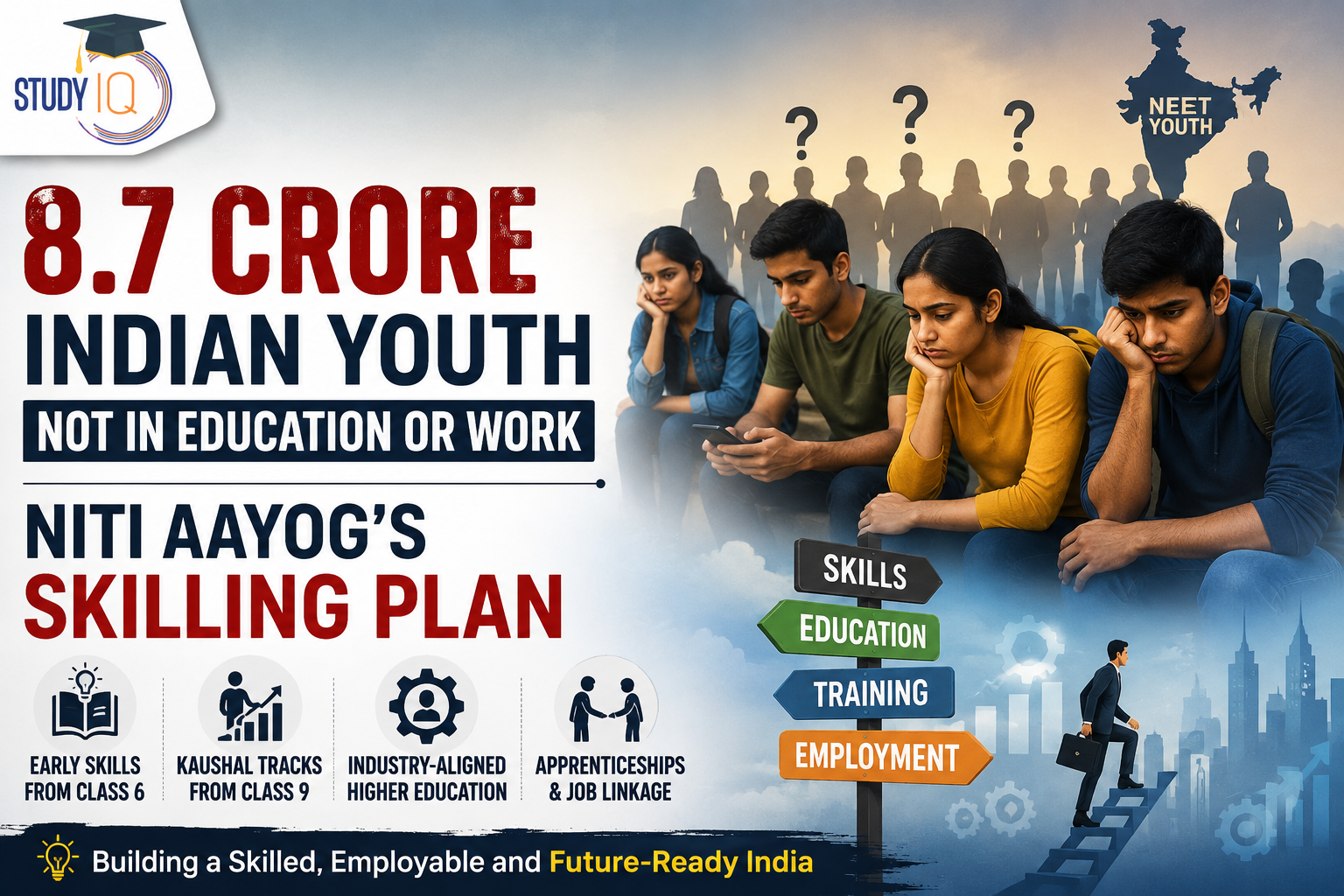
According to NITI Aayog’s report “Reimagining Skilling for Viksit Bharat@2047,” an estimated 8.7 crore Indians aged 15–29 were NEET in 2021. The report calls for a fundamental shift from a degree-oriented education system towards an employment-oriented, skill-based and industry-linked learning ecosystem.
Read Also: UPSC Daily Current Affairs 2026
What Does NEET Mean?
NEET refers to young people who are Not in Education, Employment or Training. The category includes unemployed youth as well as those outside both formal education and the labour market.
The large NEET population indicates a weak transition between education, skills and employment. It also represents a potential loss of India’s demographic advantage if young people remain disconnected from productive economic activity.
Why Is India Facing a Skill–Employment Gap?
A major concern is the limited alignment between educational qualifications and labour-market requirements.
NITI Aayog has highlighted that only 8.25% of graduates are employed in roles aligned with their qualifications. This indicates that possessing a formal degree does not necessarily translate into employability.
Several factors contribute to the problem:
- Limited exposure to practical and vocational learning.
- Weak industry–education linkages.
- Inadequate apprenticeship opportunities.
- High cost of additional skill training for low-income students.
- Preference for generic academic degrees over job-oriented specialisations.
- Fragmented skilling programmes.
- Uneven access to employment opportunities across regions.
- Rapid technological and structural changes in the labour market.
Thus, the challenge is not merely a shortage of education or training but a mismatch between what young people learn and what the economy needs.

UPSC IAS Live GS P2I Foundation 2027 Pratigya August Evening Batch 2 (Basic)
NITI Aayog’s Skilling Plan
NITI Aayog has proposed integrating employability and vocational skills into the education system from an early stage.
1. Employability Skills from Class 6
The report recommends introducing General Employability and Entrepreneurship Skills from Classes 6 to 12.
This would help students develop capabilities beyond conventional textbook learning, including:
- Communication and workplace skills
- Problem-solving
- Entrepreneurship
- Financial and professional awareness
- Basic understanding of the world of work
Such an approach can make education more closely connected with real-world requirements.
2. ‘Kaushal Tracks’ from Class 9
NITI Aayog has proposed structured vocational pathways called Kaushal Tracks from Class 9.
These tracks would provide students with deeper vocational specialisation according to local, national and emerging economic demand.
This can help overcome the traditional perception that vocational education is an alternative only for students who do not pursue academic education.
3. Vocational Education in Board Examinations
The report recommends including vocational subjects within the Class 10 and Class 12 board subject framework, with equal weightage.
State boards could also adopt the revised framework for certification.
This could help mainstream vocational education and provide it with greater parity with conventional academic subjects.
4. Industry-Aligned Higher Education
At the higher education level, NITI Aayog has advocated moving away from purely generic degrees towards applied and industry-aligned specialisations.
Universities and colleges should increasingly provide:
- Practical exposure
- Industry-linked curricula
- Work-integrated degrees and diplomas
- Apprenticeships
- Modular learning
- Earn-while-you-learn opportunities
Such reforms can reduce the gap between academic qualifications and workplace competencies.
Strengthening Apprenticeships
Apprenticeships can serve as an important bridge between education and employment.
Although initiatives such as the National Apprenticeship Promotion Scheme (NAPS) and National Apprenticeship Training Scheme (NATS) have expanded opportunities, participation remains uneven.
NITI Aayog has proposed:
- Greater incentives for MSMEs to provide apprenticeships.
- A unified platform for credible apprenticeship opportunities.
- Stronger industry–institution partnerships.
- Greater integration of workplace learning with formal education.
For a country with a large young workforce, apprenticeships can provide practical experience while reducing the transition period between education and employment.
Focus on Emerging Sectors
India’s future employment strategy must also anticipate structural changes in the economy.
NITI Aayog has highlighted sectors such as:
- Green industries
- Electric vehicles
- Emerging technologies
- Other high-demand sectors
At the same time, workers employed in declining occupations would require reskilling and upskilling to remain economically relevant.
Therefore, skilling policy should be dynamic rather than based only on current employment patterns.
From Training Numbers to Employment Outcomes
India has expanded its skilling ecosystem considerably. According to the report, more than 7.67 crore people have been trained since 2014–15.
However, the key question is whether training leads to sustainable employment and higher incomes.
This requires a shift from measuring success through:
Number of people trained → Number of people employed and earning
Skilling programmes should therefore increasingly be assessed through indicators such as:
- Placement rates
- Wage growth
- Job retention
- Employer satisfaction
- Productivity
- Career progression
- Self-employment outcomes
Challenges in Implementing the Plan
Despite its potential, the proposed transformation faces several challenges.
- First, vocational education requires trained instructors, modern laboratories and adequate infrastructure.
- Second, industry participation must increase substantially, particularly among MSMEs.
- Third, social perceptions around vocational education need to change. Skill-based careers should be viewed as legitimate and aspirational pathways rather than inferior alternatives to conventional degrees.
- Fourth, regional disparities in industrial activity and educational infrastructure can make uniform implementation difficult.
- Fifth, skilling programmes must remain responsive to rapidly changing technologies, particularly artificial intelligence, automation, robotics and the green transition.
Way Forward
A comprehensive strategy should integrate education, skilling, apprenticeships and employment rather than treating them as separate policy domains.
India should:
- Mainstream vocational education from the secondary-school stage.
- Build stronger industry–academia partnerships.
- Expand apprenticeships, particularly through MSMEs.
- Develop district-level skill plans based on local economic opportunities.
- Promote women’s participation through affordable training, financial support and flexible learning options.
- Create stronger systems for career counselling and job matching.
- Make skilling programmes outcome-based rather than certificate-based.
- Establish mechanisms for continuous reskilling and lifelong learning.
Conclusion
The presence of 8.7 crore NEET youth is not merely an employment challenge; it is a test of India’s ability to realise its demographic dividend.
NITI Aayog’s proposed approach recognises that education without employability and training without employment outcomes cannot fully address the needs of a young workforce. Integrating vocational education into schools, strengthening apprenticeships, aligning higher education with industry and focusing on emerging sectors can help create a more productive workforce.
For Viksit Bharat@2047, India must move from a degree-centric model to a skills-and-employment-oriented ecosystem. The ultimate measure of success should not be how many young Indians receive certificates, but how many acquire relevant skills, secure decent work and contribute productively to the economy.
 Child Marriage in India: Causes, Impacts...
 World Development Report 2026: The Promi...
 US Suspension of PERM Filings by Major I...














 WhatsApp