Table of Contents
Context
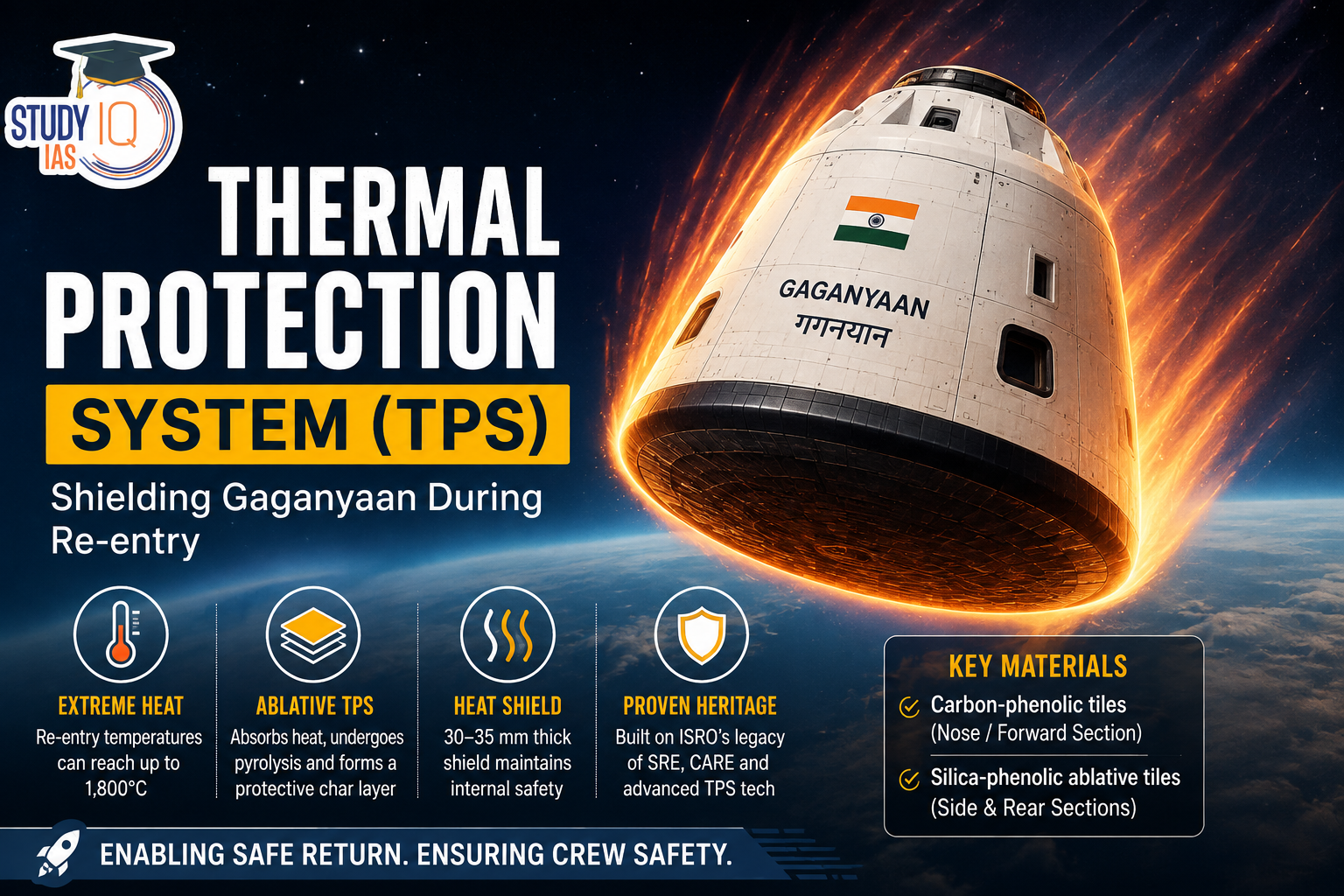
As ISRO prepares for the Gaganyaan uncrewed flight tests, the crew module’s Thermal Protection System (TPS) will protect it during atmospheric re-entry.
Read Also: UPSC Daily Current Affairs 2026
About Thermal Protection System
- Nature: External protective layer that shields spacecraft from extreme aerodynamic heating during high-speed atmospheric flight and re-entry.
- Need: During re-entry, intense shock-layer heating can raise temperatures to around 1,800°C, while rapid deceleration makes passive thermal protection essential.
- Function: Protects the spacecraft structure and keeps the crew module at a safe temperature.
How Does an Ablative TPS Work?
- Heat Absorption: The outer material absorbs intense heat and undergoes pyrolysis, a heat-driven chemical decomposition.
- Char Formation: The outer layer gradually breaks down and forms a carbon-rich char layer, which insulates the material below.
- Mass Loss: Material is progressively lost from the surface, carrying heat away from the spacecraft.
- Gas Cushion: Gases released during pyrolysis move outward and help reduce convective heat transfer to the capsule.
Key Features of Gaganyaan TPS
- Thickness: Heat shield is about 30–35 mm thick, while maintaining structural temperatures below 150°C.
- Heat Shield Materials:Carbon-phenolic tiles are used on the forward/nose section, while silica-phenolic ablative tiles protect the side and rear sections.
- Technology Heritage: Builds on ISRO’s earlier experience with ablative heat shields, including the Space Capsule Recovery Experiment (SRE) and Crew Module Atmospheric Re-entry Experiment (CARE).

 Child Marriage in India: Causes, Impacts...
 World Development Report 2026: The Promi...
 US Suspension of PERM Filings by Major I...














 WhatsApp