Table of Contents
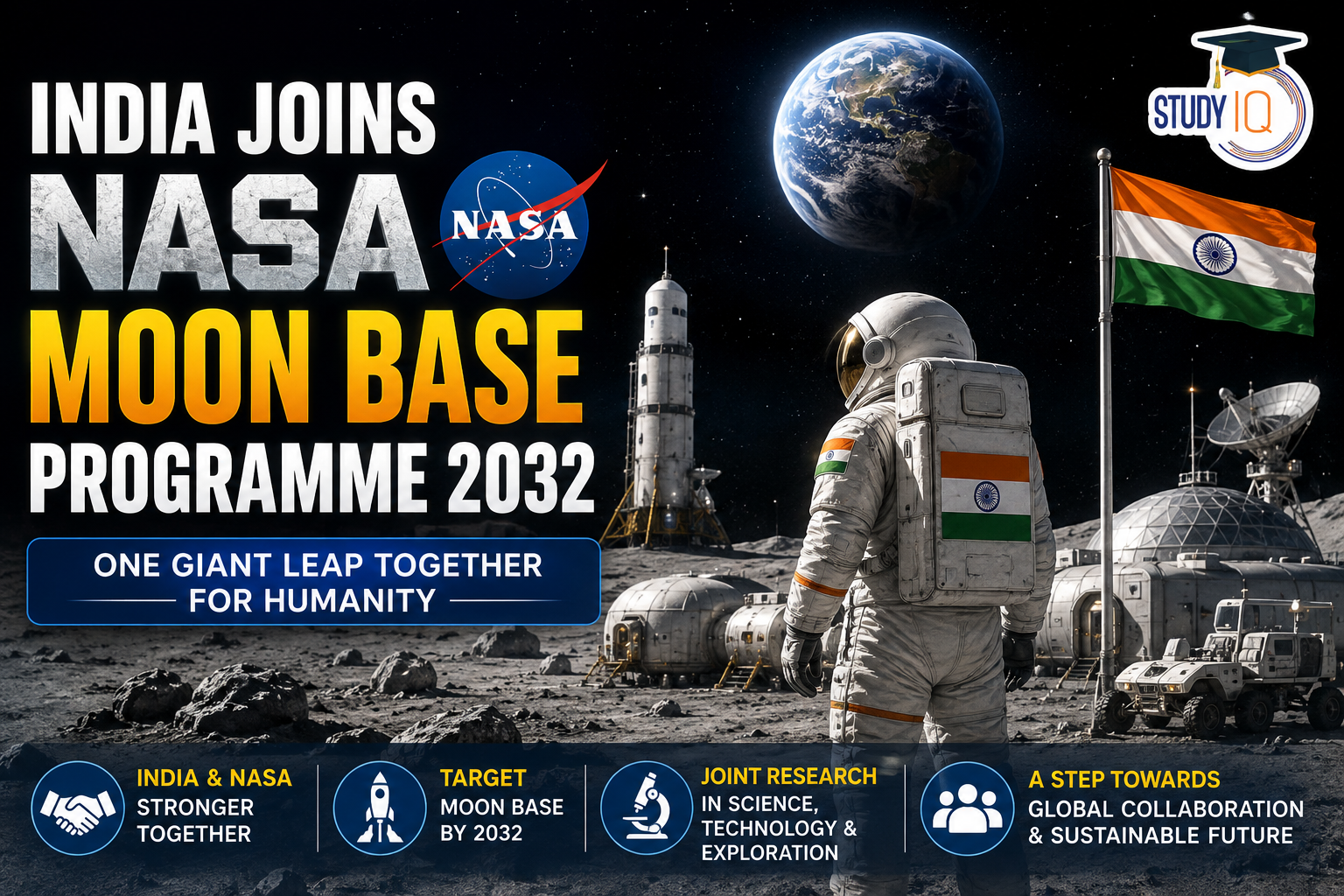
India’s possible participation in NASA Moon Base Programme could mark a significant transition in the country’s space journey—from conducting independent lunar missions to participating in developing sustainable lunar infrastructure. The initiative is particularly important as India simultaneously pursues Gaganyaan, the Bharat Antariksh Station, Chandrayaan missions and long-term human lunar exploration.
For India, the opportunity is not merely about reaching the Moon. It concerns technology, strategic autonomy, scientific diplomacy, the space economy and India’s role in shaping the emerging rules of lunar exploration.
Read Also: UPSC Daily Current Affairs 2026
What is NASA Moon Base Programme?
NASA’s lunar exploration architecture seeks to move beyond short-duration missions towards a sustained human and robotic presence on the Moon. The proposed infrastructure would support scientific research, technological demonstrations and potentially the utilisation of lunar resources.
A permanent or semi-permanent lunar presence requires advanced capabilities in life-support systems, robotics, precision landing, communications, power generation, habitation and resource utilisation.
Given the enormous costs and technological risks involved, international and commercial partnerships are central to this emerging model of lunar exploration.
Why Does India’s Participation Matter?
1. Technology Leapfrogging
The greatest advantage for India would be accelerated technological learning. Participation in complex lunar missions can provide experience in deep-space operations, autonomous robotics, lunar mobility, advanced communication, life-support systems and precision landing.
Developing every such capability independently would require enormous financial resources and time. International cooperation can therefore help India leapfrog technological stages while continuing to strengthen indigenous capabilities.
2. Strengthening Gaganyaan and Human Spaceflight
India’s Gaganyaan programme aims to demonstrate indigenous human spaceflight capability. However, lunar missions involve substantially greater challenges than missions in low-Earth orbit.
Experience with crew safety, long-duration habitation, space medicine, autonomous systems and deep-space operations could strengthen India’s future human-spaceflight capabilities.
It can create a technological pathway:
Gaganyaan → Bharat Antariksh Station → Lunar missions → Deep-space exploration
3. Supporting Bharat Antariksh Station
India’s proposed Bharat Antariksh Station will require expertise in orbital docking, crew management, life-support systems and long-duration habitation.
Participation in an international lunar programme could expose Indian scientists and engineers to large-scale space infrastructure and international mission coordination, thereby complementing India’s own space-station ambitions.
4. Boost to India’s Space Economy
A major lunar programme can generate opportunities for India’s growing private space sector.
Indian companies could contribute to:
- Robotics and autonomous systems
- Sensors and electronics
- Propulsion
- Advanced materials
- Communication systems
- Navigation
- Artificial intelligence
- Satellite and launch technologies
Thus, lunar exploration can have wider economic spillovers through innovation, investment, skilled employment and advanced manufacturing.
5. Scientific Benefits
The Moon provides a unique laboratory for understanding the early Solar System. India could participate in research on lunar geology, regolith, water ice, solar radiation, space weather and planetary science.
The lunar south polar region is particularly significant because permanently shadowed areas may contain water ice. Future technologies could potentially use such resources to support sustained lunar operations.
6. Strengthening India-US Relations
Space has emerged as an important component of India-US strategic cooperation. Greater collaboration in lunar exploration can deepen technological and scientific ties between the two countries.
At the same time, India’s participation should remain consistent with its broader foreign-policy principle of strategic autonomy. Cooperation with the US need not prevent India from maintaining space partnerships with Russia, Europe, Japan and other countries.
Artemis Accords and India
India joined the Artemis Accords in 2023, becoming an important participant in the emerging international framework for lunar exploration.
The Accords promote principles including peaceful exploration, transparency, interoperability, emergency assistance, scientific cooperation and responsible space-resource activities.
For India, participation provides an opportunity to contribute to the evolving norms governing lunar exploration.
However, India should ensure that the development of lunar resources remains consistent with the broader principles of international space law, particularly the Outer Space Treaty, 1967.
Challenges for India
Despite the potential benefits, India must address several concerns.
- First, strategic dependence: Cooperation should not result in excessive dependence on foreign technologies, standards or supply chains.
- Second, financial sustainability: India has multiple priorities, including Gaganyaan, Bharat Antariksh Station, Chandrayaan missions and advanced launch vehicles. Resources must therefore be allocated carefully.
- Third, technology access: Participation should involve meaningful scientific collaboration, industrial opportunities, training and knowledge sharing rather than merely symbolic involvement.
- Fourth, governance of lunar resources: India should support transparent and inclusive rules to prevent competition over lunar resources from becoming a source of geopolitical conflict.
Way Forward
India should follow a “cooperation without dependence” approach.
It should:
- Continue investing in indigenous space technologies.
- Use international partnerships to accelerate technological development.
- Increase private-sector participation in lunar missions.
- Strengthen universities and research institutions involved in space science.
- Promote sustainable and peaceful lunar resource utilisation.
- Maintain partnerships with multiple space powers to preserve strategic autonomy.
Conclusion
India’s participation in NASA’s Moon Base Programme could be a significant milestone in its transformation from a successful spacefaring nation into a major global space power.
The real opportunity lies not simply in reaching the Moon but in acquiring capabilities in human spaceflight, lunar infrastructure, robotics, resource utilisation and space diplomacy.
For India, the guiding principle should be clear:
International partnerships should accelerate indigenous capabilities, not replace them.
By combining global cooperation with technological self-reliance, India can use the lunar opportunity to strengthen its space economy, scientific capabilities and strategic position while contributing to the peaceful and sustainable exploration of outer space.
 US Treasury Yields at 25-Year High: Impa...
 National Coastal Mission 2.0 (NCM 2.0): ...
 New CAFE Norms 2027–32: Key Features, ...














 WhatsApp