Table of Contents
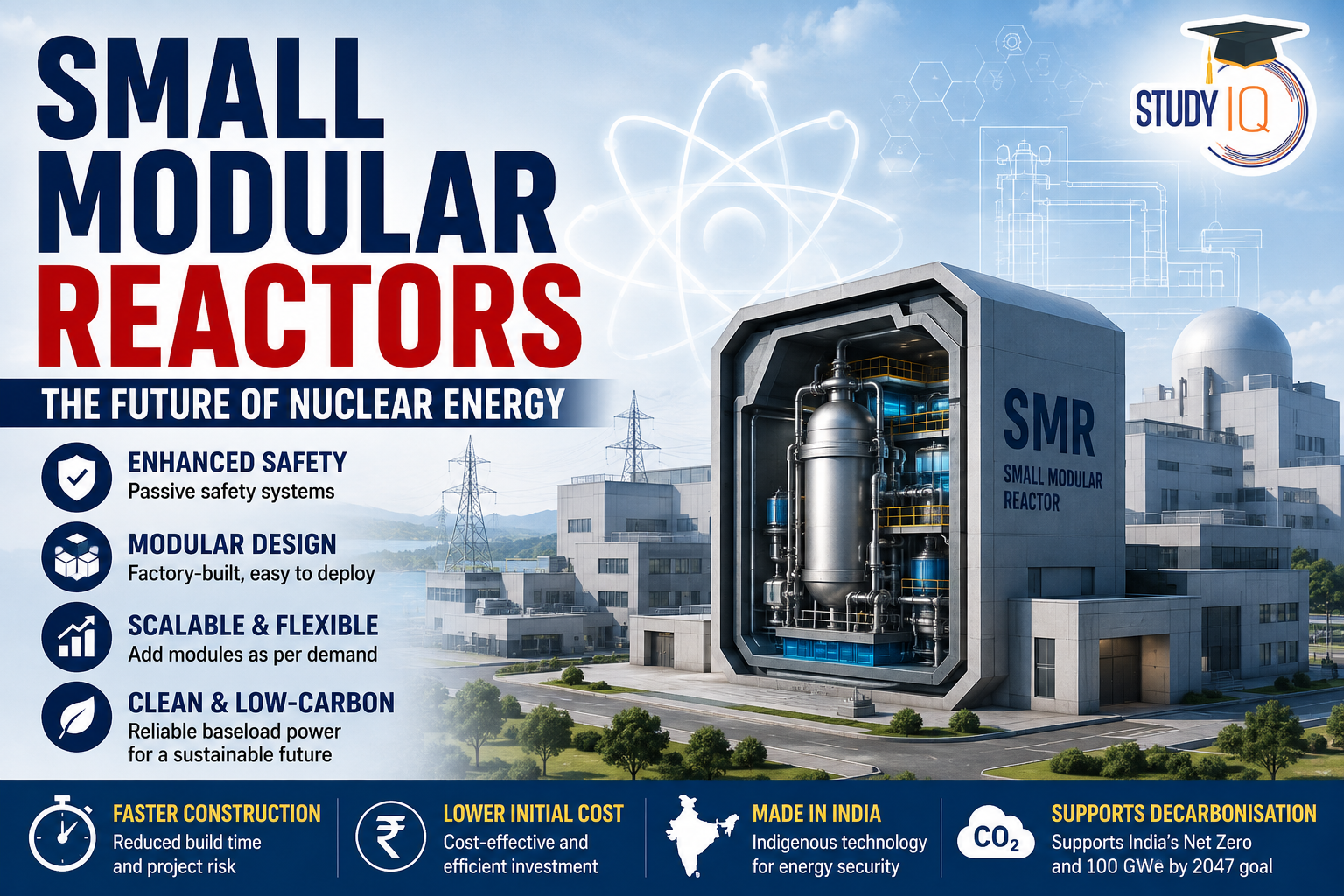
Under the Nuclear Energy Mission, the Government of India aims to develop and operationalise at least five indigenous Small Modular Reactors (SMRs) by 2033. This initiative is part of India’s broader ambition to expand nuclear power capacity to 100 GWe by 2047 and strengthen long-term energy security and decarbonisation.
What are Small Modular Reactors?
Small Modular Reactors (SMRs) are advanced nuclear reactors designed with relatively lower power output, smaller physical footprints and modular construction compared with conventional large-scale nuclear power plants.
The International Atomic Energy Agency (IAEA) generally categorises SMRs as reactors with an electrical capacity of up to 300 MWe per unit.
Unlike conventional nuclear plants that are generally built as very large, site-specific projects, SMRs are designed to allow greater standardisation, factory-based manufacturing and modular deployment.
India’s Indigenous SMR Programme
India is developing indigenous SMR technologies under the Department of Atomic Energy (DAE), with the Bhabha Atomic Research Centre (BARC) playing a major role in reactor design and technological development.
The programme seeks to leverage India’s existing expertise in nuclear technology while creating reactor designs suited to India’s energy requirements, industrial applications and diverse geographical conditions.
Legislative Framework: SHANTI Act, 2025
The development and deployment of SMRs is expected to receive greater institutional support under the SHANTI Act, 2025, which provides a framework for increased private-sector participation in the nuclear sector, including nuclear technology manufacturing and deployment.
This can potentially expand investment, domestic manufacturing capabilities and innovation in India’s nuclear ecosystem.
Key Features of SMRs
1. Smaller Power Capacity
SMRs generally produce considerably less electricity per reactor than conventional gigawatt-scale nuclear power plants. This makes them suitable for locations where a large nuclear plant may not be technically or economically feasible.
2. Passive Safety Systems
Many SMR designs incorporate passive safety mechanisms, including natural circulation and gravity-driven cooling systems. These systems can help remove residual heat without relying entirely on active pumps or external power.
3. Modular Construction
SMRs are designed around standardised modules that can potentially be manufactured in controlled factory environments and transported to the installation site.
This approach could reduce construction delays and improve quality control.
4. Lower Initial Capital Requirement
Because SMRs are smaller units, the initial investment required for a single module can be lower than that required for a conventional large nuclear power plant.
However, their overall cost competitiveness will depend on manufacturing scale, financing costs, regulatory requirements and deployment experience.
5. Scalable Deployment
SMRs can potentially be deployed progressively. Additional modules can be added as electricity demand increases, allowing greater flexibility in capacity expansion.
6. Smaller Land Footprint
Their smaller size can reduce the land requirement associated with individual generating units compared with large conventional nuclear plants, although the total site requirements depend on the reactor design and supporting infrastructure.
7. Industrial Applications
SMRs are not limited to electricity generation. Nuclear heat can potentially support desalination, district heating, hydrogen production and industrial processes, making them relevant to India’s wider clean-energy transition.
Why are SMRs Important for India?
India faces the twin challenge of meeting rapidly growing energy demand while reducing dependence on fossil fuels.
SMRs could contribute to this transition by providing reliable, low-carbon baseload electricity alongside renewable energy.
They may also be particularly relevant for:
- Decarbonising energy-intensive industries
- Providing reliable electricity to industrial clusters
- Supporting hydrogen production
- Reducing dependence on coal-based power
- Strengthening energy security
- Complementing variable renewable energy sources
- Expanding nuclear capacity through phased deployment
SMRs vs Conventional Nuclear Reactors
| Feature | SMRs | Conventional Nuclear Plants |
|---|---|---|
| Typical unit size | Up to 300 MWe | Generally much larger |
| Construction approach | Modular/standardised | Large site-specific projects |
| Initial investment | Potentially lower per module | Very high |
| Deployment | Progressive | Large-scale installation |
| Safety | Greater use of passive systems in many designs | Mix of active and passive systems |
| Land requirement | Generally smaller per unit | Larger |
| Industrial applications | Electricity + heat potential | Primarily electricity, depending on plant |
| Scalability | High | Relatively lower |
Challenges Associated with SMRs
Despite their potential, SMRs are not a technological shortcut to inexpensive nuclear power. Several challenges remain:
- Economic viability: Smaller reactors may have lower upfront capital requirements, but their cost per unit of electricity can be affected by economies of scale.
- Regulatory approval: New reactor designs require rigorous safety assessment and licensing.
- Waste management: SMRs will still generate radioactive waste that requires safe handling, storage and disposal.
- Fuel requirements: Some advanced designs may require specialised fuel supply chains.
- Manufacturing ecosystem: The economic advantage of modular construction depends on achieving sufficient production volumes and standardisation.
- Public acceptance: Nuclear projects require sustained public confidence regarding safety, environmental impacts and emergency preparedness.
Way Forward
India’s SMR strategy should focus on indigenous technology development, strong regulatory oversight, domestic manufacturing, fuel security and transparent safety standards.
A successful SMR ecosystem can also create opportunities for Indian engineering and manufacturing industries by integrating nuclear technology with the broader Make in India and clean-energy transition.
Read Also: UPSC Daily Current Affairs 2026
 Gandhi Jayanti 2026: History, Significan...
 Right to Vote in India: Constitutional S...
 Daily Mains Articles 2026 – Updated Da...













 WhatsApp