Table of Contents
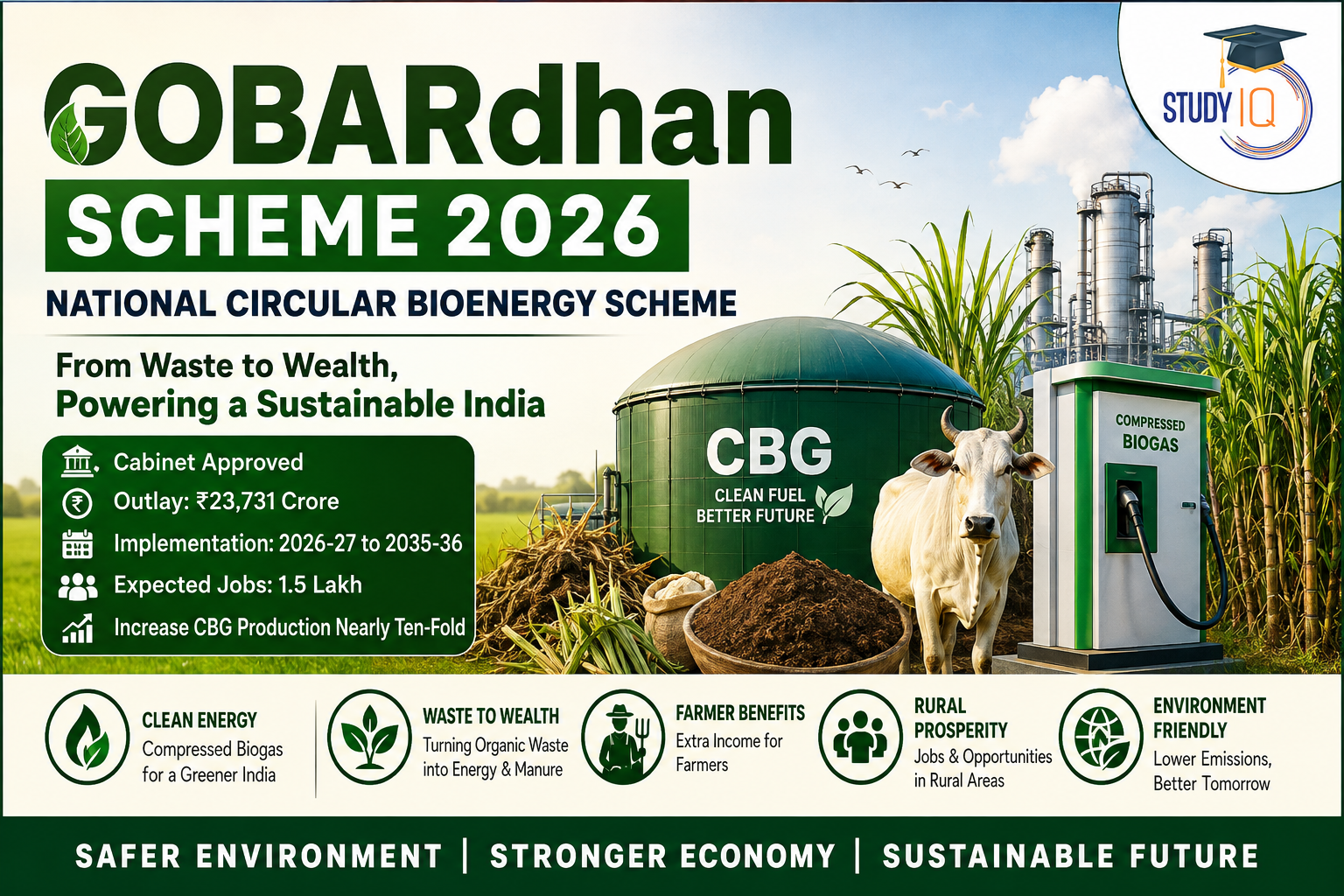
The Union Cabinet, chaired by Prime Minister Narendra Modi, has approved the GOBARdhan (Galvanizing Organic Bio-Agro Resources Dhan) – National Circular Bioenergy Scheme with a total financial outlay of ₹23,731 crore. The scheme, which will be implemented from FY 2026–27 to FY 2035–36, aims to transform organic waste into clean energy, promote rural livelihoods, strengthen India’s energy security, and accelerate the country’s transition to a circular bioeconomy.
Described by the government as a “defining moment in India’s clean energy journey,” the scheme is expected to increase domestic Compressed Biogas (CBG) production nearly ten-fold, generate 1.5 lakh jobs, mobilize significant private investment, and reduce dependence on imported fossil fuels.
What is the GOBARdhan Scheme?
The GOBARdhan Scheme is a flagship national initiative designed to convert organic waste into valuable resources through a Waste-to-Wealth approach.
The scheme promotes the production and use of Compressed Biogas (CBG) by utilizing agricultural residue, cattle dung, municipal organic waste, press mud, food waste, and other biomass. Alongside renewable energy generation, it also supports the production of organic manure, helping improve soil health and sustainable agriculture.
The scheme is implemented by the Ministry of Petroleum and Natural Gas (MoPNG) and integrates several existing bioenergy initiatives under one comprehensive framework.
Full Form of GOBARdhan
GOBARdhan stands for:
Galvanizing Organic Bio-Agro Resources Dhan
The scheme embodies the vision of converting organic waste into economic wealth while promoting environmental sustainability.
GOBARdhan Scheme 2026 Overview
| Particular | Details |
|---|---|
| Scheme Name | GOBARdhan – National Circular Bioenergy Scheme |
| Approved By | Union Cabinet |
| Financial Outlay | ₹23,731 crore |
| Implementation Period | FY 2026–27 to FY 2035–36 |
| Nodal Ministry | Ministry of Petroleum & Natural Gas |
| Primary Objective | Promote Compressed Biogas (CBG) production |
| Expected Jobs | Around 1.5 lakh |
| Key Beneficiaries | Farmers, MSMEs, Cooperatives, Entrepreneurs, Urban Local Bodies |
Objectives of the GOBARdhan Scheme
The scheme seeks to achieve multiple economic, environmental, and energy-related objectives.
Increase Domestic CBG Production
The government aims to increase India’s production of Compressed Biogas nearly ten-fold, making CBG an important component of India’s future energy mix.
Strengthen Energy Security
Greater domestic production of renewable gaseous fuel will reduce India’s dependence on imported natural gas and fossil fuels.
Convert Waste into Wealth
Agricultural residue, cattle dung, municipal organic waste, press mud, and other biomass will be scientifically processed into clean energy and organic manure.
Increase Farmers’ Income
Farmers will receive additional income by supplying agricultural residues and biomass to CBG plants.
Promote Rural Entrepreneurship
The scheme encourages MSMEs, cooperatives, startups, and private companies to establish bioenergy projects in rural India.
Achieve Climate Goals
The initiative supports India’s climate commitments by reducing greenhouse gas emissions, promoting clean fuels, minimizing stubble burning, and encouraging sustainable waste management.
Promote Circular Economy
Organic waste generated from agriculture, industries, and urban areas will be recycled into productive resources, reducing landfill waste while creating economic opportunities.
Key Features of the GOBARdhan Scheme
1. Assured CBG Offtake
The government has introduced a guaranteed procurement mechanism for Compressed Biogas.
City Gas Distribution (CGD) entities will purchase CBG to meet mandatory blending obligations.
CBG Blending Targets
| Financial Year | Blending Target |
|---|---|
| FY 2026–27 | 3% |
| FY 2027–28 | 4% |
| FY 2028–29 onwards | 5% |
Guaranteed offtake improves project viability and encourages investment.
2. Stable Pricing Mechanism
To provide long-term certainty, the government has fixed a price cap of ₹2,110 per MMBTU.
Benefits include:
- Stable revenues
- Improved investor confidence
- Predictable returns
- Affordable fuel supply
The pricing mechanism will remain valid for 10 years.
3. Capital Financial Assistance
The scheme provides financial support for establishing and expanding CBG plants.
Eligible assistance includes:
- Up to ₹2 crore per TPD (Tonnes Per Day) of installed CBG capacity
- Feedstock aggregation infrastructure
- Organic manure processing
- Value addition facilities
- Expansion of existing projects
4. Pipeline Infrastructure Development
Financial assistance will also support pipeline connectivity between CBG plants and:
- Trunk gas pipelines
- City Gas Distribution (CGD) networks
This will reduce transportation costs and improve market access.
5. Credit Guarantee Scheme
A dedicated Credit Guarantee Scheme will improve access to institutional finance, particularly for MSMEs and first-time entrepreneurs.
It aims to:
- Reduce collateral requirements
- Encourage bank lending
- Support women entrepreneurs
- Promote private investment
6. CBG Ecosystem Challenge Fund
A district-level Challenge Fund will strengthen the bioenergy ecosystem by supporting:
- Feedstock mapping
- Biomass aggregation
- Technology adoption
- Capacity building
- Organic manure value addition
- Awareness programmes
Existing Schemes Integrated under GOBARdhan
The GOBARdhan Scheme consolidates several existing government initiatives, including:
- SATAT (Sustainable Alternative Towards Affordable Transportation)
- Market Development Assistance (MDA) Scheme
- Biomass Aggregation Machinery (BAM) Scheme
- Development of Pipeline Infrastructure (DPI) Scheme
- National Bioenergy Programme (Central Financial Assistance)
Together, these initiatives have already supported the establishment of more than 200 Compressed Biogas plants across India.
Expected Benefits of the GOBARdhan Scheme
Energy Security
- Nearly ten-fold increase in domestic CBG production
- Reduced dependence on imported natural gas
- Greater use of renewable gaseous fuels
Rural Development
- Additional income for farmers
- Around 1.5 lakh employment opportunities
- Growth of rural enterprises and MSMEs
Environmental Benefits
- Better management of agricultural residue
- Reduced stubble burning
- Scientific disposal of municipal organic waste
- Lower greenhouse gas emissions
- Cleaner villages and cities
Agriculture
- Increased production of organic manure
- Improved soil fertility
- Reduced dependence on chemical fertilizers
Investment Promotion
- Stable policy framework
- Guaranteed market access
- Easier financing
- Higher private sector participation
Significance of the Scheme
The GOBARdhan Scheme aligns with India’s broader goals of:
- Energy independence
- Circular economy
- Sustainable agriculture
- Rural prosperity
- Waste management
- Climate resilience
- Green growth
- Net Zero emissions by 2070
By converting waste into valuable economic resources, the scheme supports both environmental conservation and inclusive economic development.
Challenges
Despite its ambitious vision, the scheme faces several implementation challenges:
- Efficient biomass collection and aggregation
- High transportation and logistics costs
- Availability of advanced bioenergy technologies
- Timely financial assistance
- Pipeline connectivity in remote regions
- Coordination among central and state governments
- Long-term operation and maintenance of CBG plants
Addressing these issues will be critical for the scheme’s long-term success.
Way Forward
To maximize the benefits of the GOBARdhan Scheme, India should:
- Strengthen biomass supply chains.
- Expand gas pipeline infrastructure.
- Promote research and innovation in bioenergy technologies.
- Encourage private investment through policy stability.
- Build awareness among farmers and local bodies.
- Improve market linkages for organic manure.
- Enhance coordination among ministries, states, and private stakeholders.
Successful implementation can make India a global leader in circular bioenergy while delivering sustainable growth, cleaner energy, and improved rural livelihoods.
Read Also: UPSC Daily Current Affairs 2026
 WMO State of Global Water Resources 2025...
 FCRA Amendment Bill 2026: Key Provisions...
 World Rhino Day 2026: 22 September, Them...












 WhatsApp