
Table of Contents
Context
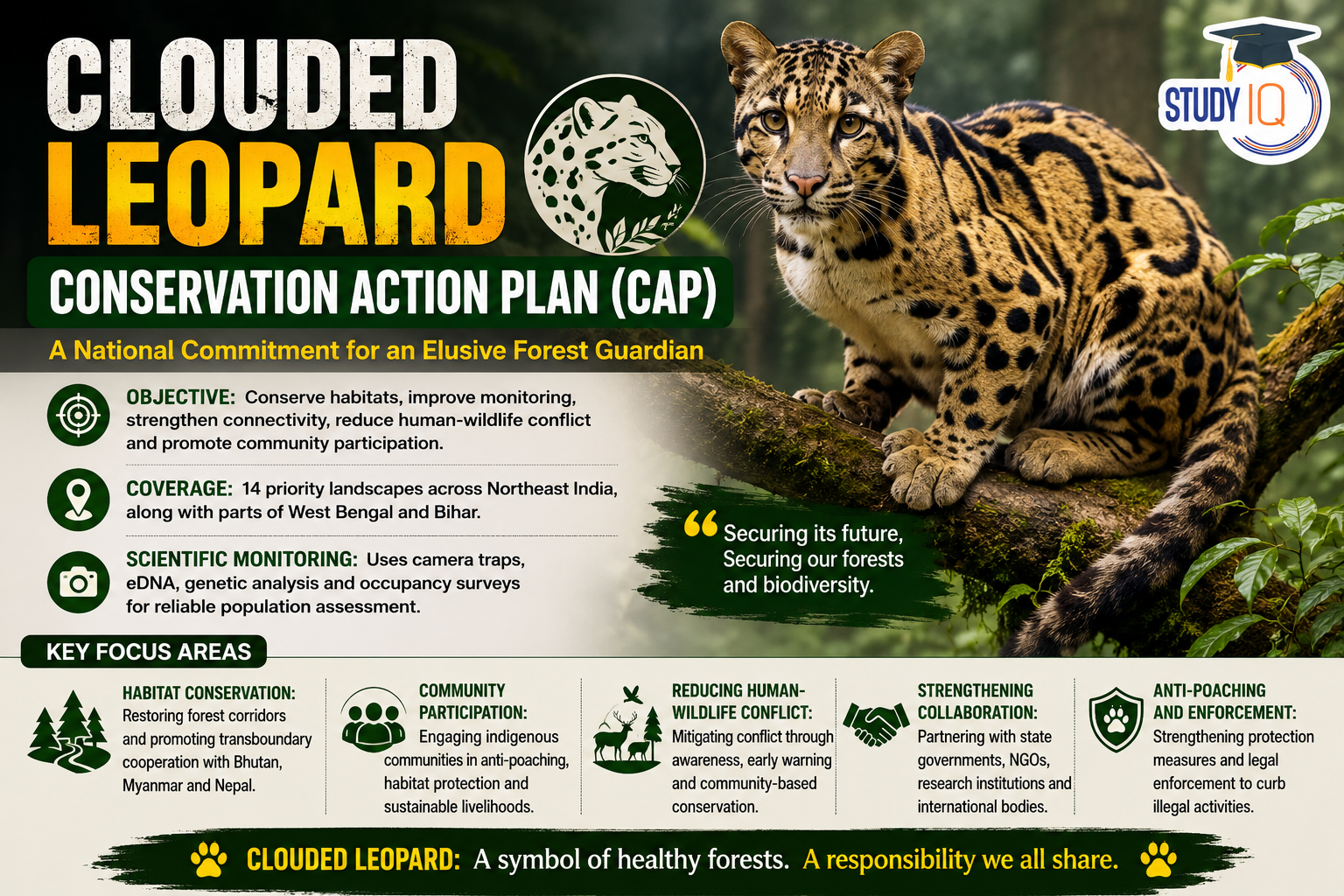
The Ministry of Environment, Forest and Climate Change (MoEFCC) launched the Clouded Leopard Conservation Action Plan (CAP) on International Clouded Leopard Day.
About Clouded Leopard Conservation Action Plan (CAP)
- Nature: The Clouded Leopard Conservation Action Plan (CAP) is a national conservation strategy for the long-term protection of the Clouded Leopard and its habitats in India.
- Objective: To conserve critical habitats, improve scientific population monitoring, strengthen ecological connectivity, reduce human-wildlife conflict, and promote community participation.
- Coverage: Focuses on 14 priority landscapes across Northeast India, along with parts of West Bengal and Bihar.
- Scientific Monitoring: Promotes standardized population assessment using camera traps, environmental DNA (eDNA), genetic analysis, and occupancy surveys to establish reliable population estimates.
- Habitat Conservation: Emphasises restoration of forest corridors connecting fragmented habitats and encourages transboundary cooperation with neighbouring range countries such as Bhutan, Myanmar, and Nepal.
- Community Participation: Involves indigenous communities in anti-poaching efforts, habitat conservation, and livelihood initiatives to reduce dependence on forest resources.
About Clouded Leopard
- Nature: The Clouded Leopard is a medium-sized wild cat native to the forests of South and Southeast Asia and represents an ancient evolutionary lineage of felids.
- Distribution: It occurs from Nepal, Bhutan, Bangladesh, and Northeast India to southern China and Southeast Asia, inhabiting tropical rainforests, foothill forests, mangroves, and dry woodlands.
- Conservation Status:IUCN Red List – Vulnerable; protected under Schedule I of the Wildlife (Protection) Act, 1972.
- Arboreal Adaptations: Possesses highly flexible ankle joints, powerful limbs, large paws, and a long tail, enabling exceptional tree-climbing abilities, including descending tree trunks headfirst.
- Physical Characteristics: Recognised by its cloud-shaped dark markings and the largest canine teeth relative to skull size among living wild cats.
- Vocalisation: Cannot roar like large cats or purr continuously like small cats, producing sounds such as growls, hisses, and chuffs.
Read Also: UPSC Daily Current Affairs 2026
 World Pharmacists Day 2026: Date, Theme,...
 UPSC EPFO Exam Strategy 2026: Complete 3...
 Census Town in India: Criteria, Meaning ...














 WhatsApp





