Table of Contents
Context
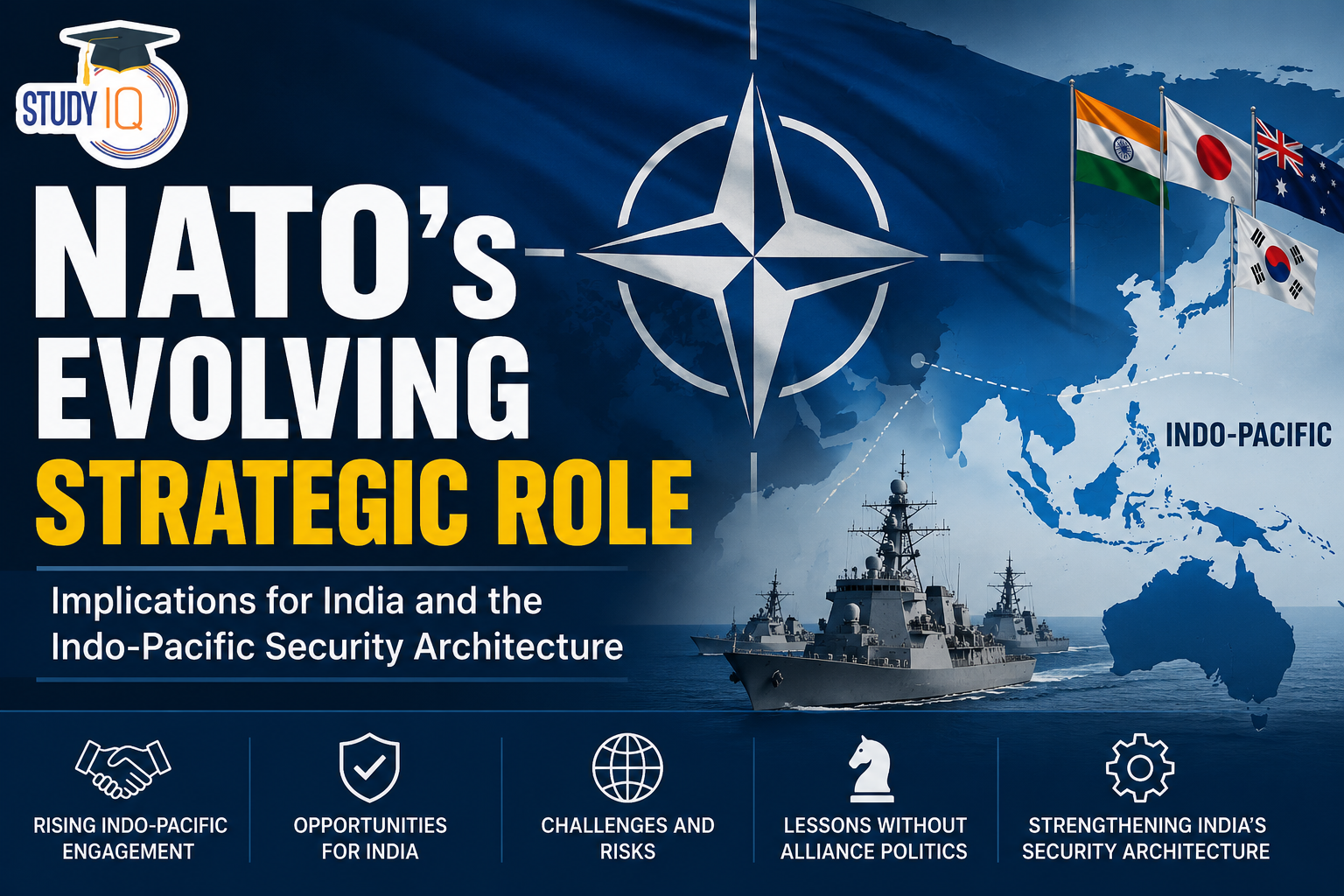
As the United States shifts its strategic focus to the Indo-Pacific, NATO is redefining its role through greater European defence responsibility and increased engagement with the Indo-Pacific, carrying important implications for India’s regional strategy and security architecture.
How does NATO’s Indo-Pacific outreach affect India’s vision of a free, open and inclusive Indo-Pacific?
Positive Impacts
- Elevates the Indo-Pacific as a Global Strategic Theatre: NATO’s growing attention has brought greater international focus to Indo-Pacific security, strengthening diplomatic support for a stable regional order.
- Example:NATO’s 2022 Strategic Concept recognised the Indo-Pacific’s strategic importance.
- Deepens India’s Engagement with European Powers: NATO’s outreach has encouraged European countries to strengthen their Indo-Pacific presence, creating new opportunities for India’s bilateral and minilateral cooperation.
- Example: India has expanded maritime and defence cooperation with France, the UK and Germany.
- Encourages Cooperation in Emerging Security Domains: NATO’s experience in cyber security, critical infrastructure resilience and emerging technologies provides useful institutional practices for India.
- Example: NATO has prioritised cyber defence and resilience in recent strategic initiatives.
- Promotes Greater International Support for Maritime Security: Growing European interest in secure sea lanes complements India’s efforts to maintain stability in the Indian Ocean through cooperative security.
- Example: European countries participate in anti-piracy operations in the Gulf of Aden, supporting secure maritime trade.
- Broadens Strategic Dialogue on Indo-Pacific Challenges: NATO’s outreach has expanded discussions on maritime security, supply chains and technology among like-minded countries, indirectly benefiting India’s strategic engagement.
- Example: NATO’s dialogue with the Indo-Pacific Four (IP4) has increased attention to regional security issues.
Negative Impacts
- Challenges India’s Inclusive Indo-Pacific Vision: NATO’s alliance-based approach contrasts with India’s preference for an inclusive, ASEAN-led regional architecture rather than bloc politics.
- Example: India’s IPOI and support for AOIP emphasise openness and inclusivity.
- Intensifies Great Power Rivalry: Greater NATO engagement may sharpen US-China competition, increasing geopolitical tensions in the region.
- Example: China has criticised NATO’s Indo-Pacific engagement as promoting an “Asian NATO.”
- Reinforces India’s Exclusion from NATO’s Regional Framework: NATO’s institutional engagement centres on the Indo-Pacific Four (IP4), while India prefers independent minilateral platforms under strategic autonomy.
- Example: India prioritises the Quad and India-France-UAE trilateral over formal NATO-led mechanisms.
- Accelerates Russia-China Strategic Convergence: NATO’s expanding strategic focus may push Russia closer to China, reducing India’s strategic flexibility in Eurasia and affecting defence cooperation.
- Example: The Russia-China “no limits” partnership (2022) has deepened amid tensions with the West.
- Limits NATO’s Long-Term Indo-Pacific Role: NATO’s primary responsibility remains Euro-Atlantic security, making its Indo-Pacific commitment secondary during crises in Europe.
- Example: The Ukraine war has remained NATO’s principal strategic priority despite its Indo-Pacific outreach.
What lessons can India’s security architecture draw from NATO’s institutional evolution without adopting alliance politics?
- Anchor Defence Reforms in a National Security Strategy: Joint commands require a common strategic direction to align priorities across the armed forces and ministries. A formal National Security Strategy (NSS) can provide this institutional guidance.
- Example: NATO’s Strategic Concept provides a common strategic framework for member states.
- Strengthen Intelligence Coordination through Institutional Incentives: Intelligence fusion should be backed by clear accountability and mandatory information-sharing to overcome agency silos.
- Example: NATO’s Intelligence Fusion Centre (IFC) supports coordinated threat assessment.
- Reform Defence Procurement to Accelerate Innovation: Innovation must be complemented by faster procurement, simplified trials and timely induction of indigenous technologies.
- Example: NATO’s DIANA complements innovation with pathways for capability development.
- Build Integrated Civil-Military Decision-Making: National security requires coordinated action across defence, diplomacy, internal security and economic ministries during crises.
- Example: NATO’s Comprehensive Approach integrates civilian and military institutions.
- Institutionalise Jointness through Permanent Structures: Integrated planning, logistics and operations should become routine rather than crisis-driven, improving military effectiveness. Example: NATO’s Integrated Military Command institutionalises joint operations.
Read Also: UPSC Daily Current Affairs 2026
 World Pharmacists Day 2026: Date, Theme,...
 UPSC EPFO Exam Strategy 2026: Complete 3...
 Census Town in India: Criteria, Meaning ...














 WhatsApp