
Table of Contents
Context
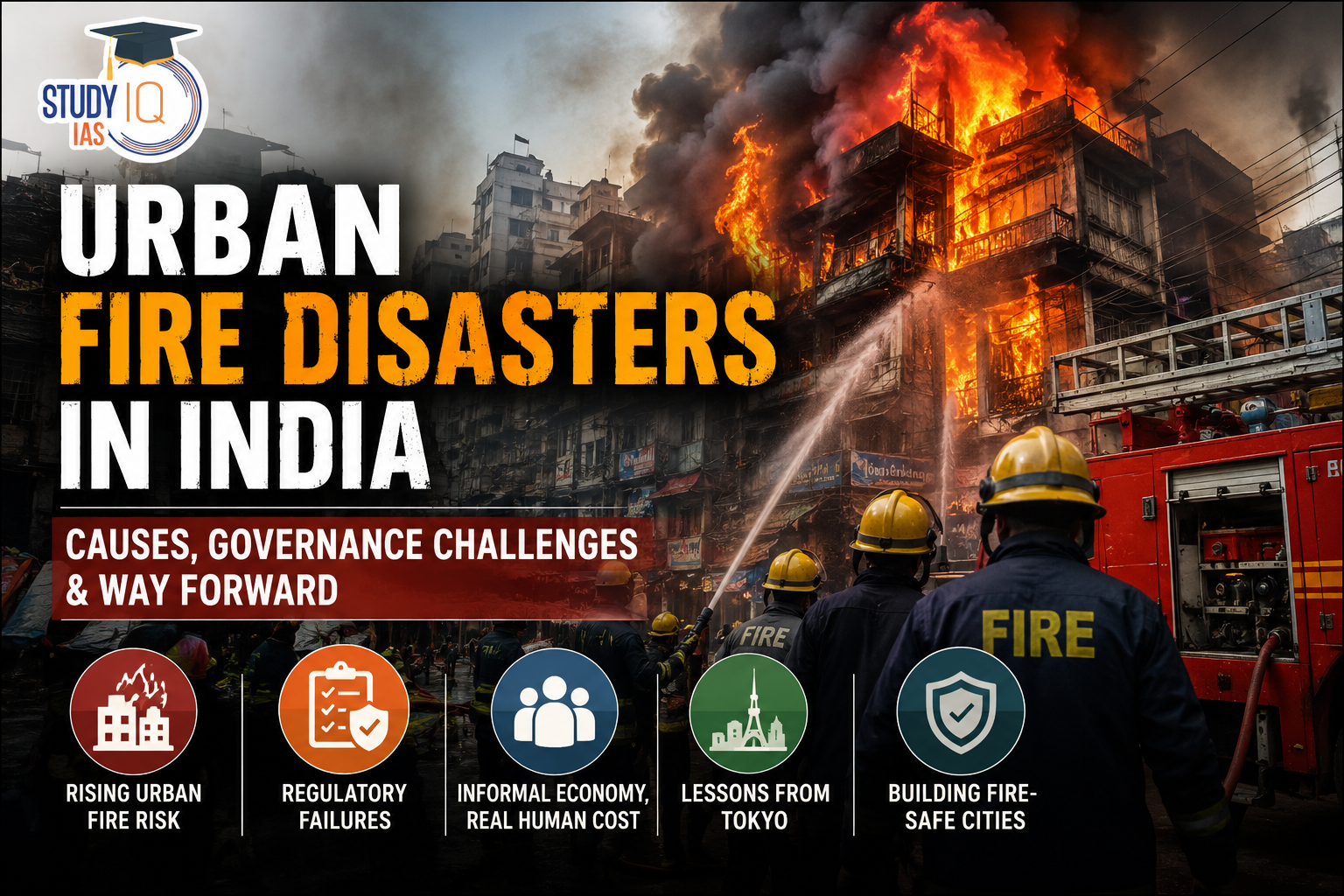
Recent urban fire incidents in Lucknow and Delhi demonstrate that recurring fire disasters are rooted in structural weaknesses in urban governance, particularly poor enforcement, unauthorized construction, and limited municipal capacity.
How has the nature of urban fire disasters evolved into a governance problem?
- Risk Transformation: Rapid urbanisation has created dense, high-rise, and mixed-use buildings, where complex fire risks exceed the assumptions of outdated fire safety codes, making urban fires a systemic challenge rather than isolated accidents.
- Example: The 2019 Anaj Mandi fire (Delhi) killed 43 workers in a factory-cum-warehouse where combustible materials, residential use, and a single narrow staircase exposed the inadequacy of existing fire safety norms.
- Regulatory Non-Compliance: Owners increasingly make illegal occupancy changes, unauthorized floor additions, and block escape routes to maximize profits, turning violations into a systemic problem.
- Example: The 2019 Surat coaching centre fire killed 22 students after a commercial building was illegally converted into an educational institution without the required fire safety approvals.
- Enforcement Capacity Gap: Widespread regulatory violations overwhelm inspection, certification, and audit systems, making fire safety enforcement a capacity challenge rather than just a technical one.
- Emergency Accessibility Failure: As unsafe buildings continue to operate, congested roads, encroachments, and inadequate firefighting infrastructure delay emergency response, increasing casualties.
- Example: During the 2022 Mundka fire (Delhi), narrow approach roads delayed fire tenders from reaching the illegally converted building, contributing to the loss of 27 lives.
- Institutional Fragmentation: Divided responsibilities among multiple agencies weaken accountability, delaying reforms and making urban fire safety a persistent governance challenge.
- Example: After the Uphaar Cinema fire, legal proceedings lasted over two decades as responsibility was shared across multiple agencies, highlighting how fragmented institutional mandates hinder accountability.
Why are repeated fire disasters emerging as the hidden cost of India’s informal urban economy?
- Cost Minimisation Logic: Informal enterprises operating on thin profit margins often cut spending on fire safety to reduce costs, embedding fire risk into their business model.
- Example: The 2018 Bawana fire (Delhi) killed 17 workers in an illegal firecracker packaging unit that lacked licensed storage and proper ventilation, removing key safeguards against fire.
- Regulatory Invisibility: To avoid licensing and compliance costs, many enterprises remain unregistered or under-report their operations, escaping inspections and allowing unsafe practices to continue.
- Labour Concentration: As unregulated units escape occupancy and land-use checks, they overcrowd workers in premises used as both factories and dormitories, turning fires into mass-casualty incidents.
- Cost Externalisation: As overcrowded workplaces often employ workers without formal contracts or insurance, the economic and human costs of fires fall on workers and their families, while owners avoid the consequences of unsafe practices.
- Weak Corrective Incentives: As businesses profit from cutting safety costs while facing limited penalties, there is little incentive to improve fire safety, allowing the same hazardous practices to persist across the informal urban economy.
Why do cities like Tokyo experience far fewer catastrophic urban fires despite comparable urban density?
- Design-Stage Risk Absorption: Tokyo integrates fire safety into building design through fire-resistant materials, compartmentalisation, and mandatory firebreaks, reducing fire risk before construction.
- Example: After the 1923 Great Kantō Earthquake triggered devastating urban fires, Japan mandated fire-resistant materials and created firebreak zones in dense wooden-house areas, limiting the spread of fires.
- Continuous Compliance Enforcement: Japan treats fire safety as a continuous responsibility by requiring periodic inspections and certification, making non-compliance an ongoing legal liability rather than a one-time violation.
- Example: Under Japan’s Fire Service Act, owners of eligible buildings must regularly submit fire safety inspection reports, with penalties for non-compliance.
- Distributed Early Detection: Regular maintenance ensures alarms, sprinklers, and detection systems remain functional, enabling fires to be detected early and contained before they spread.
- Example: Tokyo’s automatic fire alarm systems, linked directly to fire department dispatch centres, help achieve average response times of 6–7 minutes, enabling early intervention.
- Response Infrastructure Matching: As fires are detected early, Tokyo uses firefighting infrastructure suited to its dense urban layout, ensuring rapid access even through narrow streets.
- Example: The Tokyo Fire Department deploys motorcycle-mounted pump units to reach fires in narrow lanes where conventional fire engines cannot operate.
- Institutional Learning Loop: Early containment enables accurate investigation of fire causes, allowing lessons from each major fire to strengthen regulations and improve future fire safety.
- Example: The 1972 Sennichi Department Store fire, which killed 118 people, led to amendments to Japan’s Fire Service Act, making sprinklers and emergency lighting mandatory in high-rise buildings.
Way Forward
- Establish a Uniform National Fire Safety Framework: Replace fragmented state-level regulations with a legally enforceable national fire safety code that prescribes uniform standards for prevention, inspection and emergency preparedness across all urban areas.
- Institutionalise Digital Third-Party Fire Audits: Mandate annual independent fire safety audits for commercial and public buildings, with reports uploaded to a digital public portal. Renewal of trade licences, occupancy certificates and insurance should be contingent upon compliance.
- Promote Fire-Resilient Building Design: Require compartmentalisation of large buildings through fire-rated walls and doors to confine fire and smoke within designated zones, providing critical time for evacuation and firefighting operations.
- Strengthen Smoke Management Systems: Make automated smoke extraction and mechanical ventilation systems mandatory in high-rise and high-occupancy buildings, recognising that smoke inhalation accounts for the majority of fire-related fatalities.
- Develop Context-Specific Fire Response Infrastructure: Deploy compact fire tenders, motorcycle-mounted firefighting units and other agile equipment tailored to congested markets, old city areas and informal settlements where conventional fire engines cannot operate effectively.
- Institutionalise Community Fire Preparedness: Make periodic evacuation drills compulsory in schools, residential complexes, hospitals and commercial establishments to familiarise occupants with emergency procedures and evacuation routes.
- Integrate Fire Safety into School Education: Embed practical fire safety education-including safe electrical practices, LPG handling, emergency evacuation and basic extinguisher use within school curricula to build lifelong safety awareness and community resilience.
Read Also: UPSC Daily Current Affairs 2026
 World Pharmacists Day 2026: Date, Theme,...
 UPSC EPFO Exam Strategy 2026: Complete 3...
 Census Town in India: Criteria, Meaning ...














 WhatsApp





