
Table of Contents
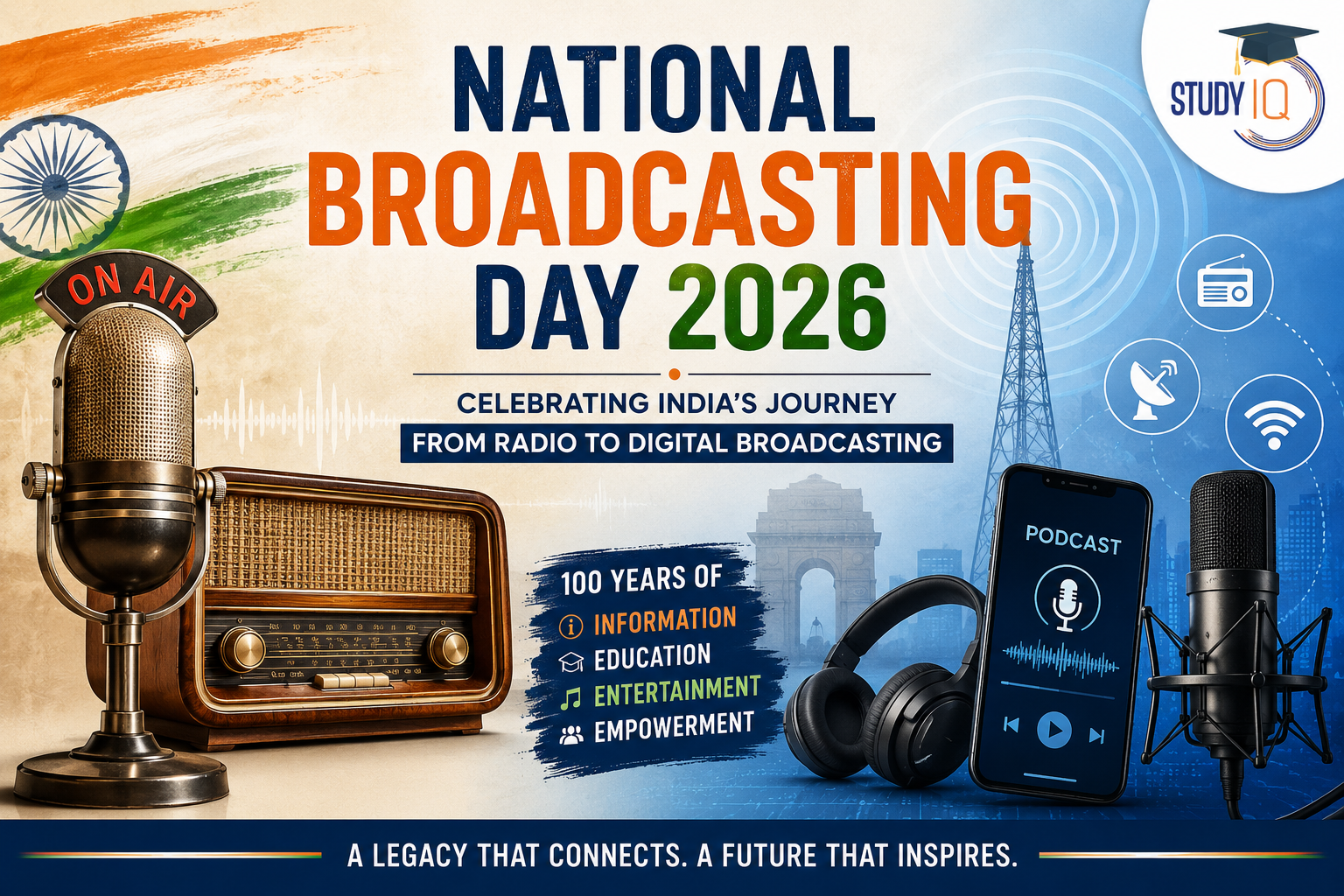
National Broadcasting Day 2026 is observed on 23 July 2026 to commemorate the first official radio broadcast in India, which took place on 23 July 1927 by the Indian Broadcasting Company (IBC) in Bombay (now Mumbai). The day celebrates India’s rich broadcasting heritage and recognizes the role of radio, television, and digital media in informing, educating, and entertaining millions of people.
From the era of valve radios to FM stations, satellite broadcasting, podcasts, internet radio, and digital streaming platforms, India’s broadcasting sector has undergone a remarkable transformation over the past century. National Broadcasting Day highlights this journey while acknowledging the contribution of broadcasters, journalists, engineers, producers, and communication professionals in nation-building.
Read Also: UPSC Daily Current Affairs 2026
National Broadcasting Day 2026 Overview
| Particular | Details |
|---|---|
| Event | National Broadcasting Day 2026 |
| Date | 23 July 2026 |
| Day | Thursday |
| First Official Broadcast | 23 July 1927 |
| Started By | Indian Broadcasting Company (IBC) |
| Purpose | To commemorate India’s first official radio broadcast and celebrate the evolution of broadcasting |
| Major Public Broadcaster | All India Radio (Akashvani) |
| Theme | No official theme has been announced for 2026 (as of July 2026). |
What is National Broadcasting Day?
National Broadcasting Day is celebrated annually on 23 July to mark the anniversary of India’s first official radio transmission in 1927. It serves as a reminder of the importance of broadcasting in connecting people, spreading information, promoting education, preserving culture, and strengthening democracy.
The day also celebrates the evolution of Indian broadcasting—from traditional radio services to modern digital platforms such as internet radio, podcasts, online news, mobile applications, and smart speakers.
National Broadcasting Day 2026 Theme
As of July 2026, no official theme has been announced for National Broadcasting Day 2026.
Each year, the observance primarily focuses on recognizing the contribution of broadcasting to public communication, education, disaster management, cultural preservation, and technological innovation.
History of National Broadcasting Day
The history of broadcasting in India dates back over a century. What began as experimental radio transmissions during British rule gradually evolved into one of the world’s largest public broadcasting systems.
Timeline of Broadcasting in India
| Year | Event |
|---|---|
| 1923 | The Radio Club of Bombay conducted India’s first experimental radio broadcast. |
| 1924 | The Calcutta Radio Club started regular broadcasting services. |
| 23 July 1927 | The Indian Broadcasting Company (IBC) launched India’s first official radio broadcast from Bombay. |
| 1930 | After IBC went into liquidation, the Government of India assumed control of broadcasting. |
| 1 April 1930 | The Indian State Broadcasting Service (ISBS) was established. |
| 8 June 1936 | ISBS was renamed All India Radio (AIR). |
| 1957 | AIR officially adopted the name Akashvani. |
| 23 July 1977 | FM broadcasting was introduced in Madras (now Chennai). |
| 1990s onwards | Private FM radio expanded across India. |
| Present | Broadcasting includes FM, digital radio, podcasts, internet streaming, satellite radio, and AI-powered audio platforms. |
Why is National Broadcasting Day Celebrated?
National Broadcasting Day is celebrated to recognize the contribution of broadcasting in shaping modern India.
The observance highlights the role of broadcasting in:
- Delivering reliable and verified news.
- Promoting education and literacy.
- Preserving India’s diverse languages and cultural heritage.
- Supporting government awareness campaigns.
- Providing emergency communication during natural disasters.
- Connecting rural and remote communities.
- Encouraging informed public participation in democracy.
Even today, radio remains one of the most affordable and trusted communication mediums, especially in rural and disaster-prone regions.
Evolution of Broadcasting in India
The Golden Era of Radio
After Independence, radio became the primary source of information and entertainment for millions of Indian households.
Popular programmes included:
- National and regional news
- Classical and film music
- Educational broadcasts
- Agricultural advisory programmes
- Drama and storytelling
- Cricket commentary
- Government announcements
All India Radio played a major role in reaching villages through broadcasts in regional languages.
Rise of FM Radio
FM broadcasting officially began in India on 23 July 1977 from Madras (Chennai).
FM radio transformed listening experiences by offering:
- High-quality stereo sound
- Music-focused programming
- Interactive radio jockeys (RJs)
- Local city-based content
- Youth-oriented entertainment
Today, both public and private FM stations operate across hundreds of Indian cities.
Digital Broadcasting Revolution
Advancements in technology have expanded broadcasting beyond traditional radio.
Today’s digital broadcasting ecosystem includes:
- Internet Radio
- Podcasts
- Audio Streaming Platforms
- Mobile Applications
- Smart Speakers
- Digital Audio Broadcasting
- AI-powered personalized recommendations
Listeners can now access news, entertainment, educational content, and live radio anytime through smartphones and internet-connected devices.
All India Radio (Akashvani)
Established on 8 June 1936, All India Radio (AIR) is India’s national public radio broadcaster.
AIR officially adopted the name Akashvani in 1957, a name that continues to enjoy widespread recognition.
Key Features of All India Radio
- Operates one of the largest broadcasting networks in the world.
- Covers nearly the entire population of India.
- Broadcasts in 23 languages and numerous dialects.
- Provides news, music, sports, education, culture, and public service programmes.
- Plays a critical role during elections, emergencies, and natural disasters.
AIR continues to remain one of India’s most trusted public broadcasters.
Importance of Broadcasting in India
Broadcasting continues to serve multiple sectors of society.
Its major contributions include:
Public Information
Broadcasting delivers verified news and government announcements to millions of citizens.
Education
Educational programmes support school students, competitive exam aspirants, farmers, and lifelong learners.
Disaster Management
Radio remains one of the fastest communication channels during floods, cyclones, earthquakes, and other emergencies.
Cultural Preservation
Broadcasting promotes Indian music, literature, folk traditions, regional languages, and cultural festivals.
National Integration
Broadcasting connects people from different states, cultures, and linguistic backgrounds through shared information and experiences.
Broadcasting in the Digital Age
Modern broadcasters have embraced technology to reach wider audiences.
Current broadcasting platforms include:
- Live streaming
- Podcasting
- OTT audio services
- Social media broadcasting
- Mobile applications
- Smart speakers
- Artificial Intelligence-based content recommendations
This digital convergence has helped broadcasters attract younger audiences while maintaining the credibility developed through decades of public service.
Interesting Facts About National Broadcasting Day
- India’s first official radio broadcast took place on 23 July 1927.
- The Indian Broadcasting Company launched the country’s first organized broadcasting service.
- All India Radio was established on 8 June 1936.
- AIR became popularly known as Akashvani in 1957.
- FM broadcasting officially began on 23 July 1977 from Madras (Chennai).
- AIR broadcasts in 23 languages and numerous dialects.
- India has one of the largest public broadcasting networks in the world.
- It is widely believed that legendary actor Amitabh Bachchan was once rejected during an audition for All India Radio before finding success in cinema.
- Radio continues to play a crucial role in remote regions where internet connectivity remains limited.
 India–Poland Relations 2026: Strategic...
 Supreme Court on Children's Right to Int...
 Daily Current Affairs PDF 2026: Download...














 WhatsApp





