Table of Contents
Context
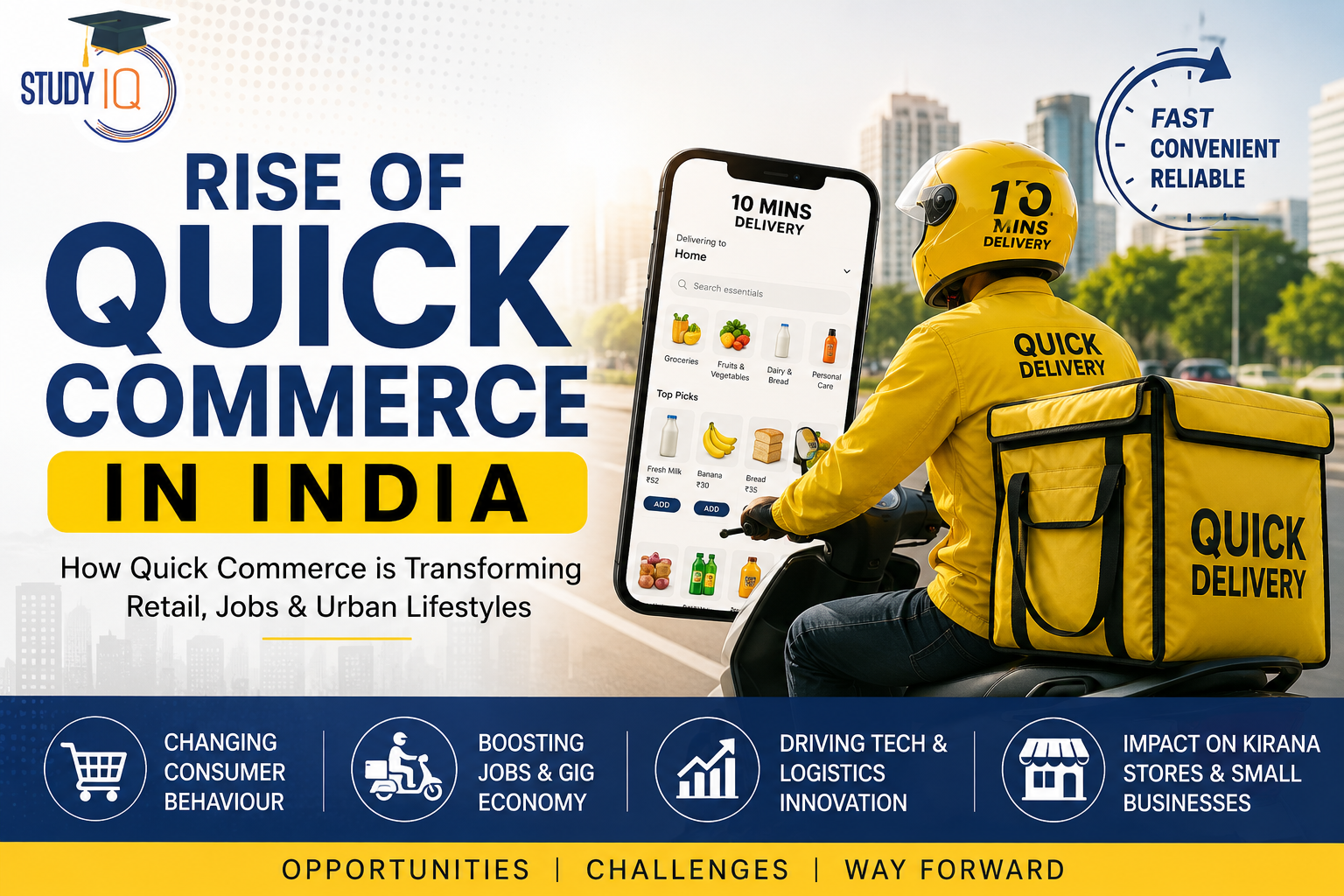
Quick commerce is rapidly transforming India’s retail landscape through hyper-local delivery and digital innovation. While it enhances consumer convenience and employment opportunities, it also raises concerns over competition, kirana stores, and gig-worker welfare, highlighting the need for a balanced regulatory framework.
What are the key opportunities associated with the growth of quick commerce in India?
- Transforming Urban Retail: Quick commerce is reshaping urban consumption by enabling rapid access to daily essentials, supporting increasingly time-constrained lifestyles.
- g., Platforms such as Blinkit, Zepto, and Swiggy Instamart have mainstreamed near-instant delivery of groceries, medicines, and household essentials.
- Generating Platform-Based Employment: The rapid expansion of quick commerce has created large-scale employment opportunities for delivery partners, warehouse personnel, and logistics workers, contributing to India’s platform economy.
- g., The NITI Aayog projects India’s gig workforce to reach 23.5 million by 2029–30, with logistics and delivery services forming a significant share.
- Accelerating Technology and Logistics Innovation: The sector is driving investment in AI-driven demand forecasting, predictive inventory management, and micro-fulfilment networks, strengthening India’s logistics capabilities.
- g.,Zepto employs AI and machine learning to optimise inventory and delivery routes.
- Strengthening Hyperlocal Supply Chains: Dense dark-store networks improve last-mile logistics and enhance the rapid distribution of essential goods during emergencies.
- g., Quick-commerce platforms supported essential deliveries during the COVID-19 pandemic and the 2024 Bengaluru water crisis.
- Catalysing Startup and Investment Ecosystems: Quick commerce has emerged as a major destination for venture capital, encouraging innovation in retail technology and logistics.
- g.,Zepto achieved unicorn status despite a slowdown in broader startup funding.
- Building a Platform Economy: Beyond retail, quick commerce is creating digital infrastructure where logistics, consumer data, and retail media become valuable economic assets.
- Future Expansion Beyond Metros: As digital infrastructure and purchasing power improve, quick commerce has the potential to expand into Tier-2 and Tier-3 cities through region-specific business models.
What are the key issues associated with the quick commerce landscape?
- Labour Precarity in the Gig Economy: Platform-based delivery work often lacks stable incomes, formal employment protection, and comprehensive social security despite algorithm-driven performance targets.
- Competitive Pressure on Independent Retail: Platform scale, logistics efficiency, and pricing strategies intensify competitive pressures on neighbourhood kirana stores and other independent retailers.
- g., The Confederation of All India Traders (CAIT) has highlighted declining sales among urban kirana stores.
- Platform Concentration and Vertical Integration: Increasing control over algorithms, consumer data, and preferred-seller networks enables platforms to influence market access while competing with third-party sellers through private labels.
- Urban Infrastructure and Environmental Externalities: High-frequency deliveries increase congestion, packaging waste, and last-mile emissions, placing additional pressure on urban infrastructure.
- g., Large delivery fleets contribute to congestion in cities such as Bengaluru and Mumbai.
- Metro-Centric Growth Model: The economics of dark stores require high population density and frequent ordering, limiting rapid expansion into many Tier-2 and Tier-3 cities.
- Consumer Protection and Regulatory Gaps: The absence of dedicated standards for pricing transparency, product quality, and grievance redressal creates accountability challenges.
Way forward
- Ensure Fair Competition and Platform Neutrality
Competition policy should prevent dominant platforms from abusing market power through predatory pricing, self-preferencing, algorithmic discrimination, and anti-competitive vertical integration while preserving a level playing field.
- g., Strengthen enforcement by the Competition Commission of India (CCI) under the Competition Act, 2002, with faster scrutiny of preferred-seller arrangements and abuse of dominant position.
- Build a Distinct Social Protection Framework for Platform Workers
Rather than reclassifying gig workers as conventional employees, India should strengthen the existing framework under the Code on Social Security, 2020 by guaranteeing minimum social protection while retaining labour-market flexibility.
- g., Provide portable social security, accident insurance, algorithmic transparency, and platform-funded welfare contributions that are periodically reviewed and transparently calibrated to minimise excessive cost pass-through to workers, consumers, or small sellers.
- Build Trusted Digital Markets
Strengthen consumer confidence through robust data governance, transparent pricing, and efficient grievance redressal.
- g., Effectively implement the Digital Personal Data Protection Act, 2023, alongside transparent pricing disclosures, standardised refund policies, and time-bound online dispute resolution.
- Promote Inclusive Digital Commerce
Expand competitive market access for MSMEs, Kirana stores, and local producers through interoperable digital infrastructure.
- g., Scale the Open Network for Digital Commerce (ONDC) alongside digital capacity-building, logistics support, and easier access to working capital.
- Enable Sustainable Urban Logistics
Internalise the environmental and infrastructure costs of high-frequency deliveries while allowing innovation in logistics models.
- g., Promote EV-based delivery fleets, sustainable packaging, and scientific zoning of dark stores through outcome-based environmental standards.
Latest UPSC Updates
| Resource | Link |
|---|---|
| UPSC Prelims Result 2026 | Check Here |
| UPSC Exam Calendar 2027 | View Calendar |
| UPSC Question Paper 2026 | Download PDF |
| UPSC Prelims Answer Key 2026 | Check Answer Key |
| UPSC Cut Off 2026 | View Cut Off |
| UPSC Syllabus 2026 | Read Syllabus |
| Daily Current Affairs 2026 | Read Updates |
| StudyIQ UPSC IAS Foundation 2027 (English) | Join Course |
| StudyIQ UPSC IAS Foundation 2027 (Hindi) | Join Course |
| StudyIQ UPSC IAS Foundation 2027 (Bilingual) | Join Course |
 US Treasury Yields at 25-Year High: Impa...
 National Coastal Mission 2.0 (NCM 2.0): ...
 New CAFE Norms 2027–32: Key Features, ...














 WhatsApp