
Table of Contents
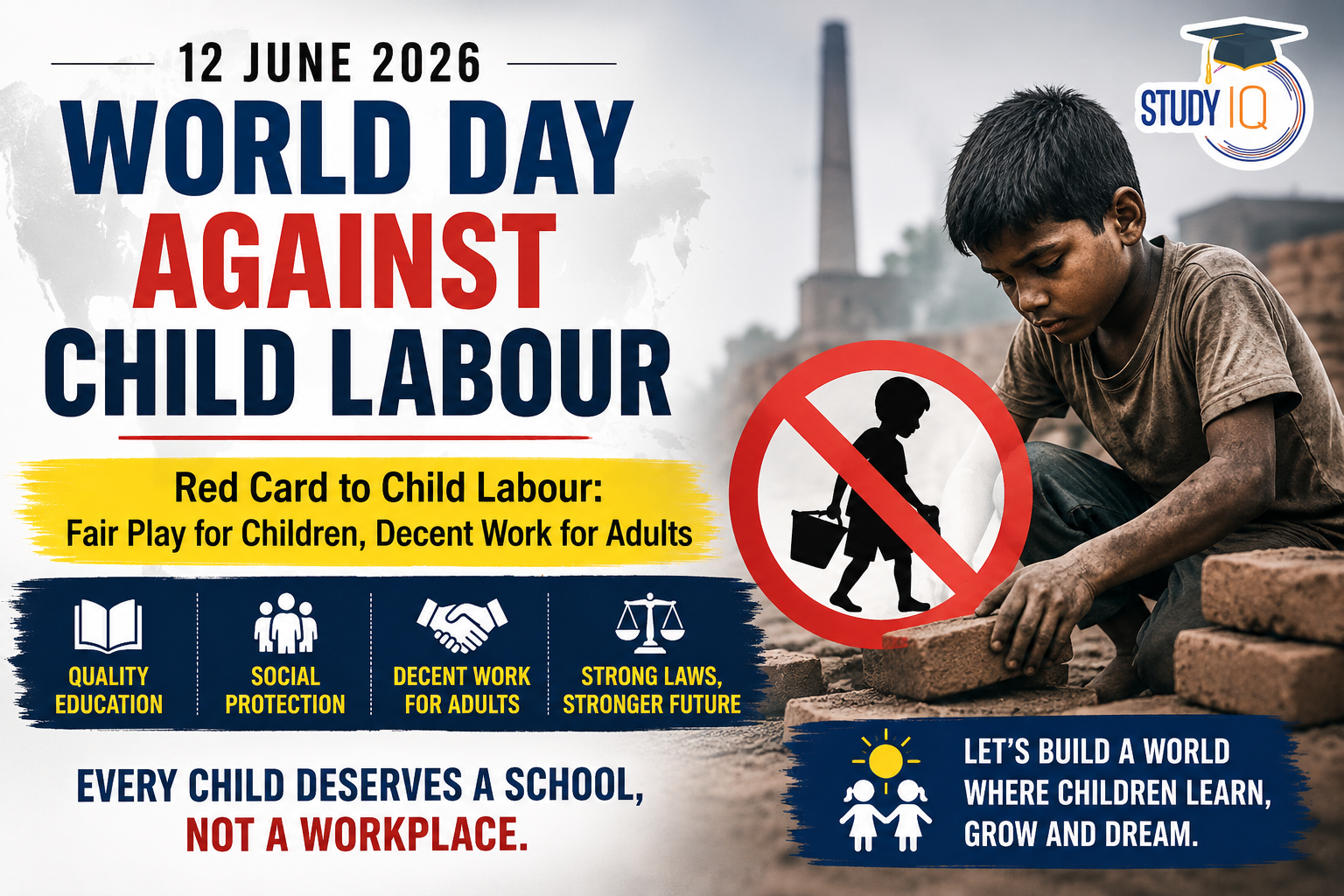
World Day Against Child Labour 2026 is observed globally on 12 June 2026 to raise awareness about the millions of children who continue to be trapped in labour instead of attending school and enjoying their childhood. The day serves as a global call to governments, businesses, civil society organizations, and citizens to work together to eliminate child labour and protect children’s rights.
This year’s observance comes at a crucial moment as the world has failed to achieve Sustainable Development Goal (SDG) Target 8.7, which aimed to eradicate child labour in all its forms by 2025.
Read Also: UPSC Daily Current Affairs 2026
World Day Against Child Labour 2026 Theme
The official theme for World Day Against Child Labour 2026 is:
“Red Card to Child Labour: Fair Play for Children, Decent Work for Adults”
Inspired by the symbolism of a red card in sports, the theme sends a strong message that child labour has no place in society. It highlights the importance of providing children with education and opportunities while ensuring decent employment and fair wages for adults.
The campaign emphasizes:
- Ending child labour in all sectors
- Promoting quality education
- Ensuring social protection for vulnerable families
- Strengthening labour rights
- Holding corporations accountable across supply chains
History of World Day Against Child Labour
The International Labour Organization (ILO) launched World Day Against Child Labour in 2002 to focus global attention on the widespread issue of child exploitation.
Since then, June 12 has been observed annually to:
- Raise awareness about child labour
- Promote children’s rights
- Encourage policy reforms
- Mobilize international cooperation
The observance supports the implementation of:
- ILO Convention No. 138 (Minimum Age Convention)
- ILO Convention No. 182 (Worst Forms of Child Labour Convention)
Why is World Day Against Child Labour Important?
Child labour remains one of the most pressing human rights challenges globally. Millions of children are forced to work in dangerous conditions that threaten their health, education, and future prospects.
The day is important because it:
Protects Children’s Rights
Every child has the right to education, health, safety, and a dignified childhood.
Raises Global Awareness
It draws attention to the social and economic conditions that force children into labour.
Encourages Government Action
Countries are urged to strengthen laws, labour inspections, and welfare programs.
Supports Sustainable Development
Ending child labour contributes directly to poverty reduction, education, gender equality, and economic development.
Global Child Labour Statistics 2026
According to recent international estimates:
| Indicator | Data |
|---|---|
| Children engaged in child labour worldwide | 138 million |
| Children involved in hazardous work | 54 million |
| Child labour in agriculture | More than 70% |
| Region with highest child labour prevalence | Africa |
| Second highest region | Asia-Pacific |
Although the number of child labourers has declined significantly over the past two decades, progress remains too slow to meet international targets.
Why Does Child Labour Persist?
Several interconnected factors continue to drive child labour globally:
Poverty
Families struggling to meet basic needs often rely on children’s income.
Lack of Access to Education
Poor educational infrastructure and high costs push children out of schools.
Economic Inequality
Unequal opportunities increase vulnerability among disadvantaged communities.
Armed Conflicts and Displacement
Wars and humanitarian crises expose children to exploitation.
Weak Labour Law Enforcement
Many countries lack adequate monitoring and enforcement mechanisms.
Marrakech Global Framework for Action Against Child Labour
A major development in 2026 was the adoption of the Marrakech Global Framework for Action Against Child Labour during the Sixth Global Conference on the Elimination of Child Labour.
The framework calls for:
- Stronger implementation of ILO Conventions 138 and 182
- Greater corporate accountability
- Expanded social protection programs
- Increased investments in public education
- Enhanced international cooperation
The framework builds upon the Durban Call to Action and seeks to accelerate efforts to eradicate child labour worldwide.
India and Child Labour
India has taken several legislative and policy measures to combat child labour.
Key Initiatives
Child Labour (Prohibition and Regulation) Amendment Act, 2016
The Act prohibits employment of children below 14 years in all occupations and processes except family enterprises under specific conditions.
National Child Labour Project (NCLP)
The scheme focuses on:
- Rescue and rehabilitation of child labourers
- Bridge education
- Vocational training
- Mainstreaming children into formal education
Right to Education Act, 2009
Ensures free and compulsory education for children aged 6 to 14 years.
Despite progress, poverty, migration, informal employment, and school dropouts continue to pose challenges.
Four Key Actions Needed to End Child Labour
1. Universal Social Protection
Provide income support and welfare programs to vulnerable families.
2. Decent Work for Adults
Ensure living wages and secure employment opportunities.
3. Corporate Accountability
Mandate supply-chain due diligence and ethical sourcing practices.
4. Quality Public Education
Guarantee free, inclusive, and accessible education for all children.
Latest UPSC 2026 Updates
| Resource | Link |
|---|---|
| UPSC Result 2026 | Check Here |
| UPSC Exam Calendar 2027 | View Calendar |
| UPSC Question Paper 2026 | Download PDF |
| UPSC Prelims Answer Key 2026 | Check Answer Key |
| UPSC Cut Off 2026 | View Cut Off |
| UPSC Syllabus | Read Syllabus |
| Daily Current Affairs | Read Updates |
| UPSC IAS Foundation 2027 (English) | Join Course |
| UPSC IAS Foundation 2027 (Hindi) | Join Course |
| UPSC IAS Foundation 2027 (Bilingual) | Join Course |
World Day Against Child Labour 2026 Quotes
“Every child deserves a classroom, not a workplace.”
“Childhood is meant for learning, not earning.”
“Ending child labour is not charity—it is justice.”
World Day Against Child Labour 2026 UPSC Relevance
Prelims Facts
- Date: 12 June
- First Observed: 2002
- Organized By: International Labour Organization (ILO)
- Theme 2026: “Red Card to Child Labour: Fair Play for Children, Decent Work for Adults”
- Related SDG: Target 8.7
Mains Relevance
- Social Justice
- Child Rights
- Labour Reforms
- Human Capital Development
- Inclusive Growth
- Sustainable Development Goals
Conclusion
World Day Against Child Labour 2026 serves as a reminder that despite decades of progress, millions of children continue to lose their childhood to labour and exploitation. The failure to achieve SDG Target 8.7 by 2025 highlights the need for urgent and coordinated action. Governments, employers, workers’ organizations, and civil society must work together to ensure that every child has access to education, protection, and opportunities for a brighter future.
The message of 2026 is clear: Give a Red Card to Child Labour and Ensure Fair Play for Every Child.
|
Read More Notes |
|
| Environment Notes | Art and Culture Notes |
| Science and Tech | History Notes |
| Geography Notes | Indian Polity Notes |
| General Knowledge | International Relation |
|
Explore StudyIQ Courses |
|
 UPSC Recruitment 2026: 212 Vacancies Thr...
 Nyedar Namlo, Arunachal Pradesh: Sacred ...
 Daily Mains Articles 2026 – Updated Da...












 WhatsApp





