Table of Contents
Context
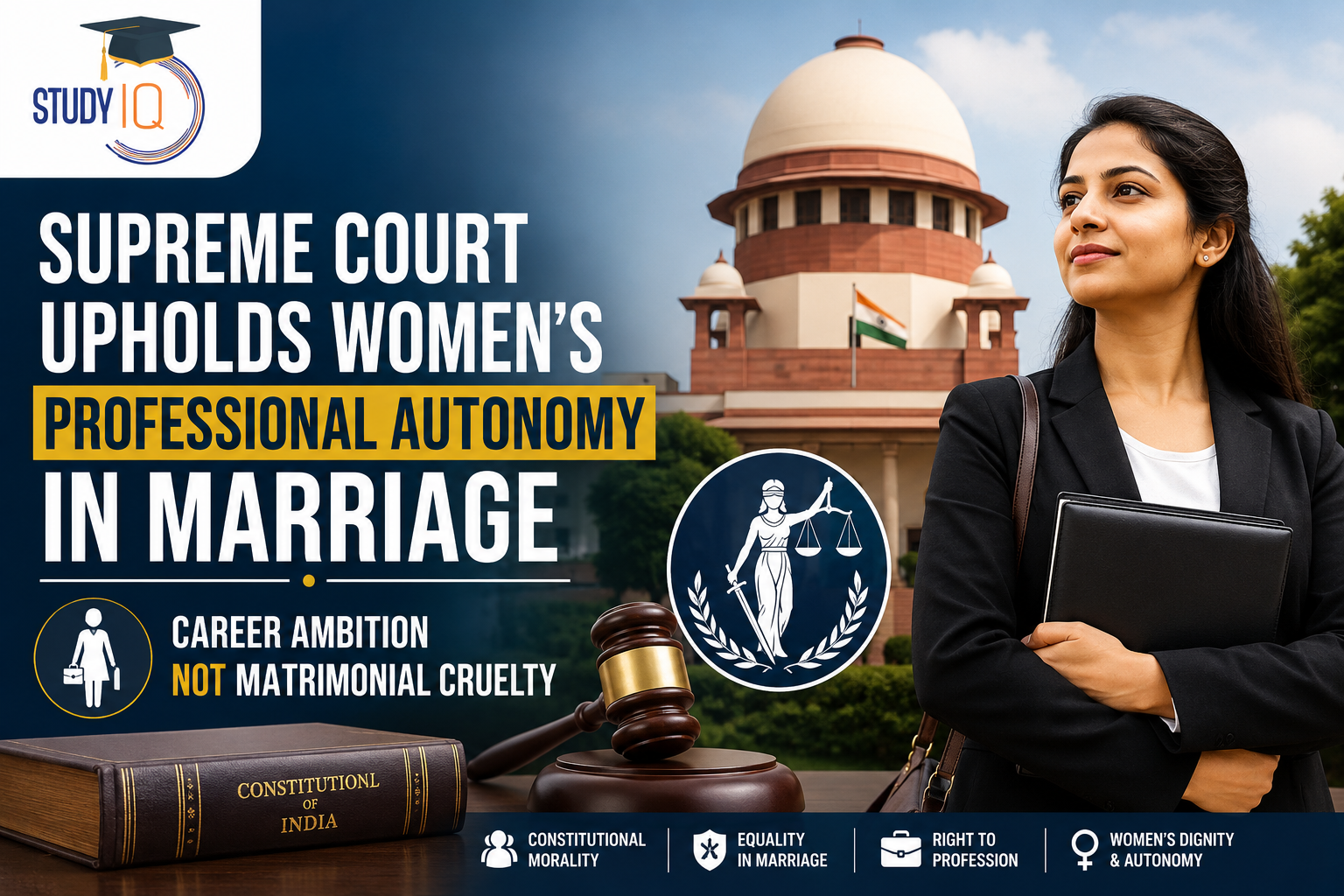
In a landmark decision that upholds constitutional principles of gender equality and personal autonomy, the Supreme Court of India in Ann Saurabh Dutt v. Lieutenant Colonel Saurabh Iqbal Bahadur Dutt (2026 LiveLaw (SC) 489) unequivocally stated that a wife’s pursuit of her professional ambitions cannot be classified as “matrimonial cruelty” solely due to its adverse impact on the feelings of the husband or his family. The Court characterised this reasoning as “profoundly regressive,” “feudalistic,” and inconsistent with the constitutional goal of women’s emancipation in modern India.
The decision, issued by a Bench of Justices Vikram Nath and Sandeep Mehta, signifies a notable advancement in Indian matrimonial law by affirming that marriage does not obliterate a woman’s individuality, dignity, or professional identity. The Court dismissed the outdated presumption that a wife must wholly subordinate her aspirations to her husband’s career or matrimonial obligations. It asserted that marriage relationships should be based on mutual respect, equality, and constitutional morality.
Read Also: Judiciary Current Affairs
Context of the Case
The conflict emerged between the appellant-wife, a licensed dentist, and the respondent-husband, an Army officer. The couple got married in 2009. The wife established her dental practice in Pune. Consequently, due to her husband’s military assignment, she moved to Kargil to live with him.
Complications emerged throughout her pregnancy, and subsequently, their daughter suffered seizure-related medical issues necessitating specialised therapy and healthcare facilities. Worried about the child’s well-being and the inadequacies of medical facilities in distant military areas, the wife relocated to Ahmedabad, where she reinstated her dentistry business and secured improved medical care for the child.
The husband initiated divorce proceedings, citing cruelty and desertion as grounds. The Family Court determined that the wife’s choice to start her dentistry clinic in Ahmedabad, purportedly without consulting her husband or in-laws, constituted cruelty. It additionally determined that her refusal to cohabit permanently with her spouse at his assignment constituted desertion.
The Gujarat High Court upheld these findings. The wife, dissatisfied with the decisions, sought recourse from the Supreme Court.
Supreme Court’s Reproach of Obsolete Gender Assumptions
The Supreme Court categorically denounced the rationale employed by the Family Court and the High Court. The Bench noted that the findings exhibited “deeply entrenched archaic societal assumptions” that are incongruent with constitutional principles and contemporary socioeconomic realities.
The Court stated:
“To brandish the effort of the wife to pursue her own career goals as acts of cruelty, as the same may have hurt the sentiments of the husband or the in-laws, is highly objectionable and deplorable.”
The Court acknowledged that women in contemporary India actively participate in various professional fields and cannot be compelled to abandon their jobs solely because of marital obligations. It characterised the lower courts’ attitude as “appalling” and “totally unacceptable.” The Court emphasised that the expectation for a professionally qualified woman to forfeit her work to join her husband, irrespective of the circumstances, embodies an “ultra-conservative” and “feudalistic” mentality.
Marriage and Constitutional Parity
A key aspect of the decision is its constitutional interpretation of marriage. The Supreme Court underscored that marriage does not diminish a woman’s autonomous identity or autonomy.
The Court noted:
“Marriage does not eclipse her individuality, nor does it subjugate her identity under that of her spouse.”
This observation corresponds with the constitutional assurances provided by Articles 14, 15, 19, and 21 of the Constitution of India. The decision acknowledges that equality in marriage is not simply a societal goal but a fundamental obligation.Article 14 ensures equality before the law and equal legal protection. Article 15 forbids discrimination based on sex. Article 19(1)(g) ensures the right to engage in any profession, occupation, trade, or business. Article 21 safeguards dignity, privacy, autonomy, and personal liberty. The Court successfully aligned matrimonial law with constitutional morality by acknowledging that a wife’s professional decisions were protected constitutional interests.
Women’s Right to Engage in Professional Pursuits
The Supreme Court’s rationale is bolstered by a longstanding tradition of constitutional jurisprudence affirming women’s equal rights to employment, professional engagement, and public participation.The Constitution does not perceive women solely as dependents within a patriarchal familial framework. Rather, it acknowledges them as independent people endowed with equal legal and constitutional rights. The Court’s remarks align with other historic decisions, including:
C.B. Muthamma v. Union of India (1979)
The Supreme Court invalidated discriminatory service regulations mandating that women officers secure government approval prior to marriage. Justice Krishna Iyer condemned systemic sexism and underscored the necessity of substantive gender equality.
Air India v. NergeshMeerza (1981)
The Court annulled arbitrary service restrictions imposed on flight attendants, including termination at the first pregnancy, deeming them discriminatory and unconstitutional.
Joseph Shine v. Union of India (2018)
The Supreme Court, in decriminalising adultery, determined that the Constitution prohibits the classification of women as the property of their spouses. The court’s decision underscored liberty, dignity, and equality within marital relationships.
Shafin Jahan v. Asokan K.M. (2018)
The Court reiterated that adult women have full liberty over personal choices, encompassing marriage and life decisions.
The current decision applies these fundamental standards to the areas of marital abuse and abandonment.
Reevaluating the Notion of Cruelty in Matrimonial Jurisprudence
According to Section 13 of the Hindu Marriage Act, 1955, cruelty serves as a ground for divorce. Indian courts have consistently emphasised that cruelty must be evaluated in context and cannot rely on subjective patriarchal standards.
Historically, matrimonial cruelty was frequently understood through traditional concepts of spousal obligation. Women who emphasised education, a job, or an independent life were often charged with disregarding matrimonial responsibilities. The Supreme Court’s decision signifies a fundamental break from these preconceptions. The Court explained that professional ambitions cannot be deemed cruel solely because of the inconvenience they cause to the spouse or his family.
The Bench underscored that both partners must balance marital responsibilities with shared ambitions. Matrimonial law cannot mandate unilateral sacrifice from women. This methodology is consistent with prior judicial decisions like Samar Ghosh v. Jaya Ghosh (2007), wherein the Supreme Court determined that cruelty should be assessed in accordance with present societal norms and the progressive standards of marital behaviour.
Abandonment and Child Welfare
The Family Court determined that the wife abandoned her husband by living in Ahmedabad instead of joining him at military assignments. The Supreme Court dismissed this rationale, primarily due to the wife’s decision being significantly influenced by apprehensions for the child’s healthcare and safety.
The Court acknowledged that a mother’s choice to prioritise medical care and educational stability for her kid does not inherently constitute abandonment. This finding indicates a child-focused and welfare-oriented understanding of marital responsibilities. It also recognises the logistical challenges encountered by wives of military members assigned to isolated locations.
The Court notably observed that if the circumstances were inverted, society would probably not anticipate the husband relinquishing his profession for his wife’s career. This revealed the gender imbalance inherent in conventional marriage expectations.
Constitutional Morality and Transformative Constitutionalism
The decision is strongly based on the principle of transformative constitutionalism. Indian constitutional jurisprudence progressively aims to convert hierarchical social systems into egalitarian frameworks founded on dignity and equality.
The Supreme Court has consistently employed constitutional morality to abolish patriarchal behaviours. Judicial decisions like Navtej Singh Johar v. Union of India (2018), Indian Young Lawyers Association v. State of Kerala (Sabarimala case), and Joseph Shine exemplify the judiciary’s dedication to constitutional principles over societal conventions.
The Court, in this instance, adeptly employed constitutional morality in family law by rejecting the validation of gender stereotypes masquerading as marriage duties. This decision acknowledges that constitutional rights persist inside the institution of marriage. Marriage must function within constitutional constraints.
The Judiciary’s Role in Promoting Gender Justice
Indian courts have always been helpful in promoting women’s rights in areas where social and legislative reforms have fallen short. The judiciary has broadened protections against sexual harassment, domestic violence, workplace discrimination, reproductive autonomy, inheritance rights, and marital equality. The current decision maintains this positive path by confirming that women have equal constitutional rights to professional achievement and personal growth.
The Court’s observations possess wider social implications. Matrimonial litigation in India frequently embodies patriarchal notions about women’s “obligations” in marriage. By firmly repudiating such beliefs, the Court aims to impact not only legal doctrine but also cultural perceptions. The decision conveys a strong message that women’s aspirations are not inferior to marital obligations.
Irreparable Dissolution of Matrimony
The Supreme Court annulled the determinations of cruelty and desertion but did not restore the marriage. The Court observed that the woman no longer wished to maintain the marital relationship and that the husband had allegedly entered into a new marriage.
Consequently, the Court classified the divorce under the notion of irretrievable breakdown of marriage. Although not explicitly established as a statutory basis within the Hindu Marriage Act, the Supreme Court has progressively utilised its power under Article 142 of the Constitution to annul marriages that have proven emotionally and practically untenable.
Cases like Naveen Kohli v. Neelu Kohli (2006) and Shilpa Sailesh v. Varun Sreenivasan (2023) demonstrate court endorsement of this notion. This judgement thus contributes to the development of law regarding the pragmatic resolution of irretrievably broken marriages.
Conclusion
The decision of the Supreme Court in Ann Saurabh Dutt v. Lieutenant Colonel Saurabh Iqbal Bahadur Dutt signifies a key endorsement of women’s constitutional independence in marriage. The Court refuted the idea that professional ambition amounts to spousal cruelty, so dismantling ingrained patriarchal preconceptions within conventional family law adjudication.
The decision emphasises that marriage constitutes a partnership of equals, rather than a hierarchical structure requiring unilateral sacrifice from women. It acknowledges that constitutional assurances of equality, dignity, autonomy, and professional liberty persist within marital relationships. The verdict reinforces the constitutional principles of gender justice and transformative constitutionalism. It demonstrates the judiciary’s ongoing endeavour to align personal legislation and matrimonial jurisprudence with modern democratic principles.
The verdict conveys a definitive societal message: a woman’s personality, goals, and professional objectives are not diminished by marriage. They are essential elements of her constitutional identity, warranting complete legal recognition and safeguarding.
 Supreme Court Dowry Enforcement Order 20...
 Supreme Court Modifies 3-Year Practice R...
 Doctrine of Per Incuriam Explained: Supr...







 WhatsApp