Table of Contents
Context
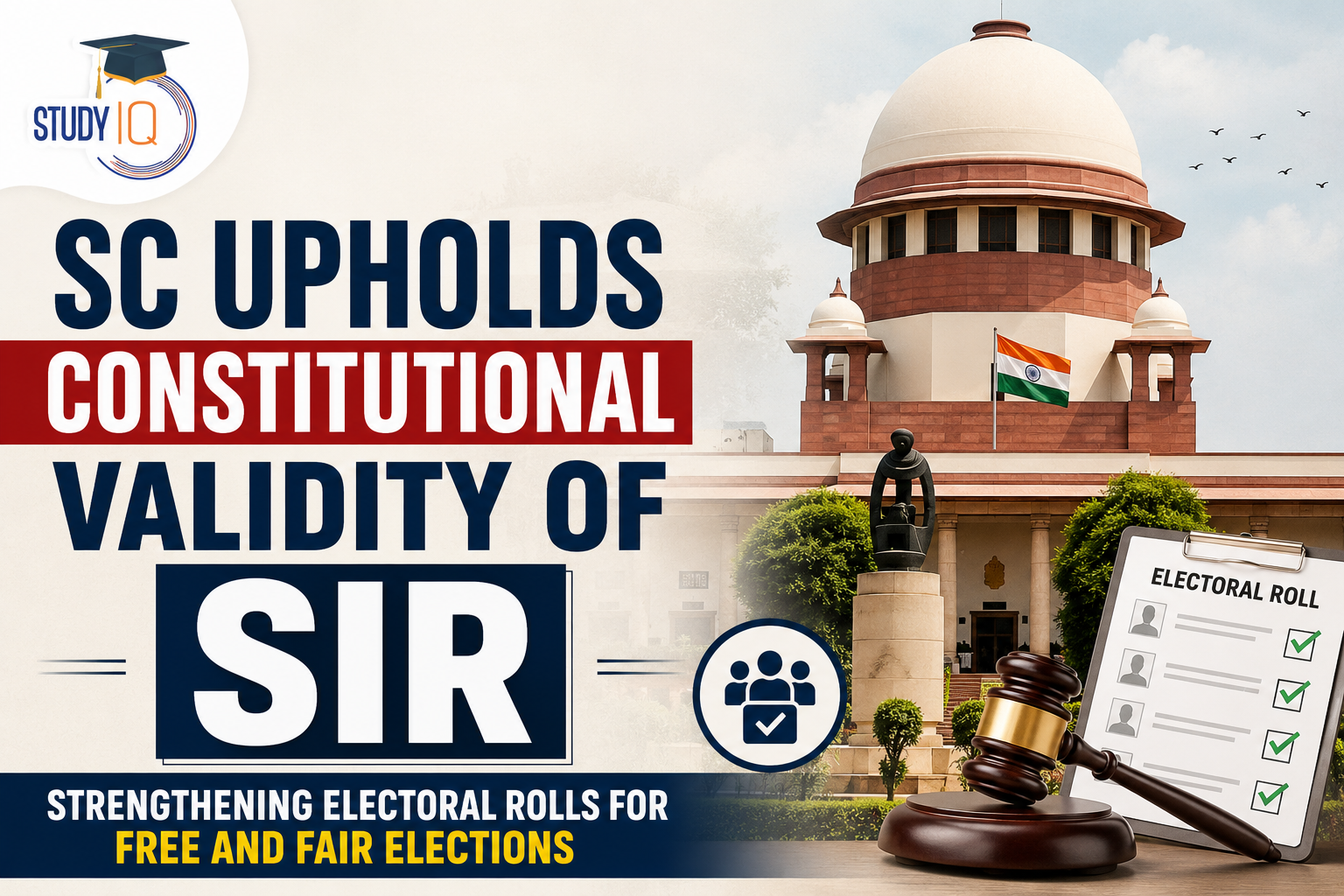
The Supreme Court upheld the constitutional validity of the Election Commission’s Special Intensive Revision (SIR) of electoral rolls, recognising it as a mechanism to strengthen electoral integrity and uphold free and fair elections across India
Read Also: UPSC Daily Current Affairs 2026
What is SIR?
- About: The Special Intensive Revision (SIR) is an extensive voter verification and electoral roll purification exercise undertaken by the Election Commission of India. Its primary objective is to ensure that every eligible citizen is included in the voter list while preventing the inclusion of ineligible or duplicate entries.
- Methods for updating electoral rolls:
- Summary Revision (Regular Process): This is a routine exercise carried out annually or before smaller elections. It mainly involves desk-based corrections such as enrolling citizens who have turned 18 and processing applications voluntarily submitted by voters, without conducting comprehensive field verification.
- Special Intensive Revision (SIR): Unlike routine revisions, the SIR is a large-scale and labour-intensive exercise involving physical verification. Under this process, Booth Level Officers (BLOs) are required to visit each household in the identified area to personally verify the identity and eligibility status of every registered voter.
Stages in the SIR Process
- Pre-Enumeration: The Election Commission prepares pre-filled Enumeration Forms (EFs) for all registered voters using existing electoral databases.
- Door-to-Door Verification: Booth Level Officers conduct multiple visits to households, distribute the Enumeration Forms, assist residents in linking their details with older electoral records, and record any necessary corrections or updates.
- Data Collection and Identification:During verification, BLOs identify voters falling under the “ASDD” category, namely Absent, Shifted, Dead, or Duplicate entries. At the same time, newly eligible citizens are provided Form 6 for fresh registration.
- Draft Roll and Hearings: After preliminary scrutiny, a revised Draft Electoral Roll is published. Individuals whose names are deleted or marked for verification are formally notified and given an opportunity to present supporting documents, such as Aadhaar, government identity proofs, or birth records, to establish their eligibility.
- Publication of Final Electoral Roll: Once all objections, claims, and appeals are resolved through the prescribed legal process under the supervision of District Magistrates, the final updated electoral roll is officially released.
Key Observations of the Supreme Court
- The Court observed that the SIR does not override the provisions of the Representation of the People Act (RPA), 1950, or the Registration of Electors Rules, 1960.
- The Bench characterised Article 324 as a “continuous source of authority”.
- The Supreme Court accepted the EC’s justification for initiating an intensive revision after more than twenty years.
- It pointed to factors such as rapid urban expansion, large-scale migration, unreported deaths, duplication of voter entries, and frequent modifications in electoral rolls.
- Electoral rolls are dynamic in nature and must be periodically updated to reflect changing demographic and residential realities.
|
Read More Notes |
|
| Environment Notes | Art and Culture Notes |
| Science and Tech | History Notes |
| Geography Notes | Indian Polity Notes |
| General Knowledge | International Relation |
|
Explore StudyIQ Courses |
|
 Alpine Musk Deer: Habitat, Distribution,...
 International Day of Rural Women 2026: D...
 Short-Lived Climate Pollutants (SLCPs): ...












 WhatsApp