Table of Contents
Context
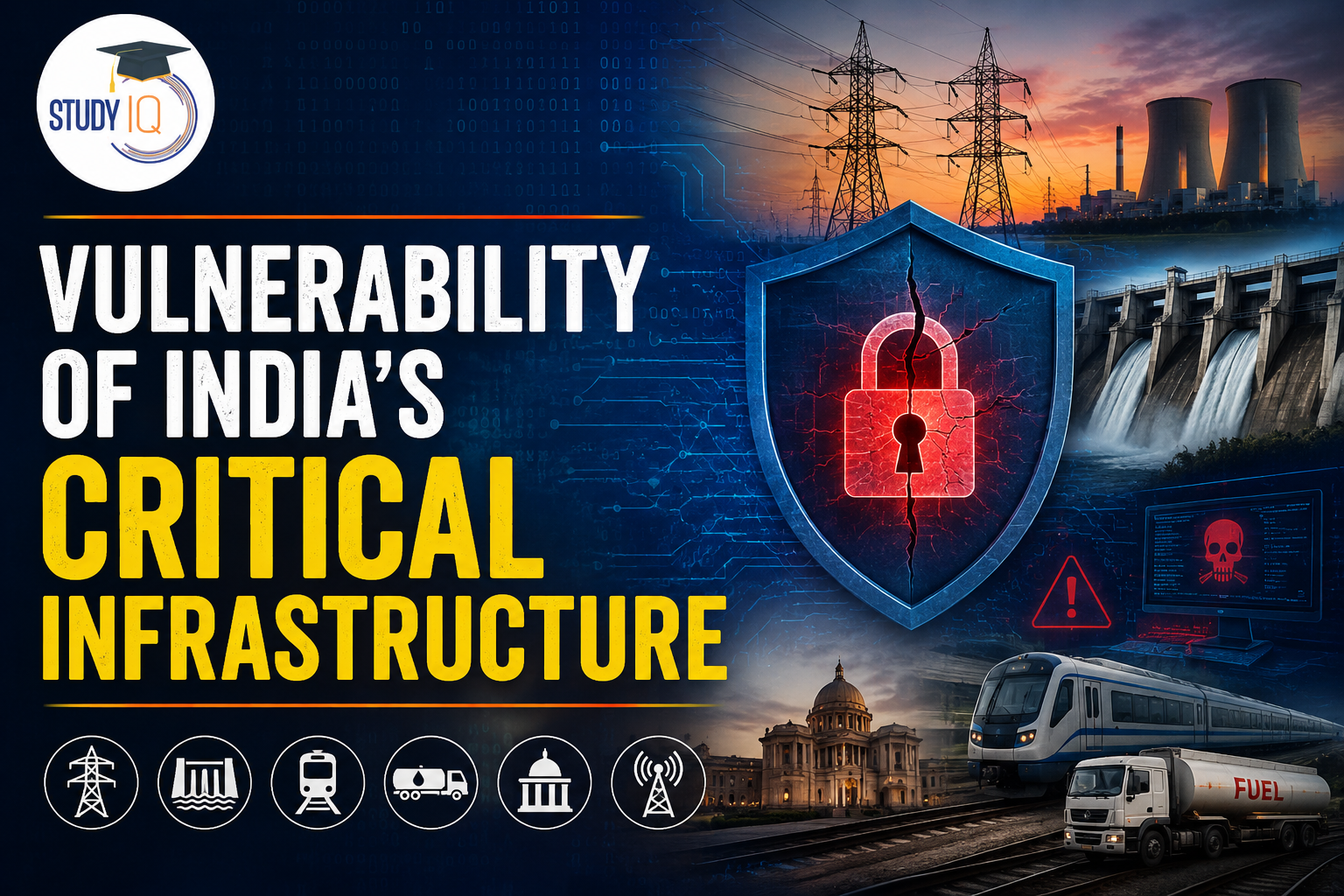
Recent studies and cyber-security reports highlighted growing vulnerabilities in India’s critical infrastructure systems to cyberattacks and IoT-based disruptions.
Read Also: UPSC Daily Current Affairs 2026
Emerging Vulnerability to Critical Infrastructure
- Expansion of Connected Infrastructure: Increasing use of IoT and AI connected power grids, dams and fuel transport systems to the internet, making them easier targets for remote cyberattacks.
- g. Smart grids, automated dams, GPS-enabled fuel logistics and automated monitoring systems
- Weak Security in OT & ICS Systems: Industrial Control Systems (ICS) and Operational Technology (OT) often lack strong cyber protection.
- g. Attackers could alter water-treatment calibration and disrupt purification systems
- Exposure of Government Systems: Vulnerable government servers and surveillance systems increase risks of phishing, espionage and misinformation. (g.Government mail-server details and live CCTV feeds from Central View Dashboard were exposed online in 2021)
- Critical Energy Infrastructure Risks: Fuel and gas transportation systems increasingly depend on connected digital systems vulnerable to remote disruption.
- g. GPS tracking and OTP-based fuel tanker e-lock systems now critical control points
- Imported IoT Device Risks: Use of unverified imported sensors, cameras and communication devices may create hidden backdoor vulnerabilities. (g. Chinese-made GPS-enabled locks used in fuel supply chains)
- Inadequate Certification Mechanisms: Security certification exists only for limited device categories.
- g. STQC certification available mainly for cameras, not all IoT devices)
- Human Error & Poor Cyber Hygiene: Weak passwords, outdated software and poor configuration practices remain major causes of breaches.
- g. India recorded 13 critical installations using default credentials(factory-set usernames and passwords assigned to devices) — highest among 20 countries studied)
- Interconnected Infrastructure Risks: Failure in one sector can trigger cascading disruption across power, banking, telecom and transport networks.
- National Security Threat: Cyberattacks on critical infrastructure can affect economic stability, governance and sovereignty. (g. 2020 Mumbai power outage allegedly linked to Chinese malware targeting India’s power grid)
Government Measures to Safeguard Critical Infrastructure
- CERT-In: Indian Computer Emergency Response Team acts as the national nodal agency for cyber-security incident response.
- NCIIPC: National Critical Information Infrastructure Protection Centre protects strategic sectors like power, banking, telecom and transport.
- National Cyber Security Policy: Provides framework for securing cyberspace and critical digital infrastructure.
- Cyber Surakshit Bharat Initiative: Enhances cyber-security awareness and capacity-building across government departments.
- STQC Certification: Security testing and certification introduced for surveillance cameras and electronic devices.
- Trusted Telecom & Electronics Push: Government promoting indigenous and trusted digital infrastructure under Atmanirbhar Bharat.
Structural Issues Despite Government Measures
- Weak Policy Enforcement: Existing IoT and cyber-security guidelines are often poorly implemented across PSUs and local agencies.
- Template-Based Procurement: Procurement systems prioritise compliance paperwork rather than deep security audits and design verification.
- Limited Indigenous Ecosystem: Dependence on imported hardware and components increases strategic vulnerability.
- Fragmented Institutional Coordination: Multiple agencies handle cyber-security with limited integrated response mechanisms.
- Lack of Skilled Workforce: India faces shortage of specialised cyber-security and industrial cyber-defence professionals.
- Slow Certification Processes: Security certification for IoT devices remains limited, lengthy and unevenly enforced.
Way Forward
- Strengthen OT & IoT Security: Extend cyber-security standards beyond IT systems to industrial control and connected infrastructure.
- Mandatory Security Audits: Conduct periodic vulnerability assessments and red-team testing for critical infrastructure.
- Promote Indigenous Technologies: Reduce dependence on unverified imported hardware in sensitive sectors.
- Integrated National Cyber Framework: Improve coordination between government, PSUs and private operators for real-time response.
- AI-Based Threat Detection: Deploy AI-enabled monitoring systems for early anomaly and intrusion detection.
- Build Skilled Workforce: Expand specialised training in SCADA, industrial cyber-security and digital forensics.
|
Read More Notes |
|
| Environment Notes | Art and Culture Notes |
| Science and Tech | History Notes |
| Geography Notes | Indian Polity Notes |
| General Knowledge | International Relation |
|
Explore StudyIQ Courses |
|
 Alpine Musk Deer: Habitat, Distribution,...
 International Day of Rural Women 2026: D...
 Short-Lived Climate Pollutants (SLCPs): ...














 WhatsApp