Table of Contents
Context
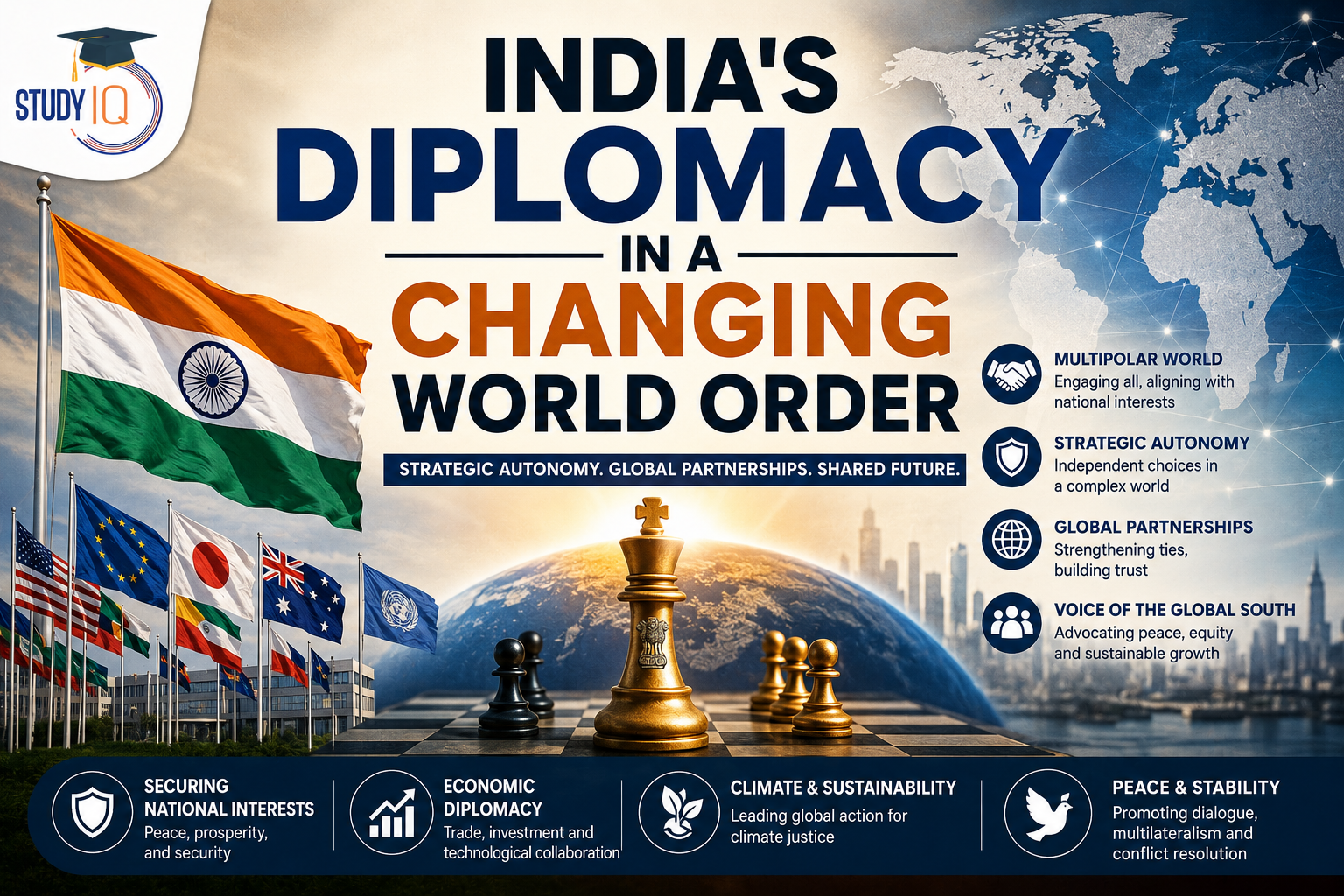
Growing geopolitical instability is reshaping the global order and requiring India to recalibrate its diplomacy.
Read Also: UPSC Daily Current Affairs 2026
About the Changing World Order
- Shift from Unipolarity to Multipolarity: The post-Cold War US-dominated order is giving way to a multipolar system with rising influence of China, India and middle powers.
- Rise of Great-Power Competition: Strategic rivalry between the United States and China is reshaping global trade, technology and security alignments.
- Fragmentation of Globalisation: Supply-chain securitisation, protectionism and friend-shoring are replacing hyper-globalisation.
- Weakening of Traditional Institutions: Institutions like NATO, WTO and multilateral frameworks face internal divisions and declining consensus.
- Rise of Flexible Coalitions: Countries increasingly engage through issue-based groupings like BRICS, Quad and I2U2 instead of rigid alliances.
- Technology & Geoeconomic Competition: Competition over AI, semiconductors, critical minerals and green technologies is becoming central to global power politics.
Five Principles to Guide Indian Diplomacy
- Reciprocity
- Mutual Strategic Support: India should support partners who back its core interests (e.g. UAE’s support on Kashmir and counterterrorism; India’s solidarity during Gulf tensions).
- Diversification
- Expanding Strategic Partnerships: India must broaden ties beyond traditional partners for trade, technology and investment (e.g. EU, EFTA agreements; stronger engagement with Nordic countries).
- Reducing Dependency Risks: Diversified economic and strategic linkages reduce vulnerability to geopolitical shocks (energy, technology and supply-chain diversification).
- Strategic Flexibility
- Multi-Alignment Approach: India should engage competing blocs simultaneously based on interests (participation in both BRICS and Quad).
- Avoiding Rigid Alliances: Flexible diplomacy allows India to adapt to rapidly changing great-power equations (US-China tensions, Russia-West conflict).
- Strategic Expansion
- Greater Focus on Emerging Regions: India must deepen engagement with strategically important regions (Africa for minerals, markets, connectivity and maritime security).
- Competition for Influence: India faces growing competition from China, Gulf countries and Western powers in the Global South.
- Domestic Renewal
- Internal Strength as Foreign Policy Foundation: Economic growth, manufacturing capacity and technological capability are essential for effective diplomacy.
- Need for Structural Reforms: India must address bureaucratic delays, infrastructure gaps and innovation deficits to leverage global opportunities.
|
Read More Notes |
|
| Environment Notes | Art and Culture Notes |
| Science and Tech | History Notes |
| Geography Notes | Indian Polity Notes |
| General Knowledge | International Relation |
|
Explore StudyIQ Courses |
|
 UAPA Act 1967: Key Provisions, Supreme C...
 Sarus Crane: Habitat, Features, Conserva...










 WhatsApp