Table of Contents
Context
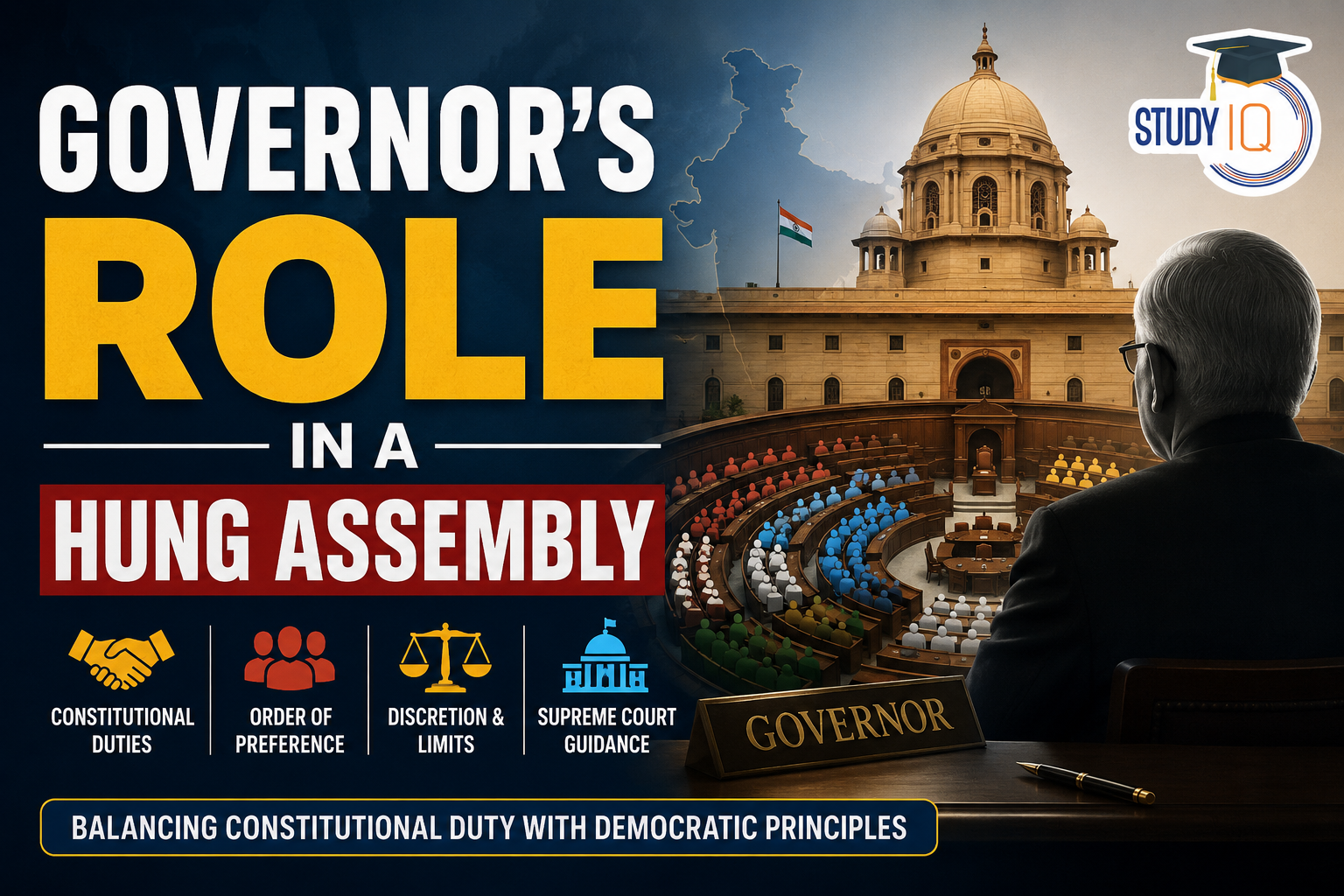
After TVK emerged as the single largest party in the 2026 Tamil Nadu Assembly elections, the Governor sought letters from 118 MLAs before inviting C. Joseph Vijay to form the government
Read Also: UPSC Daily Current Affairs 2026
Introduction to hung assembly
About hung assembly:
- A hung Assembly arises when no political party or alliance secures a clear majority in the Legislative Assembly after elections.
- In such situations, the Governor plays a crucial constitutional role in ensuring the formation of a stable government while preserving democratic and constitutional principles.
In such circumstances:
- Government formation becomes uncertain.
- Coalition-building and support from independents become important.
- The Governor must decide whom to invite to form the government.
Exploring Possibilities of Government Formation
- Consultation with Political Parties: In a hung Assembly, the Governor may consult political parties, seek information regarding alliances and verify support from independent MLAs to identify whether a stable majority government can be formed.
- Reasonable Time for Majority Formation: The Governor may allow parties some time to build alliances and demonstrate legislative support.
- However the Governor cannot delay indefinitely because prolonged uncertainty may encourage political defections, horse-trading and instability.
- Power to Dissolve the Assembly: Under Article 174(2)(b), the Governor may recommend dissolution of the Assembly if no stable government can be formed.
- The Supreme Court in the R. Kapur case and Rameshwar Prasad case recognised this constitutional power.
- Recommendation of President’s Rule: If all possibilities of government formation fail, the Governor may recommend President’s Rule under Article 356, but it is considered as an exceptional measure.
- Order of Preference in Government Formation:
- First Preference: The Sarkaria Commission recommended that priority should be given to a pre-election alliance that commands majority support to provide greater political stability.
- Second Preference: If no alliance has a majority, the Governor may invite the single largest party which demonstrates majority support through alliances, support letters and backing from independents.
- Third Preference: Post-Poll Alliances: If neither a pre-poll alliance nor the largest party secures majority support, the Governor may consider post-election coalitions.
Growing Concerns Regarding the Governor’s Discretion
- Delays in Inviting Parties to Form Government: Governors are sometimes accused of unnecessarily delaying the invitation to political parties despite clear claims of majority support, leading to political uncertainty.
- Eg: In the 2026 Tamil Nadu Assembly elections, the Governor sought physical letters of support before inviting the single largest party leader to form the government.
- Allegations of Political Bias: Critics argue that Governors may favour the ruling party at the Centre while exercising discretionary powers in States governed by opposition parties
- Misuse of Recommendation for President’s Rule: Concerns arise when Governors recommend President’s Rule without fully exploring possibilities of government formation.
- Eg: In the Rameshwar Prasad case (Bihar, 2005), the Supreme Court criticised premature dissolution of the Assembly.
- Delay in Conducting Floor Tests: Postponing floor tests can create opportunities for defections, horse-trading, and political manipulation.
- Eg: In the Karnataka crisis (2018), the Supreme Court reduced the time for the floor test from 15 days to 24 hours.
- Expansion of Discretion Beyond Constitutional Limits: Excessive reliance on personal satisfaction rather than legislative testing may weaken democratic principles and federalism.
- Eg: The Supreme Court in the S. R. Bommai case emphasised that the majority should be tested on the Assembly floor, not determined solely by the Governor.
Way Forward
- Codify Clear Guidelines: India should consider a legally binding framework and uniform procedures for hung Assembly situations
- Ensure Time-Bound Floor Tests: Floor tests should be conducted quickly to prevent instability and reduce misuse of discretion
- Strengthen Constitutional Neutrality: Governors should function strictly as Constitutional heads, neutral arbiters rather than political actors.
- Reduce Scope for Arbitrary Delays: The Supreme Court’s jurisprudence increasingly supports immediate legislative testing of majority and limited subjective discretion
 UAPA Act 1967: Key Provisions, Supreme C...
 Sarus Crane: Habitat, Features, Conserva...













 WhatsApp