
Table of Contents
Context
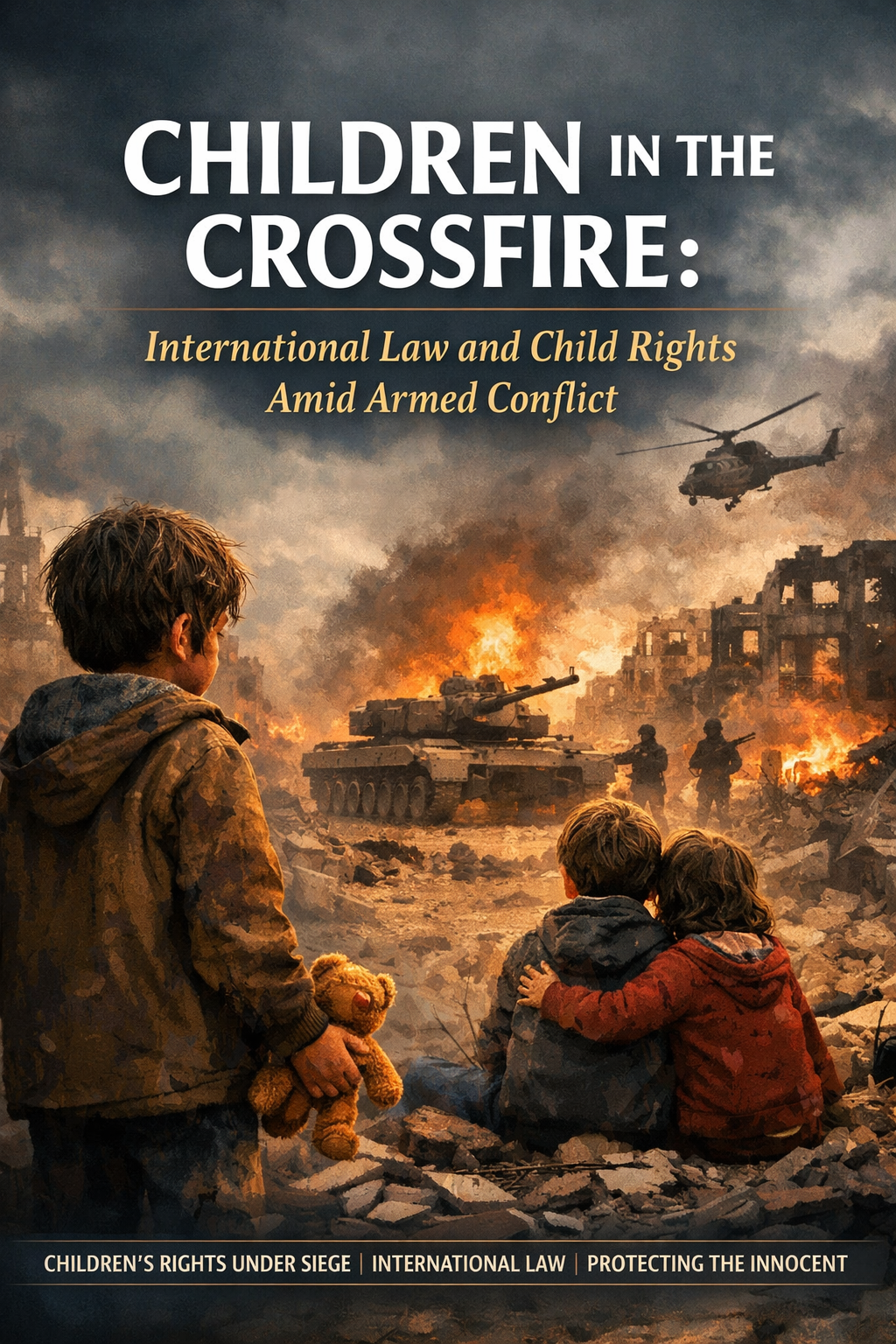
On 28 February 2026, a catastrophic event in Minab, southern Iran, highlighted the vulnerability of international legal safeguards for children in armed conflict. A precision-guided munition, allegedly a US Tomahawk cruise missile, impacted the Shajareh Tayyebeh girls’ elementary school during class hours. What ought to have been a sanctuary for safety and education was swiftly converted into a site of widespread devastation. The explosion destroyed the school, trapping students and teachers under rubble, as smoke and panic enveloped the area.
The human toll was devastating. Iranian officials recorded fatalities ranging from 168 to 180, predominantly including schoolgirls aged seven to twelve, in addition to teachers and staff. The school’s proximity to an Islamic Revolutionary Guard Corps naval base rendered it susceptible during an extensive military operation aimed at that facility. Initial inquiries, including disclosed information from US military sources, suggested a targeting error; planners neglected to ascertain the civilian status of the next building, despite accessible satellite photos and open-source intelligence affirming its position as an operational primary school.
This tragedy is not an isolated incident but a reflection of profound structural deficiencies in the enforcement of international humanitarian and human rights law. It necessitates a thorough re-evaluation of whether current legal frameworks sufficiently safeguard children in modern warfare, especially in an age characterised by precision weaponry, artificial intelligence, and real-time intelligence systems.
The Framework of Safeguards in International Law
International Humanitarian Law and the Distinction Principle
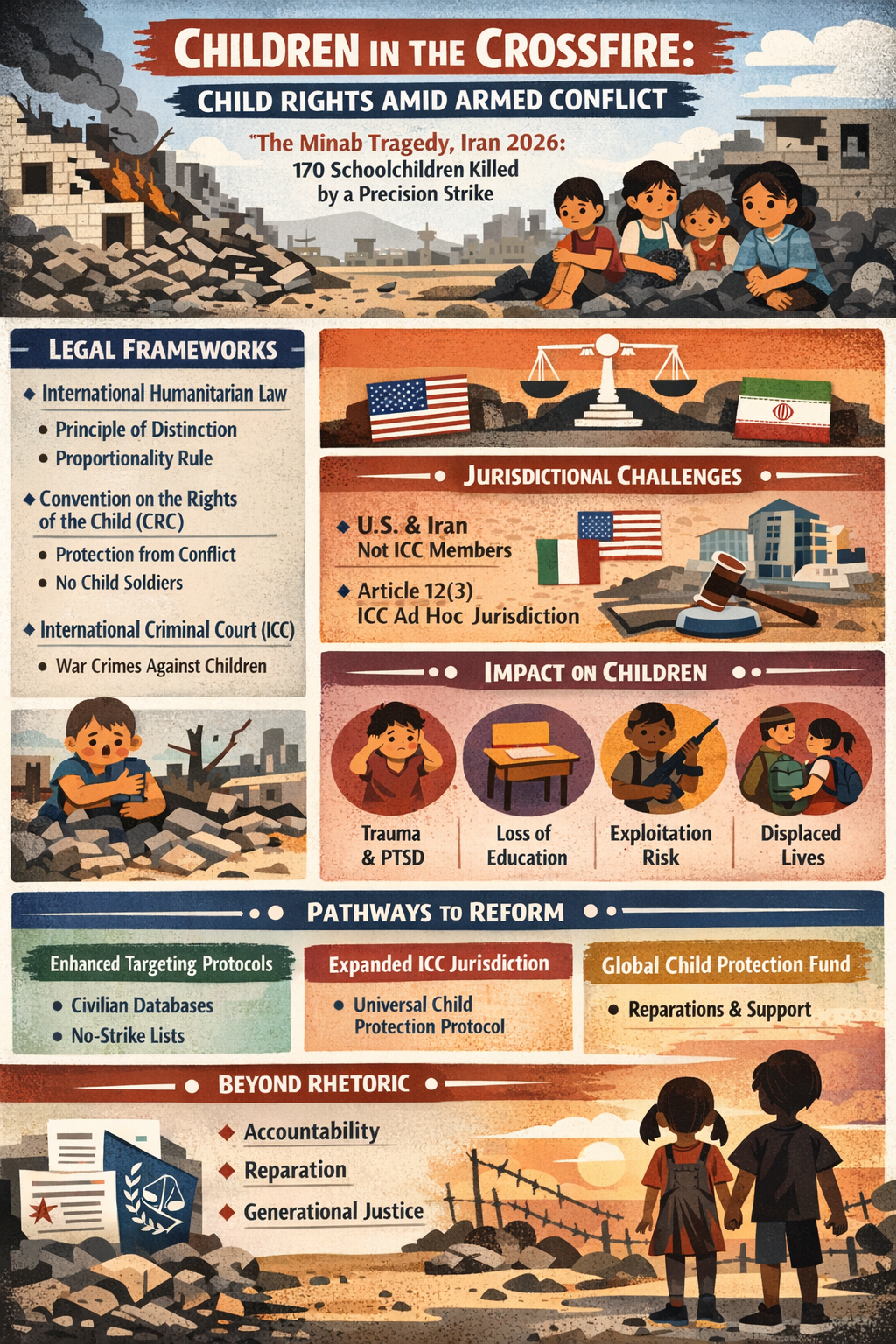
International Humanitarian Law (IHL) constitutes the fundamental legal framework regulating conduct during armed conflict. The principle of distinction, enshrined in Article 48 of Additional Protocol I to the Geneva Conventions (1977), is fundamental to International Humanitarian Law (IHL). It requires conflicting parties to consistently differentiate between civilians and combatants, as well as between civilian objects and military objectives.
Schools are inherently regarded as civilian entities and hence receive protection from attack unless they are utilised for military objectives. The Minab incident revealed no evidence indicating that the school had been converted for military purposes. Consequently, it maintained its safeguarded civilian status under International Humanitarian Law.
The Principle of Proportionality
Article 51(5)(b) of Additional Protocol I establishes the principle of proportionality, which forbids attacks likely to inflict incidental civilian harm that would be disproportionate to the clear and direct military advantage anticipated. This regulation aims to reconcile military imperatives with humanitarian concerns.
The closeness of the school to a military facility in the Minab strike presents intricate issues of proportionality. The existence of intelligence indicating an operational school implies that any expected civilian casualties were predictable. In International Humanitarian Law, foreseeability is essential for evaluating proportionality, and neglecting this aspect compromises the legitimacy of the attack.
Customary International Law and Enhanced Protections for Minors
Customary international law enhances protections for minors. Rule 135 of the International Committee of the Red Cross (ICRC) stipulates that children impacted by armed conflict are entitled to enhanced respect and protection. This indicates a broader acknowledgement that children, owing to their susceptibility, require enhanced protection.
The Minab disaster exemplifies a failure to properly operationalise these protections, highlighting issues over the disparity between normative promises and practical execution.
International Human Rights Legislation and Child Safeguarding
The Convention on the Rights of the Child (CRC)
The Convention on the Rights of the Child (CRC) serves as the foundation of international human rights law pertaining to children. Article 38 of the CRC prohibits the enlistment of anyone under the age of fifteen into military forces.
Despite the near-universal approval of the CRC, its enforcement methods are constrained. The United States has notably not ratified the Convention, complicating accountability in situations like the Minab strike.
Optional Protocol Regarding the Participation of Children in Armed Conflict (OPAC)
The Optional Protocol to the CRC concerning the involvement of children in armed conflict (OPAC) enhances protections by elevating the minimum age for direct engagement in hostilities and mandatory recruitment to eighteen years. Iran and the United States are signatories to OPAC, therefore pledging to elevated standards of child safety.
Notwithstanding these agreements, the Minab episode exemplifies the ongoing difficulties in converting legal responsibilities into practical implementation during military operations.
Oversight and Compliance Mechanisms
The United Nations Security Council has instituted monitoring measures to address six severe violations against children in armed conflict, including assaults on educational institutions and medical facilities. Countries involved in these crimes have been enumerated in UN reports regarding the conflicts in Syria, Yemen, and Gaza.
Entities like UNESCO and the Global Coalition to Protect Education from Attack record several validated occurrences each year, underscoring the pervasive nature of the issue. Nonetheless, enforcement is patchy, especially when influential states or their allies are implicated.
The Minab strike illustrates this enforcement shortfall. The legal structure explicitly forbids such attacks, although the lack of adequate accountability measures diminishes its deterrent impact.
The Principle of Foreseeability and Contemporary Warfare
A fundamental element of International Humanitarian Law is the principle of foreseeability. Military strategists must evaluate probable civilian casualties based on accessible intelligence. In modern warfare, the availability of tools such as satellite imaging, open-source intelligence platforms like Google Earth, and AI-assisted targeting systems has markedly transformed the criterion of foreseeability.
Regarding the Minab case:
- Satellite photos and public records classified the edifice as an educational institution.
- The deployment of a high-impact explosion capable of inducing structural failure heightened the probability of mass deaths.
- The school’s closeness to a military target required increased vigilance.
These elements cumulatively indicate that civilian injury was both foreseeable and preventable. The omission of such information in targeting decisions prompts significant concerns regarding adherence to International Humanitarian Law (IHL).
The Lexicon of Contemporary Warfare: “Collateral Damage” and Its Discontents
The language used in military discussions frequently conceals the human toll of warfare. Expressions like “collateral damage,” “fog of war,” and “military objective” function to obscure the harsh truths of human anguish.
The Minab incident’s classification of the hit as a targeting error exemplifies a pervasive institutional rhetoric that diminishes accountability. Nonetheless, according to international law, the legality of an attack is assessed not only by intent but also by the reasonableness of the safeguards implemented.
The transition from indiscriminate “carpet bombing” to pinpoint strikes has not eradicated innocent deaths. Instead, it has established a novel moral framework, wherein judgments are governed by algorithms and statistical risk evaluations. The Minab strike exemplifies a concerning instance of how such assessments can deem children’s lives as permissible collateral damage.
The Historical Development of Children’s Rights in Armed Conflict
The safeguarding of children in armed conflict has progressively developed throughout the last century. Initial humanitarian law mechanisms, including the Geneva Conventions of 1949, offered generic protections for civilians but failed to particularly consider the distinct vulnerability of children.
Subsequent advancements, particularly the Additional Protocols of 1977 and the CRC (1989), signified a transition towards acknowledging children as unique rights-bearing entities. This evolution signifies an enhanced comprehension of the enduring effects of armed war on children’s physical, psychological, and social development.
Notwithstanding these advancements, the recurrence of situations such as Minab demonstrates that legal standards alone are inadequate. Effective protection necessitates not only strong legal frameworks but also political will, institutional capability, and accountability mechanisms.
International Criminal Law and the Constraints of Accountability
The Rome Statute and War Crimes Against Children
International criminal law establishes a framework for individual culpability over grave breaches of international humanitarian law. The Rome Statute of the International Criminal Court (ICC) unequivocally criminalises attacks on people and civilian entities. Article 8(2)(b)(i) and (ii) categorise as war crimes the deliberate targeting of civilians and civilian infrastructure, including educational facilities.
The Minab strike, which led to the fatalities of some 170 students and teachers, possibly meets the legal criteria for a war crime. The Elements of Crimes under the Rome Statute designate schools as protected civilian entities, and the predictability of civilian injury reinforces the argument for criminal accountability.
The ICC has repeatedly shown its readiness to pursue offences involving children. In Prosecutor v. Thomas Lubanga Dyilo, the Court achieved its first conviction for the conscription and enlistment of child soldiers. In Prosecutor v. Bosco Ntaganda, the Court examined offences, including sexual violence against minors within armed factions. These cases highlight the Court’s acknowledgement of children as a unique and vulnerable group deserving of special protection.
Nonetheless, notwithstanding the evident relevance of the Rome Statute to the Minab episode, jurisdictional constraints substantially hinder accountability.
Jurisdictional Limitations and Geopolitical Conditions
A primary obstacle in pursuing the Minab strike resides in the jurisdictional structure of the ICC. Neither the United States nor Iran is a State Party to the Rome Statute. Although Iran has signed the Statute, it has not completely ratified or implemented it within its domestic framework. The United States has traditionally opposed the ICC, implementing measures like the American Servicemembers’ Protection Act and putting sanctions on ICC officials.
The potential for ICC jurisdiction is contingent upon alternative methods. Article 12(3) of the Rome Statute permits non-State Parties to consent to the Court’s jurisdiction on an ad hoc basis for particular crimes occurring within their territory. This clause has been effectively utilised by nations including Ukraine and Palestine.
Human rights organisations have pushed Iran to issue a declaration about the atrocities perpetrated since 28 February 2026. If approved, this would empower the ICC Prosecutor to examine the Minab strike and other incidents independently of a referral from the United Nations Security Council (UNSC), whose veto powers frequently hinder accountability.
Nonetheless, this course is laden with political hazards. The ICC depends significantly on state collaboration for apprehensions and enforcement actions. In instances involving dominant nations or their allies, diplomatic coercion, financial threats, and geopolitical factors frequently compromise the Court’s efficacy. The Minab victims face a paradox: their deaths are legally recognised as war crimes, yet they remain mostly inaccessible to international justice.
The Function of the Judiciary in Safeguarding Child Rights
Judicial Responses at International and Domestic Levels
Judicial institutions are essential in interpreting and enforcing children’s rights during armed conflict. International tribunals, regional courts, and domestic judiciaries collectively enhance jurisprudence that fortifies legal rights.
The ICC’s jurisprudence has increasingly acknowledged the severity of crimes against minors. Moreover, international tribunals, including the International Court of Justice (ICJ), have confirmed the relevance of human rights duties in the context of armed conflict, thereby strengthening the relationship between International Humanitarian Law (IHL) and human rights law.
Domestic tribunals also provide a crucial function. In numerous jurisdictions, courts have employed constitutional and human rights concepts to hold governments accountable for violations impacting children. Although these measures may not directly tackle cross-border military operations, they foster a wider culture of accountability.
Societal Consequences of Transgressions Against Minors
Prolonged Ramifications
The ramifications of armed conflict on children surpass mere immediate casualties. Survivors frequently encounter:
- Acute psychological trauma, encompassing post-traumatic stress disorder (PTSD)
- Interruption of schooling and forfeiture of prospects
- Social dislocation and disintegration of familial structures
- Heightened susceptibility to exploitation and enlistment in armed factions
The obliteration of educational institutions, shown by the situation in Minab, yields profoundly detrimental effects. Schools are not just physical edifices but environments of security, consistency, and growth. Their absence undermines the social structure and sustains cycles of violence and poverty.
Degradation of Normative Frameworks
Continual infringements of children’s rights in conflict areas undermine the normative authority of international law. The credibility of legal systems degrades when states neglect established principles without incurring repercussions. This establishes a perilous precedent, normalising transgressions and compromising initiatives to safeguard at-risk populations.
Transitioning from Rhetoric to Reform: Structural Reconfiguration
Technological and Operational Reforms
The Minab disaster highlights the necessity of including legal protections in military operations. A proposed improvement is the compulsory integration of civilian infrastructure databases into targeting systems. Verified and updated “no-strike” lists from impartial entities like the United Nations Office for the Coordination of Humanitarian Affairs (OCHA) or the International Committee of the Red Cross (ICRC) might markedly diminish the likelihood of civilian object targeting.
Moreover, AI-enhanced targeting systems ought to use overlays of child population density obtained from satellite images and terrestrial intelligence. Such approaches would augment the capacity of military strategists to evaluate risks and adhere to International Humanitarian Law (IHL).
Addressing the Jurisdictional Void
Overcoming the constraints of the ICC necessitates inventive strategies. A proposal suggests the implementation of a new Optional Protocol to the Rome Statute that would provide automatic jurisdiction over grave crimes concerning minors, regardless of state ratification. Alternatively, regional tribunals or hybrid courts possessing universal jurisdiction may offer mechanisms for accountability.
Encouraging nations such as Iran to invoke Article 12(3) constitutes a pragmatic measure to broaden jurisdiction, despite the existence of ongoing impediments.
Transcending Criminal Accountability
Although criminal prosecution is crucial, it is inadequate. An exhaustive strategy for accountability must encompass reparations, rehabilitation, and institutional transformation. The creation of a Global Child Protection in Conflict Fund might offer financial and psychological assistance to impacted children and communities.
Such projects would enhance legal frameworks by tackling the wider ramifications of conflict and fostering sustainable rehabilitation.
Reevaluating Military Necessity and Ethical Accountability
The notion of military necessity requires re-assessment considering current circumstances. Conventional interpretations frequently emphasise strategic goals at the expense of humanitarian concerns. Nonetheless, the anticipated loss of an entire generation of children cannot be rationalised by any military benefit.
A transition to a paradigm of generational justice is essential. This methodology highlights the enduring effects of violence on children and future communities, altering the standards of permissible behaviour in warfare.

The Function of Global Governance and Shared Accountability
Safeguarding children in violent conflict necessitates synchronised efforts on a worldwide scale. The United Nations, with initiatives like the Children and Armed Conflict agenda, is crucial in overseeing infractions and fostering adherence.
Nevertheless, current procedures must transition from symbolic reporting to actionable enforcement plans. Increased focus must be directed towards compliance monitoring, penalties for non-compliance, and the incorporation of child protection factors into peacekeeping and conflict resolution initiatives.
Conclusion
The Minab tragedy serves as a stark condemnation of the inadequacies of international law in safeguarding children during armed conflict. Notwithstanding the presence of extensive legal frameworks, such as International Humanitarian Law, human rights law, and international criminal law, deficiencies in enforcement and political resolve persistently compromise their efficacy.
The episode underscores the pressing necessity for structural reforms, encompassing improved technology safeguards, broadened jurisdictional processes, and thorough accountability frameworks. It advocates for a redefinition of the ethical principles of warfare, prioritising the protection of children in global agendas.
Ultimately, the inquiry is not whether the international community has the legal mechanisms to safeguard children- it does. The difficulty resides in the readiness of states to adopt these instruments and to maintain the ideas they represent. The fatalities in Minab necessitate not only commemoration but also substantive measures to prevent the recurrence of such catastrophes.

 Supreme Court Dowry Enforcement Order 20...
 Supreme Court Modifies 3-Year Practice R...
 Doctrine of Per Incuriam Explained: Supr...








 WhatsApp





