Table of Contents
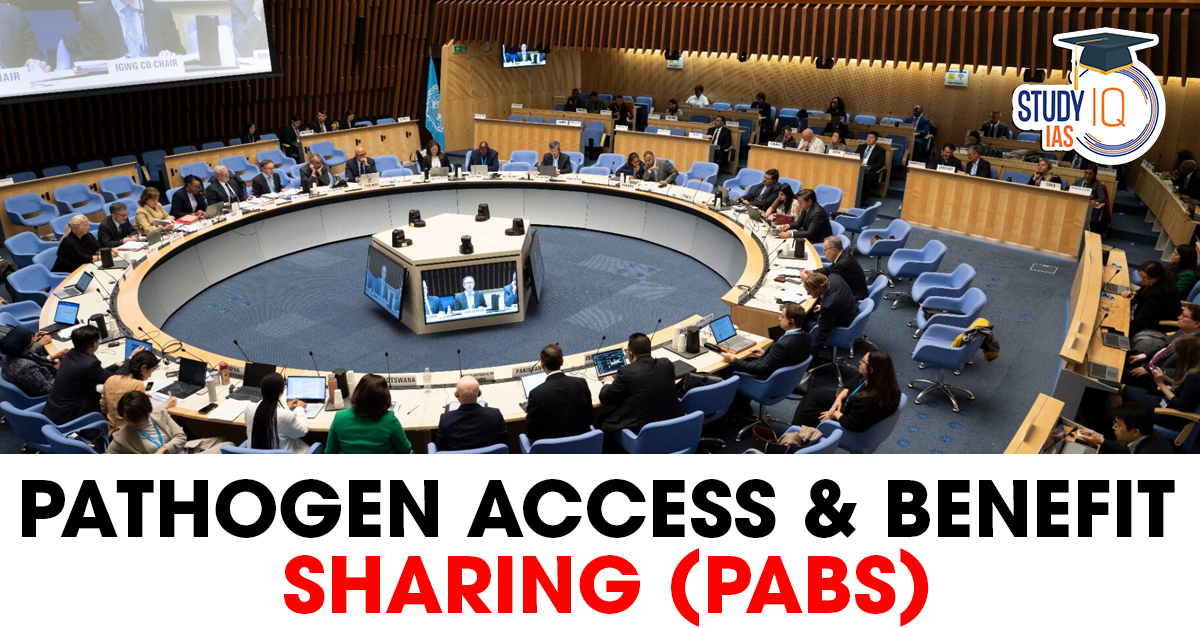
Context: Negotiations for the Pathogen Access and Benefit Sharing (PABS) framework are in the last stages.
About Pathogen Access & Benefit Sharing (PABS)
- Pathogen Access & Benefit Sharing (PABS) is the operational heart of the Pandemic Agreement. It is being negotiated as a separate “Annex” (specifically under Article 12). Without this Annex, the Agreement has no mechanism to actually distribute vaccines or ensure that data sharing happens fairly.
- PABS is the legally binding mechanism under Article 12 of the WHO Pandemic Agreement. It operates as a global “quid pro quo”: Rapid Pathogen Access in exchange for Fair Benefit-Sharing.
- Essentially, PABS is a global trade agreement: Countries share the virus data, and in exchange, they are guaranteed a share of the cure.
- The PABS system is intended to be a multilateral, legally binding framework that creates an “equal footing” between two demands that were previously disconnected:
- Rapid Access: When a new dangerous pathogen is discovered, countries agree to share:
- Physical Samples: The actual biological material (e.g., a “slime in a vial”).
- Genetic Sequence Data (GSD): The digital code or “blueprint” of the virus.
- Timeline: This sharing must be “rapid,” allowing scientists and companies to start working on vaccines and tests immediately.
- Benefit-Sharing: In return for this access, pharmaceutical companies that use the PABS materials must sign legally binding contracts with the WHO. These contracts typically include:
- 20% Rule: Manufacturers must reserve 20% of their real-time production of pandemic products (vaccines, treatments, tests).
- 10% is donated for free to the WHO.
- 10% is provided at affordable, non-profit prices.
- Monetary Contributions: Companies may pay an annual fee to fund global preparedness.
- Tech Transfer: Encouraging companies to share their “recipe” so that vaccines can be produced locally in Africa, Asia, and Latin America.
Issues Currently being Debated under PABS
| Feature | The Current “Draft” Reality |
| The 20% Rule | Manufacturers would be required to give 10% of their production for free and 10% at non-profit prices to the WHO. |
| GSD Tracking | Negotiators are debating how to track users of digital sequence data to ensure that “digital biopiracy” (using data without sharing benefits) doesn’t happen. |
| Standardized Contracts | Instead of case-by-case deals, the WHO wants standardised, enforceable contracts that every manufacturer must sign to access the PABS data library. |
| One Health Scope | There is still a debate on whether PABS should cover only human viruses or also zoonotic pathogens found in animals before they jump to humans. |
North vs South Debate
- Global South (The Group for Equity): Led by countries like India, Brazil, and the African Group, they insist that sharing pathogens must be legally tied to benefit-sharing. They refuse to sign a treaty that leaves benefits up to “voluntary” corporate charity.
- Global North (EU, USA, etc.): While they agree with the principle, they are concerned that strict mandatory registration and production quotas could stifle innovation or create legal conflicts with intellectual property rights.
Need for Pathogen Access and Benefit Sharing (PABS) Framework
- Inequity Gap: During COVID-19, high-income nations reached 50% vaccination by early 2021, while low-income nations remained below 1%.
- “Data Trap”: Countries like South Africa and India shared genomic data on new variants (like Omicron) immediately, only to be met with travel bans and “last-in-line” status for vaccines. PABS ensures data providers are the first to benefit, not the last.
- Problem with Goodwill: Historically, global health relied on voluntary donations (like COVAX), which often resulted in “near-expiry” doses or being outbid by wealthy nations.
- Legal Shift: PABS replaces “maybe” with “must.” It uses standardized, legally binding contracts so that access to a pathogen’s “blueprint” is legally tied to a commitment to share the final product.
- Digital Loophole: Modern mRNA technology allows companies to “print” vaccines using only Genetic Sequence Data (GSD) downloaded from the internet, bypassing the need for physical samples.
- PABS Solution: It closes the loophole by ensuring that digital access triggers the same benefit-sharing obligations as physical samples, ensuring profit-makers give back to the data-originators.
- Transparency vs. Fear: If countries fear economic punishment (like travel bans) or lack of medicine, they may hide new outbreaks (e.g., Bird Flu).
- “20% Insurance”: By guaranteeing a 20% production reserve (10% free, 10% at cost), PABS provides a national security incentive for countries to report threats early, making the entire world safer.
- Zoonotic Tracking: With 75% of new diseases originating in animals, PABS aims to create a unified system to track pathogens before they jump to humans.
- Unified Surveillance: It provides the formal structure needed to monitor animal-to-human spillover, ensuring a coordinated global response rather than a fragmented one.

 QDENGA Dengue Vaccine: India’s First A...
 Skyroot Vikram-1 Mission Aagaman: India'...
 Oor Pare Prehistoric Site: Location, Roc...











 WhatsApp