
Table of Contents
Context
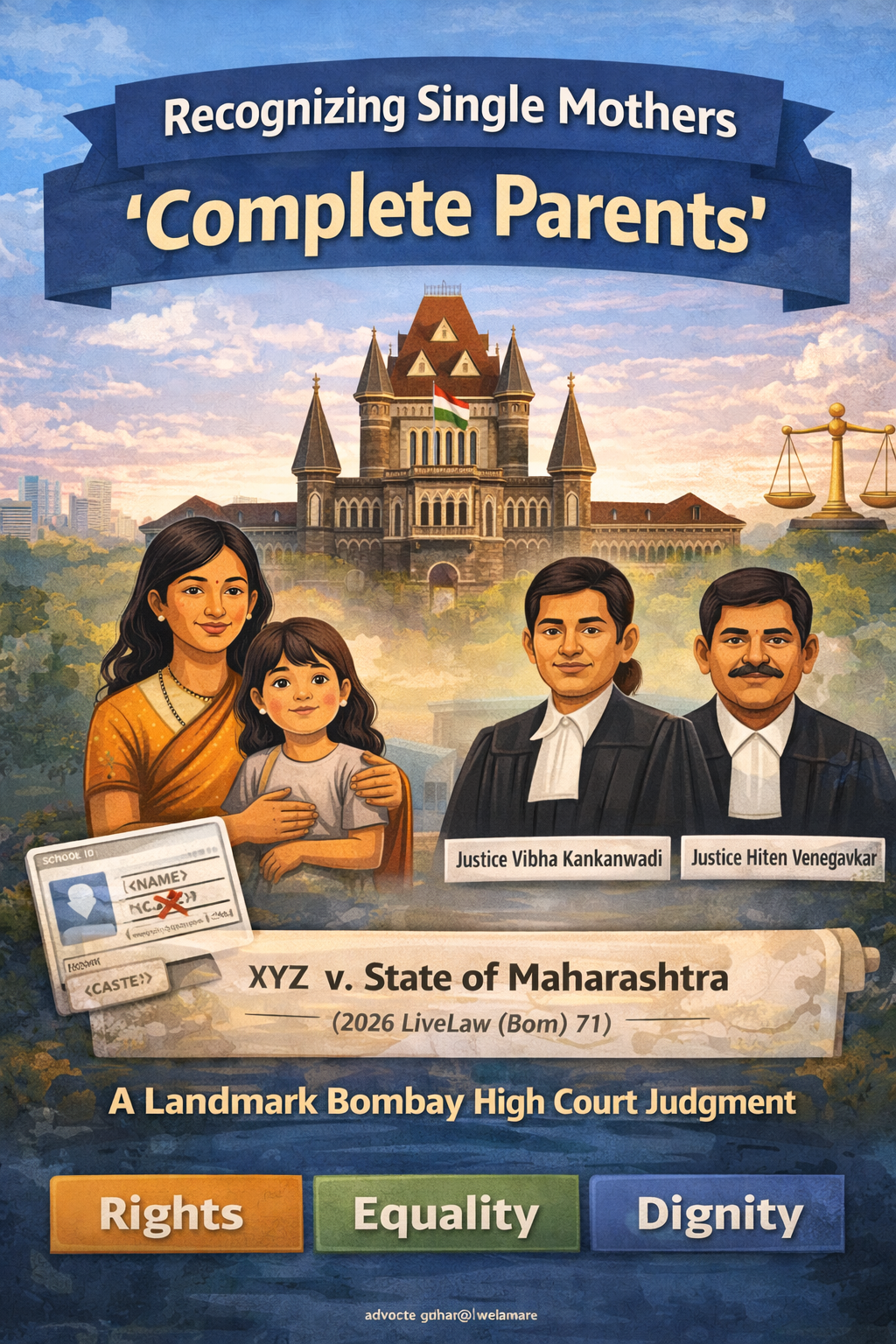
The recent judgment of the Bombay High Court in XYZ v. State of Maharashtra (Writ Petition 15528 of 2025), 2026 LiveLaw (Bom) 71, signifies a key development in Indian constitutional and family law doctrine. The Court emphasised that removing the biological father’s name from a minor girl’s school records and amending her caste designation from her father’s caste (Maratha) to her mother’s caste (Mahar, Scheduled Caste) signifies that acknowledging a single mother as a full parent is not a mere act of benevolence but a reflection of constitutional fidelity.
The decision signifies a definitive transition from patriarchal assumptions to dignity-centred constitutional citizenship and strengthens the judiciary’s function in safeguarding children and single mothers against administrative and social injustices.
Background and Details of the Case
A petition was jointly submitted to the Bombay High Court by a 12-year-old child and her mother. The mother was a victim of rape, and the biological father of the child was the defendant in the criminal case. Following DNA testing that verified paternity, the mother and the alleged father reached a settlement in which he renounced any role, duty, or relationship with the child. The mother assumed exclusive responsibility for the child’s upbringing and custody.
Notwithstanding this reality, standard administrative procedures led to the father’s name being inscribed on the child’s birth certificate and educational records. The child’s caste was documented as that of the father (Maratha), despite the child being raised exclusively within the mother’s Mahar Scheduled Caste community. The mother requested correction of the records, but the school authorities denied her request, leading to the appeal in the High Court.
Constitutional Reasoning
The Division Bench of Justice Vibha Kankanwadi and Justice Hiten Venegavkar issued a strong judgment underscoring constitutional dignity, equality, and the welfare of children. The Court held that acknowledging a single mother as a fully-fledged parent is an issue of constitutional integrity, rather than benevolence. The ruling expressed a transition from patriarchal obligation to constitutional autonomy, and from lineage-based identification to dignity-centred rights.
Article 21: Right to Dignity and Identity
The Court emphasised that Article 21 of the Constitution of India safeguards not only physical existence but also life with dignity. The identification of a child, encompassing the name and caste recorded in public documents, is essential to their dignity. Compelling a child to accept the name and caste of an absent father, especially one charged with a serious crime, has no beneficial outcome and causes unnecessary social and psychological distress.
The Court noted that school records are public documentation that accompany a child across several institutions and into their professional life. Consequently, administrative structures must embody actual experiences rather than patriarchal presuppositions.
Article 14: Equality and Anti-Patriarchal Constitutionalism
The Court, referencing Article 14, determined that the presumption that identity must derive from the father is not a neutral administrative default but rather a patriarchal presupposition. Insisting on paternal identification in instances of sole maternal guardianship imposes a structural burden on women and children, violating the principle of equality by making citizenship dependent on a male intermediary.
Directive Principles: Articles 39(f) and 46
The Court cited Articles 39(f) and 46, which mandate the State to safeguard children and develop the educational and economic interests of the Scheduled Castes. Academic records must not serve as tools of stigma or harm. The denial to amend the child’s records was described as bureaucratic lethargy at odds with constitutional advancement.
Caste Identity and Societal Reality
The Court meticulously weighed the issues of caste certificate exploitation against the responsibilities of educational institutions in caste validation. It highlighted that although schools do not serve as caste-determining authority, they cannot obligate a child raised solely inside the mother’s Scheduled Caste community to adopt the father’s caste identity. The modification was presented not as a voluntary caste alteration but as a repair that mirrors social and legal realities.
The ruling acknowledged that caste classifications affect access to benefits, social acceptance, and psychological affiliation. Imposing the father’s caste upon the child may result in ostracism from the father’s society and ambiguity within the mother’s community, thereby compromising dignity and social integration.
The Role of Mothers as Custodians Under Hindu Jurisprudence
Historically, under traditional Hindu law, guardianship was patriarchal, with the father considered the primary guardian and the mother assuming a subordinate role. This patriarchal structure was formalised in early judicial interpretations and bolstered by social practices that favoured paternal lineage.
The Hindu Minority and Guardianship Act of 1956 (HMGA) represented a substantial transformation. Section 6 of the HMGA designates the father as the natural guardian of a legitimate minor child, succeeded by the mother; nonetheless, this article has been gradually construed by the judiciary. In instances of illegitimate children, the mother is acknowledged as the natural guardian.
In Githa Hariharan v. Reserve Bank of India (1999), the Supreme Court construed the phrase “after the father” in Section 6 to signify “in the absence of the father,” regardless of whether this absence is due to death, incapacity, or disinterest. This pivotal verdict enhanced the mother’s role and confirmed her position as a natural caregiver in a practical sense.
In ABC v. State (NCT of Delhi) (2015), the Supreme Court determined that an unwed mother may serve as the exclusive legal guardian of her child without revealing the father’s identity. This ruling affirmed the independence of single mothers and prioritised child welfare above patriarchal norms.
The Bombay High Court decision expands upon this legal principle by holding that a female who is the sole caregiver should be regarded as the sole parent for civic identity purposes.

Hindu Minority and Guardianship Act, 1956: Context and Significance
The HMGA was enacted as part of the Hindu Code Bills to reform Hindu personal law. The aims encompass the safeguarding of minors, the acknowledgement of guardianship rights, and the harmonisation of personal law with constitutional principles.
Fundamental Provisions
Section 4 delineates a minor as an individual under the age of 18 years.
Section 6 delineates natural guardians for both legitimate and illegitimate children.
Section 13 stipulates that the welfare of the minor is the paramount consideration in guardianship matters.
The HMGA embodies a synthesis of conventional Hindu law and contemporary legal doctrines. Although it initially maintained patriarchal systems, judicial interpretation has gradually conformed it to constitutional principles of equality and dignity.
In modern India, the HMGA is pertinent not only for custody conflicts but also for matters of identification, documentation, and social entitlements. The Act’s focus on child welfare establishes a legal basis for decisions such as the Bombay High Court’s order.
Influence on Society and Administrative Procedures
The decision carries substantial social and administrative consequences. It confronts established bureaucratic practices that favour paternal identification while marginalizing mother identity. The Court asserted that state formats should serve as precise tools of welfare rather than moral evaluations, highlighting the transforming function of constitutionalism in daily governance.
The ruling further promotes the rights of rape survivors and single mothers, reducing stigma and validating their parental legitimacy. It acknowledges that identity documentation can influence social perception, peer behaviour, and access to affirmative action benefits, especially for Scheduled Castes.
The Court facilitates the amendment of caste entries in school records, enabling students from marginalised communities to obtain constitutional protections and assistance programs.
The Function of the Judiciary in Transformative Constitutionalism
The Indian judiciary has been instrumental in deconstructing patriarchal standards within family law. Courts have broadened women’s rights and child welfare protections through the progressive interpretation of statutes and constitutional provisions.
Notable cases encompass:
- Githa Hariharan v. RBI (1999): Acknowledged mothers as natural guardians in the absence of the father.
- ABC v. State (NCT of Delhi) (2015): Acknowledged unmarried women as exclusive guardians without the necessity of paternal identification.
- Danamma v. Amar (2018): Upheld daughters’ equal coparcenary rights pursuant to Hindu succession law.
The Bombay High Court’s ruling is consistent with the trend of transformative constitutionalism, wherein judges reinterpret legislation to conform with modern social realities and constitutional principles.
Normative Framework within International Human Rights Law
International human rights law progressively acknowledges family diversity, gender equality, and the paramount importance of the child’s best interests. The acknowledgement of a single mother as a fully-fledged parent, alongside a child’s right to an identity that mirrors their experienced social reality, is consistent with global standards enshrined in international treaties, customary international law, and soft-law instruments. These frameworks jointly contest patriarchal legal norms and advocate for dignity, equality, and non-discrimination in personal identification and family law.
The Bombay High Court’s rationale aligns with the global trend of shifting from inflexible patriarchal lineage systems to rights-based and child-centric legal identities. International law no longer considers paternal lineage as the exclusive basis for legal identity; it now acknowledges diverse family structures and emphasises substantive equality over rigid administrative conventions.
Convention on the Rights of the Child (CRC): Primacy of Best Interests and Identity
The United Nations Convention on the Rights of the Child, 1989 (CRC), of which India is a State Party, represents the most extensive international framework regulating children’s rights. Article 3 stipulates that the paramount factor in all activities regarding children will be their best interests. Article 7 acknowledges the child’s entitlement to a name, nationality, and identity, but Article 8 mandates States to uphold and safeguard a child’s identity, encompassing familial connections.
In the realm of educational records and caste identification, compelling a child to adopt the name and caste of an absent or antagonistic parent contravenes the principle of best interests and the child’s right to identity. The CRC Committee has continuously underscored that identity should embody the child’s actual experiences and psychological health, rather than solely formal biological connections. The Court’s emphasis on the child’s social context, psychological affiliation, and well-being reflects the CRC’s comprehensive perspective on identity.
Convention on the Elimination of All Forms of Discrimination Against Women (CEDAW)
CEDAW, 1979, mandates States to eradicate discrimination against women in all domains, including familial connections (Article 16). The Convention specifically advocates for parity in parental rights and obligations, contesting legal frameworks that favour paternal authority or lineage. The default emphasis on paternal recognition in public documents results in indirect discrimination against women by rendering mothers administratively subordinate, notwithstanding their significant caregiving responsibilities.
The CEDAW Committee has condemned patriarchal documentation practices that obliterate maternal identity or regard women as subordinate to male guardianship. Recognising a single mother as a full parent corresponds with CEDAW’s demand for substantive equality and promotes gender justice by ensuring that women’s caregiving efforts are acknowledged within legal identification frameworks.
International Covenant on Civil and Political Rights (ICCPR) and Human Dignity
The ICCPR of 1966 codifies the rights to privacy, family life, and dignity (Articles 17 and 23), together with equality before the law (Article 26). Administrative demands for paternity identity, when lacking reasonable justification and causing harm, infringe upon privacy and family life. It also perpetuates gender-based inequity, violating the non-discrimination principle outlined in Article 26.
The jurisprudence of the Human Rights Committee emphasises that States are obligated to honour various family structures and refrain from enforcing traditional patriarchal models that undermine individual autonomy and dignity. The Bombay High Court’s assertion that identity should not be “forcibly tethered” to an absent father embodies ICCPR-based dignity jurisprudence.
Global Soft Law and Policy Instruments
UNICEF, UN Women, and other international organisations have provided policy recommendations encouraging States to update civil registration systems to reflect varied family configurations. The UN Special Rapporteur on violence against women has emphasised that patriarchal documentation practices might sustain stigma towards children born outside conventional family structures, especially those conceived via sexual abuse.
The Yogyakarta Principles, while predominantly addressing sexual orientation and gender identity, also underscore the right to legal recognition and the significance of documentation that accurately represents lived identity rather than imposed classifications. These principles facilitate a wider normative transition towards self-determined and welfare-oriented identity frameworks.

Convergence of Caste, Identity, and Global Equality Standards
Caste, while a distinct social structure in South Asia, is acknowledged by international law as a type of unlawful discrimination based on descent. The UN Committee on the Elimination of Racial Discrimination (CERD) has tackled caste bias as a form of descent-based discrimination, encouraging States to mitigate stigma and guarantee equitable access to social benefits.
The Bombay High Court’s acknowledgement that caste listings in educational records influence access to rights, societal perception, and psychological belonging aligns with CERD’s focus on addressing structural discrimination. Amending caste identity to accurately represent the child’s actual community affiliation is consistent with international anti-discrimination standards and the principle of substantive equality.
Child-Centric Jurisprudence and the Doctrine of Evolving Capacities
International child rights law progressively acknowledges children as rights-holders with developing capacities. Legal identity is regarded not solely as a bureaucratic characteristic but as an element of personal autonomy and psychological growth. Coercing a child to adopt a prescribed paternal identity undermines the child’s developing self-concept and contravenes the child-centred ideals outlined in the CRC.
The Court’s focus on psychological belonging and social integration aligns with international child psychology and rights-based jurisprudence, which prioritise the child’s subjective experience in conjunction with objective welfare factors.
Transition from Patriarchal Lineage to Rights-Based Identity
Historically, numerous legal systems emphasised patrilineal ancestry for identification, inheritance, and social standing. Contemporary international law increasingly repudiates patriarchal norms in favour of gender equality and child-centric frameworks. Legal identity is now understood as a function of caregiving, social reality, and dignity, rather than solely biological lineage.
The ruling of the Bombay High Court shows this global normative transition. By dismissing the inherent prioritisation of paternal identity and acknowledging maternal identity as whole and adequate, the Court aligns Indian constitutional jurisprudence with advancing international human rights norms.

Conclusion
The Bombay High Court’s decision exemplifies the judiciary’s function as a conduit between national constitutional principles and international human rights standards. By basing its rationale on dignity, equality, and child welfare, the Court tacitly aligns Indian law with international human rights principles. The acknowledgement of a single mother as a fully-fledged parent is not only a domestic constitutional requirement but also indicative of India’s international commitments to safeguard women and children from systemic discrimination.
This ruling enhances international regulations regarding family diversity, child identity, and gender equality. It asserts that legal identity should embody lived experiences and dignity, and that States must progress beyond patriarchal administrative customs to meet their constitutional and international human rights obligations.

 Supreme Court on Plaint Amendment After ...
 Supreme Court on Children's Right to Int...
 Supreme Court Dowry Enforcement Order 20...






 WhatsApp





