
Table of Contents
What Is Civil Services Day 2026?
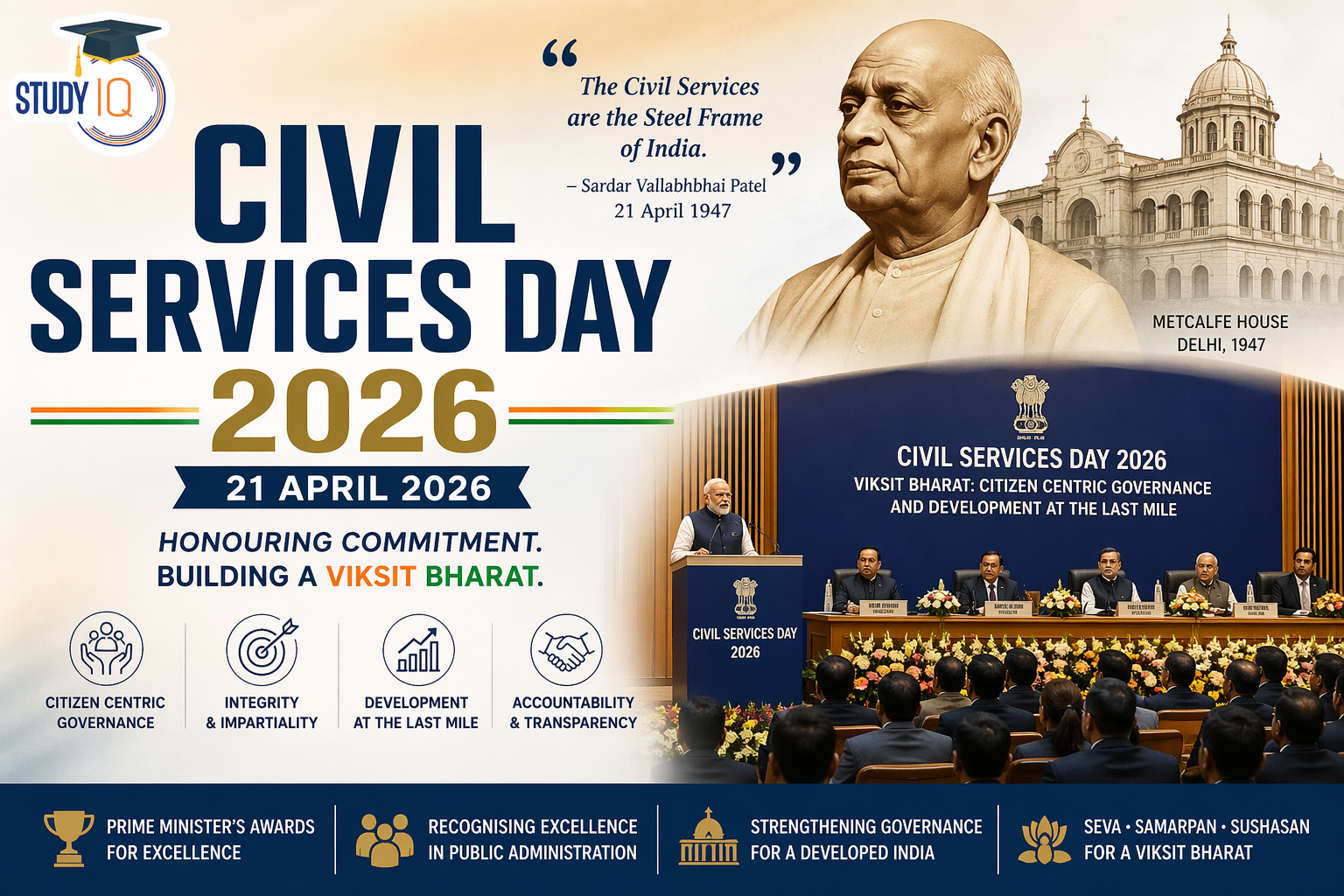
Civil Services Day 2026 is observed every year on April 21 across India to honour the dedication, integrity, and service of civil servants who form the backbone of Indian governance. It is a day for civil servants at all levels — from the Union Government to the states and districts — to recommit themselves to the ideals of public service and citizen-centric administration.
The event is organized by the Department of Administrative Reforms and Public Grievances (DARPG) under the Ministry of Personnel, Public Grievances and Pensions. It serves as a national platform for recognizing excellence, sharing best practices, and deliberating on key governance priorities.
Civil Services Day 2026: Key Highlights at a Glance
| Detail | Information |
|---|---|
| Date | April 21, 2026 |
| Edition | 18th National Civil Services Day |
| Venue | Vigyan Bhawan, New Delhi |
| Organising Body | DARPG, Ministry of Personnel, Public Grievances and Pensions |
| Theme | Viksit Bharat: Citizen-Centric Governance and Development at the Last Mile |
| Chief Guest | Vice President of India, C. P. Radhakrishnan |
| Key Award | Prime Minister’s Awards for Excellence in Public Administration |
Civil Services Day 2026 Theme
The theme for Civil Services Day 2026 is:
“Viksit Bharat: Citizen-Centric Governance and Development at the Last Mile”
This theme encapsulates India’s administrative vision for the coming decades. It focuses on:
- Viksit Bharat (Developed India): Aligning civil services with India’s goal of becoming a fully developed nation by 2047, the centenary of independence.
- Citizen-Centric Governance: Placing the citizen at the heart of every policy, scheme, and administrative decision.
- Development at the Last Mile: Ensuring that the benefits of government programmes reach the most remote and underserved communities — not just urban centres.
The theme reflects a decisive shift in India’s administrative philosophy — from a command-and-control model inherited from the colonial era to a service-delivery model rooted in transparency, accountability, and technology.
Historical Background: Why April 21?
Sardar Patel’s Landmark 1947 Address
The choice of April 21 as Civil Services Day is deeply rooted in India’s post-independence history. On April 21, 1947 — months before India officially became independent — Sardar Vallabhbhai Patel, the first Home Minister and Deputy Prime Minister of India, addressed the first batch of probationers of the All India Administrative Service (AIAS, later renamed IAS) at Metcalfe House, New Delhi.
In that historic address, Sardar Patel described civil servants as the “Steel Frame of India” — a phrase that has since become synonymous with the Indian Administrative Service. He urged civil servants to uphold integrity, neutrality, and impartiality in their service, warning that without a strong, incorruptible administrative backbone, the newly independent nation could not survive.
His words remain as relevant today as they were in 1947:
“You will have to be impartial and independent to serve well. It is not a service to your political masters, it is a service to your country.”
Constitutional Recognition (1950)
After Independence, the Constitution of India formally retained and restructured the civil services. Part XIV of the Constitution (Articles 308–323) deals with Services under the Union and States. The All India Services — the IAS (Indian Administrative Service), IPS (Indian Police Service), and IFoS (Indian Forest Service) — were established to provide unified, professional governance across the country.
Formal Declaration in 2006
The Government of India officially declared April 21 as National Civil Services Day in 2006, institutionalising the annual recognition of civil services. The first National Civil Services Day was observed on April 21, 2006, at Vigyan Bhawan, New Delhi — a tradition that continues to this day.
Civil Services Day 2026: Events and Programme
Chief Guest
The Vice President of India, Shri C. P. Radhakrishnan, is the Chief Guest at Civil Services Day 2026. He will deliver the keynote address, emphasizing the importance of integrity, accountability, and citizen-centric governance in strengthening India’s administrative framework.
Prime Minister’s Awards Ceremony
The centrepiece of Civil Services Day is the presentation of the Prime Minister’s Awards for Excellence in Public Administration. The Prime Minister presents these awards to districts and government organizations that have demonstrated outstanding and innovative work in public service delivery.
Breakaway Sessions
Four thematic breakaway sessions are organised to deliberate on key governance priorities. One notable session is:
“Sustainable Livelihood through PM Vishwakarma”
- Focus: Strengthening livelihood opportunities for traditional artisans and craftspersons
- Chaired by: Shri Jitan Ram Manjhi, Union Minister for Micro, Small and Medium Enterprises
These sessions bring together senior civil servants from the Centre and States to exchange ideas, share successful models, and chart a course for governance reform.
Prime Minister’s Awards for Excellence in Public Administration 2026
The PM’s Awards for Excellence in Public Administration are the most prestigious recognition for civil servants in India. They are awarded under three main categories:
1. Holistic Development of Districts
This category recognizes districts that have achieved overall progress across multiple development indicators — health, education, infrastructure, sanitation, and economic growth — through coordinated governance and effective implementation of public welfare schemes.
It rewards districts where the District Collector and local administration have worked in a cohesive, multi-sectoral manner to uplift the entire population.
2. Aspirational Blocks Programme
Launched to mirror the success of the Aspirational Districts Programme, the Aspirational Blocks Programme targets the most underdeveloped administrative blocks in the country. This award category recognizes blocks that have shown significant improvement in socio-economic indicators — such as infant mortality rate, school enrolment, income levels, and access to clean water and sanitation — through targeted government interventions.
3. Innovation Category
Innovation is at the heart of modern governance. This category highlights districts or organizations that have introduced creative, technology-driven, or process-level innovations that:
- Improve the quality and speed of public service delivery
- Can be replicated in other districts or states
- Strengthen citizen-government interaction
- Reduce corruption or leakage in scheme implementation
Significance of Civil Services Day 2026
1. Reaffirming the Constitutional Mandate
Civil Services Day is a reminder that Indian civil servants are servants of the Constitution — not of any political party, government, or ideology. It reaffirms the foundational values of the services: impartiality, integrity, and commitment to public welfare.
2. Recognizing Grassroots Heroes
Most civil servants who drive real change — Block Development Officers, Tehsildars, District Collectors, Medical Officers, Teachers — work in obscurity. Civil Services Day shines a light on these unsung heroes and motivates thousands of others to innovate and excel.
3. Driving Governance Reform
Civil Services Day is not just ceremonial. The deliberations, breakaway sessions, and award presentations drive concrete governance reforms. Best practices shared at the national event are replicated across states, creating a multiplier effect on administrative quality.
4. Aligning Civil Services with National Goals
The 2026 theme explicitly links civil services to Viksit Bharat @ 2047 — India’s long-term vision of becoming a developed nation. Civil servants are the primary implementers of this vision, and Civil Services Day reinforces their role in achieving it.
Key Governance Initiatives Highlighted in 2026
Mission Karmayogi
Mission Karmayogi, the National Programme for Civil Services Capacity Building (NPCSCB), is one of the most significant governance reforms in recent years. It focuses on:
- Competency-based training for civil servants at all levels
- Digital learning through the iGOT (Integrated Government Online Training) platform
- Shifting from rule-based to role-based governance
- Building a future-ready, citizen-centric civil service
Mission Karmayogi transforms how civil servants are trained — from generic classroom instruction to personalised, on-demand digital learning mapped to their roles and responsibilities.
CPGRAMS (Centralised Public Grievance Redress and Monitoring System)
CPGRAMS is India’s flagship digital platform for citizen grievance redressal. It allows any citizen to lodge a complaint against any government department or ministry and track its resolution in real time. In 2026, CPGRAMS continues to improve:
- Faster grievance resolution timelines
- AI-based categorisation and routing of complaints
- Transparency and accountability dashboards for senior officers
Aspirational Districts and Blocks Programme
The Aspirational Districts Programme (ADP), launched in 2018, identified 112 of India’s most underdeveloped districts and set up a competitive, data-driven improvement model. By 2026, the programme has expanded to the Aspirational Blocks Programme, covering thousands of the most backward blocks across the country.
Civil Services in India: A Quick Overview
India’s civil services are among the largest and most complex administrative structures in the world. They are broadly divided into:
All India Services (AIS)
- Indian Administrative Service (IAS)
- Indian Police Service (IPS)
- Indian Forest Service (IFoS)
Central Services
- Indian Revenue Service (IRS)
- Indian Foreign Service (IFS)
- Indian Audit and Accounts Service (IAAS)
- Indian Railways services, and many more
State Civil Services
- State Administrative Services
- State Police Services
- Various state-level departments
Each year, the Union Public Service Commission (UPSC) conducts the Civil Services Examination — one of the toughest competitive exams in the world — to recruit officers for the IAS, IPS, IFoS, and 22 other central services.
Civil Services Day vs. IAS Day: Are They the Same?
Yes, Civil Services Day and IAS Day refer to the same national observance — April 21. While it was historically associated closely with the IAS (Indian Administrative Service) as the senior-most civil service, the day has evolved into a comprehensive celebration of all civil services, including officers from the IPS, IFoS, Central Services, and State services.
Frequently Asked Questions (FAQs)
Q1. When is Civil Services Day celebrated in India? Civil Services Day is celebrated every year on April 21 in India.
Q2. Why is Civil Services Day celebrated on April 21? April 21 commemorates the historic speech by Sardar Vallabhbhai Patel on April 21, 1947, in which he addressed the first batch of IAS probationers and called civil servants the “Steel Frame of India.”
Q3. What is the theme for Civil Services Day 2026? The theme for Civil Services Day 2026 is “Viksit Bharat: Citizen-Centric Governance and Development at the Last Mile.”
Q4. Who is the chief guest at Civil Services Day 2026? The Chief Guest at Civil Services Day 2026 is the Vice President of India, Shri C. P. Radhakrishnan.
Q5. Which organization organizes Civil Services Day? Civil Services Day is organized by the Department of Administrative Reforms and Public Grievances (DARPG) under the Ministry of Personnel, Public Grievances and Pensions.
Q6. What is the “Steel Frame of India”? The “Steel Frame of India” is a phrase coined by Sardar Vallabhbhai Patel in his 1947 address, referring to the Indian civil services as the structural backbone that holds the nation together.
Q7. What is the Prime Minister’s Award for Excellence in Public Administration? It is the highest recognition given to civil servants in India for outstanding work in public administration. Awards are given under three categories: Holistic Development of Districts, Aspirational Blocks Programme, and Innovation.
Q8. Which edition of Civil Services Day is being celebrated in 2026? Civil Services Day 2026 marks the 18th edition of the national observance.
Conclusion
Civil Services Day 2026 is more than an annual ceremony — it is a national reaffirmation of India’s commitment to governance rooted in service, integrity, and innovation. From Sardar Patel’s visionary words in 1947 to the ambitious Viksit Bharat agenda of 2026, the journey of India’s civil services reflects the nation’s own journey — complex, aspirational, and ever-evolving.
As India races toward its centenary of independence in 2047, the civil services remain the most critical instrument for translating political vision into ground-level reality. Civil servants who work in the remotest corners of the country — often without recognition or reward — are the true architects of India’s development story.
Civil Services Day is a reminder to celebrate them, learn from them, and ensure that the systems supporting them are as strong, transparent, and citizen-centric as the ideals they serve.
 Supreme Court on Children's Right to Int...
 Daily Current Affairs PDF 2026: Download...
 Daily Mains Articles 2026 – Updated Da...




 WhatsApp





