Table of Contents
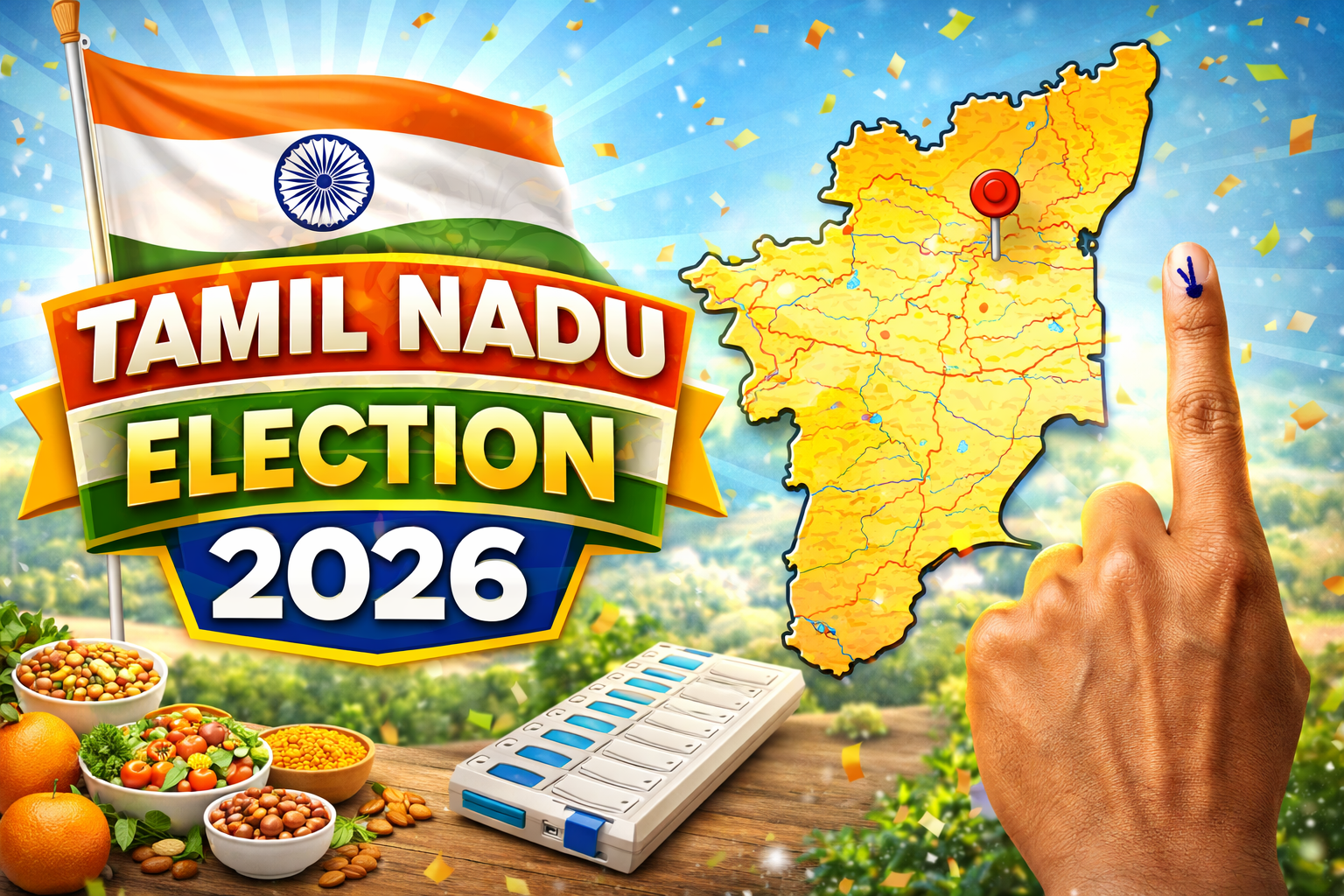
The Tamil Nadu Assembly Election 2026 is shaping up to be one of the most crucial political battles in the state’s recent history. With intense competition, shifting alliances, and new political entrants, the election will determine the future political direction of Tamil Nadu.
Tamil Nadu Election 2026
- Polling Date: 23 April 2026
- Result Date: 4 May 2026
- Total Seats: 234
- Majority Mark: 118 seats
- Voters: Over 5.69 crore registered voters
The election will be conducted in a single phase, and the Model Code of Conduct is already in force.
Also Check Here: West Bengal Election Result 2026
Tamil Nadu Election 2026 Date
The Tamil Nadu Legislative Assembly Election 2026 is scheduled to be held in a single phase on 23 April 2026, with counting of votes set for 4 May 2026. Conducted by the Election Commission of India, the election will cover all 234 विधानसभा constituencies, where millions of voters will decide the next government in the state. The announcement of the dates has triggered intense campaigning among major political parties, making it one of the most closely watched state elections in India.
Tamil Nadu Election 2026 Result Date
Tamil Nadu Election 2026 Result Date is 4 May 2026, when the counting of votes across all 234 constituencies will take place under the supervision of the Election Commission of India. This day will determine which party or alliance secures the majority mark of 118 seats and forms the next government in the state, making it a decisive moment in Tamil Nadu’s political landscape.
Also Check Here: Assam Assembly Election 2026
Political Landscape: A Bipolar Contest
Tamil Nadu politics has traditionally been dominated by two Dravidian giants:
- Dravida Munnetra Kazhagam (DMK) – Currently in power under Chief Minister M. K. Stalin
- All India Anna Dravida Munnetra Kazhagam (AIADMK) – Main opposition led by Edappadi K. Palaniswami
Despite the entry of new players, the state continues to witness a largely bipolar contest between these two parties.
Major Alliances in 2026
1. DMK-Led Alliance (INDIA Bloc)
The ruling DMK is contesting with allies like:
- Indian National Congress
- Other regional parties
The alliance benefits from strong governance claims and past electoral dominance, including sweeping victories in recent national elections.
2. AIADMK-Led Alliance (NDA Bloc)
The opposition front includes:
- Bharatiya Janata Party
- Pattali Makkal Katchi
- Amma Makkal Munnetra Kazhagam
AIADMK and BJP reunited ahead of the elections, with Palaniswami projected as the CM face
Emerging Players
- Tamilaga Vettri Kazhagam led by actor Vijay
- Naam Tamilar Katchi led by Seeman
These parties are expected to split votes and influence close contests, especially in urban constituencies like Chennai.
Also Check all about West Bengal Election 2026
Key Issues in Tamil Nadu Election 2026
1. Governance vs Anti-Incumbency
- DMK is campaigning on welfare schemes and governance performance
- Opposition is raising issues like state debt and administration concerns
2. Alliance Politics
Alliances are crucial in Tamil Nadu, where even small vote-share differences can lead to major seat swings.
3. Caste and Community Dynamics
Caste remains a decisive factor, with communities like:
- Vanniyars
- Thevars
- Gounders
- Dalits
playing a key role in electoral outcomes.
4. Rise of New Political Forces
The entry of Vijay’s TVK has added a third dimension to the traditionally bipolar contest.
5. Digital Campaigning & Misinformation
Parties are increasingly using fact-check units to counter fake news and AI-generated misinformation.
Who Has the Edge?
- DMK Alliance: Strong incumbency, organisational strength, past electoral success
- AIADMK Alliance: Consolidated opposition, BJP support, caste-based mobilisation
- Third Front (TVK, NTK): Potential vote splitters and kingmakers
According to analytical studies, DMK remains the frontrunner, but the AIADMK-led alliance is a strong challenger.
Conclusion
The Tamil Nadu Election 2026 is not just a contest for power but a battle between continuity and change. While the DMK seeks to retain its dominance, the AIADMK-led alliance is fighting for a comeback, and new entrants like TVK are reshaping the political landscape.
With multiple alliances, strong personalities, and evolving voter dynamics, the election promises to be highly competitive and unpredictable.

 India–Poland Relations 2026: Strategic...
 Supreme Court on Children's Right to Int...
 Daily Current Affairs PDF 2026: Download...









 WhatsApp