Table of Contents
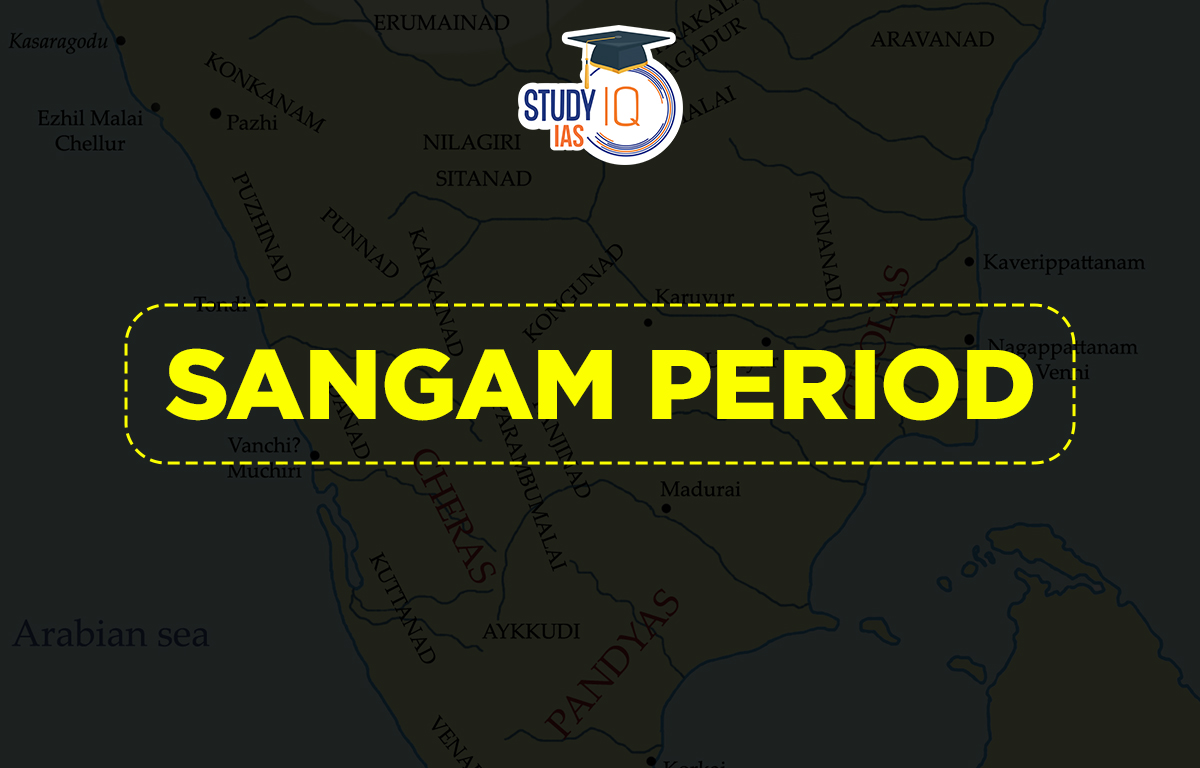
The Sangam Period represents an important phase in the early history and cultural development of South India. It is associated particularly with ancient Tamilakam, covering much of present-day Tamil Nadu and Kerala and extending its cultural and commercial links to other parts of South India and Sri Lanka.
The period is best known for its rich corpus of early Tamil literature, the political prominence of the Chera, Chola and Pandya dynasties, extensive internal and overseas trade, and a society organised around different ecological zones.
The term Sangam refers to literary assemblies or academies traditionally believed to have been patronised by the Pandya rulers. However, the traditional account of three Sangams (Muchchangam) is largely preserved through later Tamil literary tradition and should not be treated as an independently established historical fact.
For UPSC, the Sangam Age is important for understanding early South Indian state formation, Tamil literature, society, economy, maritime trade and cultural history.
Sangam Period: Chronology
The chronology of the Sangam period remains a subject of scholarly discussion. A commonly used framework places the major Sangam literary tradition broadly between the early centuries BCE and the early centuries CE, with several texts and layers of composition and compilation dating to different periods.
Therefore, rather than assigning the entire Sangam corpus to one fixed date, it is more accurate to understand it as a broad literary and historical phase.
The period is reconstructed through:
- Sangam literature
- Tamil-Brahmi inscriptions
- Archaeological evidence
- Coins
- Megalithic remains
- Foreign accounts
- Evidence of Indo-Roman trade
Tamil is one of the world’s oldest continuously used classical literary languages, and Sangam poetry provides valuable evidence about the society and cultural world of early Tamilakam.
Three Sangams
According to Tamil literary tradition, three Sangams existed:
| Sangam | Traditional Location | Traditional Account |
|---|---|---|
| First Sangam | Madurai | Said to have been attended by gods and legendary sages |
| Second Sangam | Kapadapuram | Traditionally associated with the composition of early Tamil works |
| Third Sangam | Madurai | Associated with surviving Sangam literary traditions |
Historical Significance
The historicity of the first two Sangams is uncertain. The traditional account is important for understanding Tamil literary memory, but historians rely primarily on surviving texts, inscriptions, archaeology and external accounts to reconstruct the period.
Major Sources of the Sangam Period
1. Sangam Literature
Sangam literature is the most important literary source for reconstructing early Tamil society.
Major categories include:
Tolkappiyam
Tolkappiyam is an important early Tamil grammatical and literary work traditionally attributed to Tolkappiyar.
It is particularly significant because it discusses:
- Tamil grammar
- Poetics
- Literary conventions
- Social and cultural practices
- Landscape-based classification
2. Ettuthokai — Eight Anthologies
The Ettuthokai or Eight Anthologies include:
- Ainkurunuru
- Narrinai
- Akananuru
- Purananuru
- Kuruntokai
- Kalittokai
- Paripadal
- Pathitrupathu
The poems provide information on love, warfare, kingship, trade, social life and political relationships.
3. Pattuppattu — Ten Idylls
The Pattuppattu or Ten Idylls include ten long poems, such as:
- Tirumurugatrupadai
- Porunaratrupadai
- Sirupanatrupadai
- Perumpanatrupadai
- Mullaippattu
- Nedunalvadai
- Maduraikkanji
- Kurinjippattu
- Pattinappalai
- Malaipadukadam
4. Pathinenkilkanakku
The Pathinenkilkanakku consists of eighteen works, many of which focus on ethics and morality.
The Tirukkural of Tiruvalluvar is the most famous work associated with this tradition.
5. Tamil Epics
Two important Tamil epics are:
- Silappadikaram — traditionally attributed to Ilango Adigal
- Manimekalai — traditionally attributed to Sattanar
These works provide insights into religion, society, trade and urban life.
Archaeological and External Sources
The Sangam period is not reconstructed from literature alone.
Important evidence comes from:
- Tamil-Brahmi inscriptions
- Coins
- Pottery
- Megalithic burials
- Urban and industrial archaeological sites
- Roman coins
- Maritime archaeological evidence
Important archaeological sites associated with early historic Tamilakam include Arikamedu, Kodumanal, Puhar and Keeladi, among others.
Foreign writers also provide evidence of commercial connections between South India and the Mediterranean world. Greek and Roman geographical and commercial accounts, together with archaeological discoveries, help establish the importance of overseas trade.
Tamil Nadu’s official educational material continues to treat Sangam literature, archaeology and the ancient Tamil economy and trade as major components of the study of Tamil history.
Three Major Sangam Dynasties
The political landscape of ancient Tamilakam was dominated by three major dynasties:
- Cheras
- Cholas
- Pandyas
They were collectively referred to as the Muvendar or “Three Crowned Kings.”
| Dynasty | Important Centre/Capital | Important Ruler | Symbol | Major Ports/Trade Centres |
|---|---|---|---|---|
| Chera | Vanji | Senguttuvan | Bow and arrow | Musiri, Tondi |
| Chola | Uraiyur, Puhar | Karikala | Tiger | Puhar/Kaveripattinam |
| Pandya | Madurai | Neduncheliyan | Fish | Korkai |
Cheras
The Chera kingdom controlled parts of present-day Kerala and western Tamil Nadu.
Important Features
- Capital traditionally associated with Vanji
- Important ports included Musiri and Tondi
- Emblem: Bow and arrow
- Pepper trade was an important feature of the western region
- Strong commercial links existed with the Roman world
Cheran Senguttuvan
Senguttuvan is one of the best-known Chera rulers mentioned in Tamil literary traditions.
He is prominently associated with Silappadikaram and the Pattini/Kannagi cult.
However, literary accounts of his northern military expedition should be treated as literary-historical evidence rather than straightforward contemporary political records.
Cholas
The Sangam Cholas controlled parts of present-day Tamil Nadu and adjoining regions.
Important Centres
- Uraiyur
- Puhar/Kaveripattinam
Karikala Chola
Karikala is the most famous Sangam Chola ruler.
He is traditionally associated with:
- Battle of Venni
- Expansion of Chola power
- Agricultural development
- Irrigation works
- Development of Puhar as a major commercial centre
The Kallanai (Grand Anicut) across the Kaveri is traditionally associated with Karikala and remains an important symbol of the early history of irrigation in the Kaveri region.
Pandyas
The Pandyas ruled mainly over southern Tamil Nadu.
Capital
Madurai
Important Centre
Korkai was an important coastal centre associated with the Pandya kingdom and pearl fishing.
Important Rulers
Sangam traditions mention rulers such as:
- Nediyon
- Mudukudumi Peruvaludhi
- Neduncheliyan
- Uggira Peruvaludhi
The Madurai Kanji provides important information about Madurai and Pandyan society.
Sangam Period Polity
The Sangam political system was largely based on hereditary kingship, but the king operated within a wider network of chiefs, warriors, poets and local communities.
The king was supported by officials and advisers.
Important administrative terms found in traditional accounts include:
- Amaichar — ministers
- Anthanar — priests/learned persons
- Senapati — military commanders
- Thuthar — envoys
- Orrar — spies
However, the administrative system should not be understood as a highly centralised bureaucratic state comparable to later imperial formations.
Minor Chieftains and Kadai Elu Vallalgal
Apart from the three major dynasties, numerous local chieftains played an important role.
The famous Kadai Elu Vallalgal, or Seven Great Patrons, included:
- Pari
- Kari
- Ori
- Nalli
- Pegan
- Ay
- Adiyaman
They are celebrated in Tamil literary traditions for their generosity and patronage of poets.
Sangam Society
Sangam society can be understood particularly through the concept of Tinai, which connected human activities and cultural practices with different ecological landscapes.
Five Tinais
| Tinai | Landscape | Associated Deity | Major Economic Activity |
|---|---|---|---|
| Kurinji | Hills | Murugan | Hunting and gathering |
| Mullai | Pastoral/forest | Mayon | Cattle rearing |
| Marudam | Agricultural plains | Vendan/Indra | Agriculture |
| Neythal | Coast | Varunan | Fishing and maritime activities |
| Palai | Arid landscape | Korravai | Hunting, warfare and raiding |
This landscape-based classification is one of the distinctive features of Sangam literature. Sangam poetry also broadly distinguishes between akam (interior/love themes) and puram (public life, warfare, heroism and generosity).
Sangam Period Economy
Agriculture was the main economic activity, particularly in the fertile Marudam regions.
Major Crops
- Rice
- Millets
- Sugarcane
- Cotton
- Pepper
- Ginger
- Turmeric
Other important economic activities included:
- Weaving
- Metalworking
- Pottery
- Bead-making
- Jewellery
- Shipbuilding
- Fishing
- Pearl fishing
- Salt production
Trade and Commerce
Trade was one of the most important features of the Sangam Age.
Internal Trade
Goods were transported through:
- Roads
- Carts
- Pack animals
- River routes
- Coastal routes
Barter played an important role in local exchange, while coins were also used in wider commercial networks.
Overseas Trade
Tamilakam maintained commercial links with the Roman world and the wider Indian Ocean network.
Important ports and commercial centres included:
- Puhar/Kaveripattinam
- Korkai
- Musiri
- Tondi
- Arikamedu
Major Exports
- Pepper and other spices
- Pearls
- Precious stones
- Ivory
- Textiles
- Other luxury goods
Major Imports
- Gold and silver
- Horses
- Wine
- Luxury goods
The discovery of Roman coins and archaeological evidence from trading settlements provides material evidence for these commercial connections.
Sangam Period Religion
Religious practices were diverse and closely connected with the landscape and community.
Important Deities
- Murugan/Seyon — Kurinji
- Mayon — Mullai
- Vendan/Indra — Marudam
- Varunan — Neythal
- Korravai — Palai
Murugan occupied an important position in early Tamil religious traditions.
Hero Stones or Nadukal
The tradition of hero-stone worship, known as Nadukal, was an important feature of the period.
Hero stones were erected in memory of warriors who died in battle or in acts of heroism.
They provide valuable evidence for:
- Warrior culture
- Heroism
- Memorial practices
- Local social traditions
Position of Women
Sangam literature provides considerable information about women and their social roles.
Important female poets included:
- Avvaiyar
- Kakkai Padiniyar
- Nachchellaiyar
Women appear in Sangam poetry as:
- Poets
- Lovers
- Wives
- Mothers
- Participants in social life
The concept of karpu, or chastity/fidelity, was highly valued in literary traditions.
However, references to women in literary texts should be interpreted carefully because literature does not necessarily provide a complete picture of the experiences of all sections of society.
Sangam Period Arts and Culture
The Sangam Age witnessed a rich literary and artistic tradition.
Literature
Poets received patronage from:
- Kings
- Chieftains
- Nobles
Music and Dance
Sangam literature mentions:
- Yazh — stringed instrument
- Drums
- Singing bards
- Dancers
- Koothu — performance tradition
Poets and performers played an important role in royal courts and public cultural life.
Decline of the Sangam Age
By the early centuries CE, the political structure of Tamilakam underwent significant changes.
The traditional narrative associates the subsequent period with the Kalabhras, whose rule is often described as an interruption in the established Chera-Chola-Pandya political order.
The Kalabhra phase remains comparatively less documented.
Later, the political dominance of the region was re-established by powers including the:
- Pallavas
- Pandyas
Jainism and Buddhism also had significant influence in the broader cultural landscape of early medieval South India.
Sangam Period: Important Facts for UPSC
Prelims Quick Revision
- Three major dynasties: Chera, Chola and Pandya
- Collective term: Muvendar
- Chera emblem: Bow and arrow
- Chola emblem: Tiger
- Pandya emblem: Fish
- Chera port: Musiri
- Chola centre: Puhar/Kaveripattinam
- Pandya capital: Madurai
- Pandya port: Korkai
- Important early Tamil grammatical work: Tolkappiyam
- Eight Anthologies: Ettuthokai
- Ten Idylls: Pattuppattu
- Moral/ethical corpus: Pathinenkilkanakku
- Major Tamil epics: Silappadikaram and Manimekalai
- Five landscapes: Kurinji, Mullai, Marudam, Neythal and Palai
- Love poetry: Akam
- Public/heroic poetry: Puram
- Hero stones: Nadukal
- Famous Sangam Chola ruler: Karikala
- Famous Chera ruler: Senguttuvan
- Important Pandya centre: Madurai
Sangam Period: UPSC Significance
The Sangam Age is important for UPSC because it provides insights into:
- Early state formation in South India
- Evolution of Tamil literature
- Chera-Chola-Pandya political history
- Indian Ocean trade
- Indo-Roman commercial relations
- Ancient urban centres and ports
- Ecological classification through Tinai
- Early Tamil religious traditions
- Status and representation of women
- Hero-stone traditions
- Archaeological evidence and Tamil-Brahmi inscriptions
- Development of classical Tamil culture
The study of Sangam history is also explicitly included in Tamil Nadu’s official history and competitive-examination curriculum, including Sangam literature, the three ancient kingdoms, socio-economic conditions, the five-fold landscape division and trade and commerce.
Read about: Indus Valley Civilization

 Energy Resources in India: Types, Distri...
 Samvatsari Parva 2026: Know the Signific...
 Role of Indian Press in Freedom Movement...




 WhatsApp