Table of Contents
Context
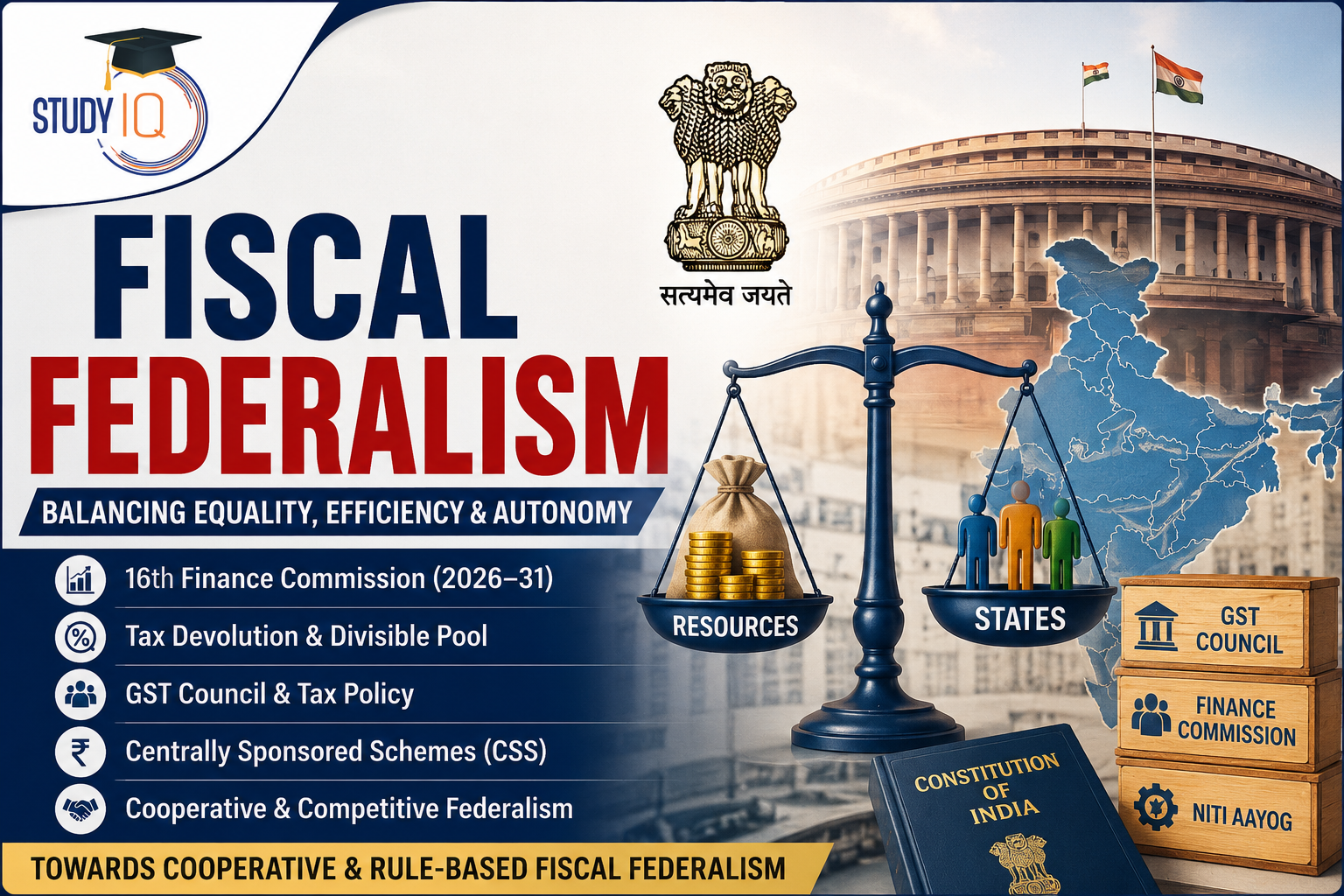
The 16th Finance Commission (2026–31) has retained the States’ share in the divisible tax pool at 41% while restructuring grants and placing greater emphasis on fiscal discipline and performance-based transfers. This has reignited the debate over whether India’s fiscal federalism is shifting from its constitutional objective of fiscal equalisation towards efficiency-oriented resource allocation.
How is the rise of institutions outside the Finance Commission redefining its role in India’s fiscal federalism?
- Shrinking Divisible Pool: Cesses and surcharges are constitutionally excluded from the divisible pool, so their growing share in gross tax revenue reduces the resources available for Finance Commission (FC)-recommended tax devolution. This enables the Centre to retain greater fiscal space outside the FC’s redistributive framework.
- g., Rising collections from health and infrastructure cesses have reduced the proportion of central taxes shared with states.
- Tax Base Decoupling: The GST Council now determines indirect tax rates, exemptions and revenue design, separating tax policy from the Finance Commission’s devolution function. Consequently, the FC increasingly recommends how revenues are shared rather than influencing the fiscal base from which they are generated.
- g., GST Council decisions on rate rationalisation directly affect the revenue available for tax devolution, independent of the FC’s recommendations.
- Rise of Alternative Fiscal Transfer Channels: With tax policy and an increasing share of fiscal resources operating outside the FC’s framework, the Centre has increasingly relied on Centrally Sponsored Schemes (CSS) to transfer resources to states. This reduces the Finance Commission’s relative influence over the overall architecture of intergovernmental fiscal transfers.
- g.,Ayushman Bharat–PMJAY channels substantial Union funds through a sector-specific programme rather than the FC’s formula-based devolution.
- Negotiated Transfers Replacing Rule-based Devolution: Unlike the FC’s formula-driven, unconditional transfers, many Centrally Sponsored Schemes are tied to state co-financing, sectoral priorities and performance benchmarks. This transforms fiscal federalism from rule-based devolution towards negotiated and conditional transfers.
- g.,Jal Jeevan Mission releases central funds based on state matching contributions and achievement of implementation milestones.
- From Fiscal Architect to Constitutional Equaliser: As tax policy, discretionary transfers and conditional schemes are increasingly shaped outside the Finance Commission, its role is progressively narrowing to recommending tax devolution from the divisible pool and grants-in-aid. While it continues to address vertical and horizontal fiscal imbalances, it is no longer the principal architect of India’s intergovernmental fiscal transfers.
- g., The Fifteenth Finance Commission expanded local body, health and sector-specific grants to supplement a devolution framework over which it has diminishing influence.
How far has India’s fiscal federalism moved beyond rule-based constitutional arrangements?
- Eroding Divisible Pool: Article 270 provides for formula-based sharing of central taxes through the Finance Commission (FC). However, the increasing reliance on cesses and surcharges, which lie outside the divisible pool, has reduced the resources distributed through this constitutional mechanism, weakening the effectiveness of rule-based tax devolution.
- g., Rising collections from health and infrastructure cesses have reduced the effective tax base available for FC-recommended devolution.
- Negotiated Tax Design: While tax devolution remains constitutionally determined, the tax base itself is increasingly shaped through intergovernmental bargaining in the GST Council. Consequently, fiscal outcomes depend not only on constitutional rules but also on negotiated tax policy.
- g., The continuation of the GST Compensation Cess after 2020 required political negotiations rather than automatic constitutional resolution.
- Conditional Transfers: As a growing share of Union support flows outside tax devolution, the Centre increasingly channels resources through Centrally Sponsored Schemes (CSS) linked to sectoral priorities, state co-financing and performance benchmarks. This shifts transfers from unconditional constitutional entitlement towards conditional programme funding.
- g., Jal Jeevan Mission releases funds based on state matching contributions and achievement of implementation milestones.
- Conditioned Borrowing: The Union increasingly shapes states’ fiscal space through borrowing approvals under Article 293, reinforced by FRBM-linked fiscal conditions. As a result, states’ borrowing autonomy increasingly depends on compliance with Union-prescribed reforms alongside statutory fiscal rules.
- g., During the COVID-19 pandemic, the additional 2% of GSDP borrowing limit was linked to reforms such as One Nation One Ration Card and ease of doing business.
- Bargaining Federalism: Taken together, a shrinking rule-based devolution pool, negotiated tax design, conditional transfers and conditioned borrowing have expanded the role of intergovernmental bargaining in India’s fiscal federalism. While constitutional arrangements remain its foundation, an increasing share of fiscal outcomes is now shaped by negotiated institutional processes rather than automatic constitutional entitlement.
- g., Special financial packages and borrowing relaxations have, at times, been extended through political negotiations outside the Finance Commission’s formula-based framework.
Way Forward
- Expand the Rule-based Fiscal Space: Rationalise cesses and surcharges or include a greater share within the divisible pool to strengthen constitutional tax devolution and reduce discretionary fiscal transfers.
- Institutionalise Fiscal Coordination: Establish a formal coordination mechanism among the Finance Commission, GST Council, NITI Aayog and Union Finance Ministry to align tax policy, devolution and expenditure priorities within a coherent fiscal framework.
- Rebalance Conditional Transfers: Limit Centrally Sponsored Schemes to genuine national priorities while increasing untied Finance Commission transfers, preserving states’ fiscal autonomy and cooperative federalism.
- Rule-based Borrowing Framework: Operationalise transparent, objective criteria under Article 293 and FRBM provisions to reduce ad hoc borrowing approvals and enhance fiscal predictability for states.
- Strengthen the Finance Commission’s Mandate: Expand the FC’s terms of reference to assess the cumulative impact of GST, cesses, CSS and borrowing constraints, enabling it to serve as the principal constitutional institution for integrated fiscal federalism.
Read Also: UPSC Daily Current Affairs 2026
 World Rhino Day 2026: 22 September, Them...
 Daily Current Affairs PDF 2026: Download...
 World Pharmacists Day 2026: Date, Theme,...














 WhatsApp