
Table of Contents
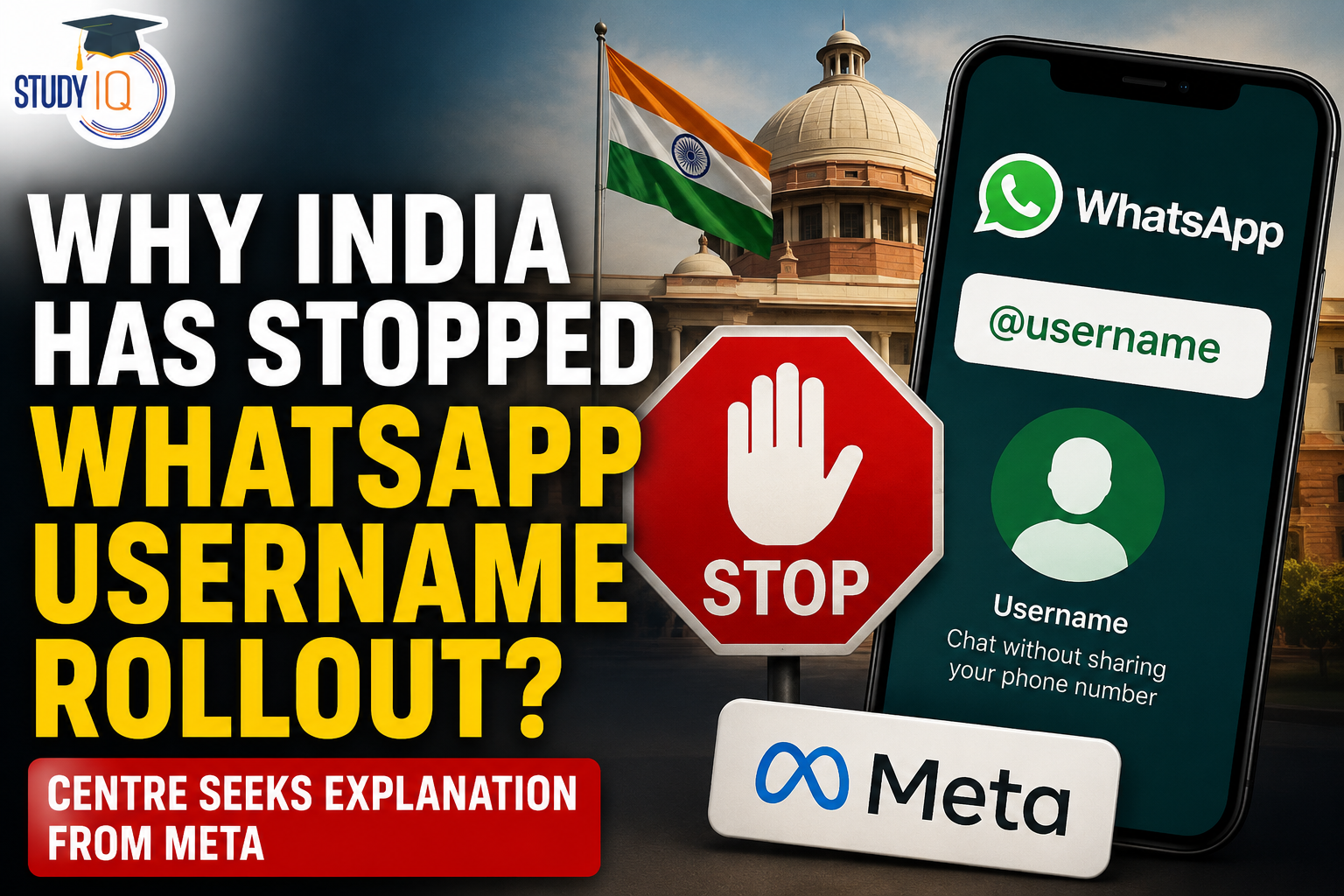
The Government of India has asked Meta to temporarily pause the rollout of WhatsApp’s Username feature in the country and submit a detailed explanation within three days. The decision comes amid concerns that the new identity system could be exploited for impersonation, phishing, and financial fraud if introduced without adequate safeguards.
According to government sources, Meta has been instructed not to operationalise the feature in India until consultations with the authorities are completed. The Centre is examining whether the proposed feature complies with India’s legal and cybersecurity framework before allowing its launch.
Why Has India Stopped the WhatsApp Username Rollout?
The Centre is evaluating the legal, security, and regulatory implications of replacing phone-number-based identification with usernames.
Officials fear that malicious actors could create usernames resembling those of:
- Government departments
- Public officials
- Banks and financial institutions
- Businesses and brands
- Celebrities and public figures
Such impersonation could mislead users into sharing sensitive information or transferring money to fraudulent accounts.
A senior government official indicated that the government will study the legality of the feature and, if necessary, introduce new legal provisions to curb digital impersonation.
What Is the WhatsApp Username Feature?
Meta recently introduced a Username feature that allows WhatsApp users to reserve unique handles instead of sharing their mobile phone numbers.
The feature is designed to:
- Allow communication without revealing phone numbers.
- Enhance user privacy.
- Simplify connecting with new contacts.
- Improve interactions for creators, businesses, and communities.
The system is similar to usernames used on Telegram, Instagram, Signal, and X (formerly Twitter).
Although Meta has begun enabling username reservations globally, the feature has not yet become fully operational for users.
Questions Raised by the Government
The Centre has sought a detailed response from Meta explaining several aspects of the feature, including:
- How usernames will be created and verified.
- Mechanisms to prevent impersonation.
- Privacy and security protections.
- Compliance with Indian laws and IT regulations.
- Safeguards against phishing and cybercrime.
- Support for law enforcement investigations where legally required.
Meta has been given three days to provide its response.
Why Are Authorities Concerned?
The government believes usernames may introduce new cybersecurity challenges despite improving privacy.
Unlike phone numbers, usernames can closely resemble trusted identities. Fraudsters could create deceptive usernames to imitate government agencies, customer support services, banks, or businesses.
Officials have cited similar concerns seen on other messaging platforms where screen names have occasionally been misused for scams and identity fraud.
The government wants to ensure that WhatsApp incorporates sufficient safeguards before making the feature available in India.
WhatsApp Pay Adds Another Layer of Concern
Legal experts note that WhatsApp is no longer just a messaging application.
With WhatsApp Pay integrated into India’s Unified Payments Interface (UPI), impersonation through misleading usernames could increase the risk of payment fraud.
A fake username appearing to represent a trusted bank, merchant, or government agency could potentially deceive users into making financial transactions.
This has prompted regulators to examine the feature more closely before granting approval.
Could New Regulations Be Introduced?
Government officials have indicated that if existing legal provisions are found to be inadequate, new rules or amendments may be considered to address digital impersonation.
Possible regulatory measures include:
- Mandatory anti-impersonation safeguards.
- Stronger identity verification mechanisms.
- Faster compliance with law enforcement requests.
- Enhanced due diligence requirements for digital platforms.
The review reflects India’s broader efforts to strengthen cybersecurity and consumer protection as digital communication and online payments continue to expand.
What Happens Next?
Meta is expected to submit its explanation within the three-day deadline. Based on the company’s response, the government will decide whether the feature can be rolled out with additional safeguards, modified before launch, or subjected to further regulatory scrutiny.
Until the review is complete, the WhatsApp Username feature will remain on hold in India.
Conclusion
The Centre’s decision to pause WhatsApp’s Username rollout underscores the growing focus on balancing user privacy with cybersecurity and digital trust. While usernames can reduce the need to share personal phone numbers, regulators want to ensure that the feature cannot be exploited for impersonation, phishing, or financial fraud. The outcome of Meta’s response will determine the future of the feature in one of WhatsApp’s largest global markets.
Latest UPSC Updates
| Resource | Link |
|---|---|
| UPSC Prelims Result 2026 | Check Here |
| UPSC Exam Calendar 2027 | View Calendar |
| UPSC Question Paper 2026 | Download PDF |
| UPSC Prelims Answer Key 2026 | Check Answer Key |
| UPSC Cut Off 2026 | View Cut Off |
| UPSC Syllabus 2026 | Read Syllabus |
| Daily Current Affairs 2026 | Read Updates |
| StudyIQ UPSC IAS Foundation 2027 (English) | Join Course |
| StudyIQ UPSC IAS Foundation 2027 (Hindi) | Join Course |
| StudyIQ UPSC IAS Foundation 2027 (Bilingual) | Join Course |
Sharing is caring!
 India–Poland Relations 2026: Strategic...
 Supreme Court on Children's Right to Int...
 Daily Current Affairs PDF 2026: Download...














 WhatsApp





