Table of Contents
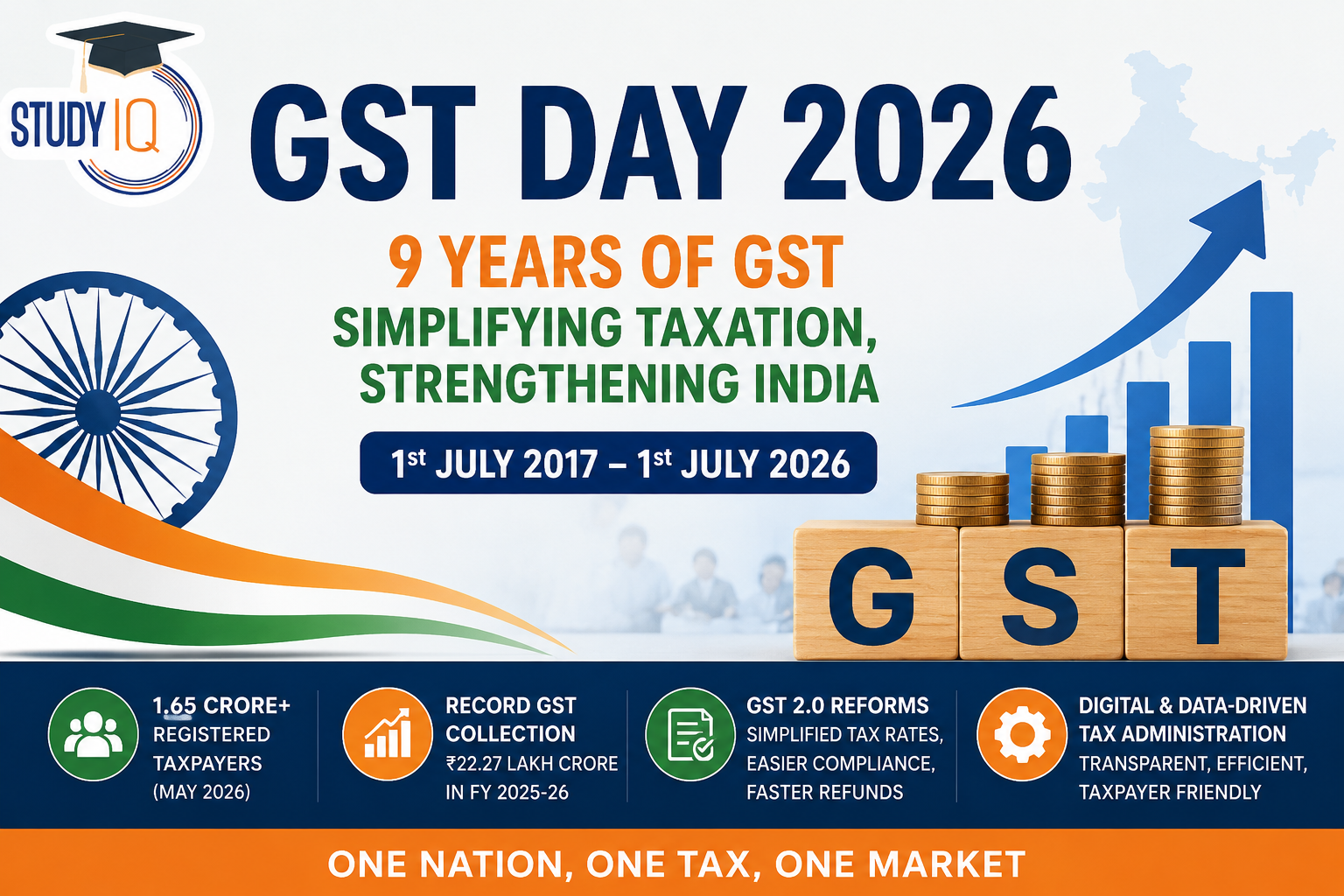
GST Day 2026 is being observed across India on July 1 to commemorate the ninth anniversary of the Goods and Services Tax (GST), one of the country’s most significant tax reforms. Introduced on July 1, 2017, GST replaced a complex network of Central and State indirect taxes with a unified tax system under the vision of “One Nation, One Tax.”
On the occasion, the Government highlighted GST’s contribution to creating a common national market, expanding the formal economy, improving tax compliance, and strengthening cooperative federalism. According to official data, the number of registered GST taxpayers has grown from 66.5 lakh in 2017 to 1.65 crore as of May 2026, while annual GST collections have reached record levels.
GST Day 2026 Highlights
| Particular | Details |
|---|---|
| Event | GST Day 2026 |
| Date | July 1, 2026 |
| Occasion | 9 Years of Goods and Services Tax |
| GST Launch | July 1, 2017 |
| Theme | Nine Years of GST: Simplifying Taxation, Strengthening India |
| Registered Taxpayers | 1.65 crore (May 2026) |
| FY 2025-26 GST Collection | ₹22.27 lakh crore |
What is GST?
The Goods and Services Tax (GST) is a destination-based indirect tax levied on the supply of goods and services across India. It replaced multiple indirect taxes such as VAT, Central Excise Duty, Service Tax, Entry Tax, Luxury Tax, and several cesses, thereby creating a unified taxation system.
GST subsumed 17 indirect taxes and 13 cesses, eliminating cascading taxation and simplifying compliance for businesses operating across states.
Why GST Was Introduced
Before GST, India’s indirect tax structure was fragmented, with different tax laws imposed by the Centre and States. Businesses often faced multiple registrations, overlapping taxes, and the burden of “tax on tax.”
The objectives of GST were to:
- Create a unified national market.
- Eliminate cascading taxation.
- Simplify tax compliance.
- Improve ease of doing business.
- Increase tax transparency.
- Strengthen cooperative federalism.
- Expand the formal economy.
Nine Years of GST: Key Achievements
Over the past nine years, GST has significantly transformed India’s indirect tax administration.
Expansion of Taxpayer Base
One of the biggest achievements has been the rapid increase in registrations.
- 2017: 66.5 lakh taxpayers
- May 2026: 1.65 crore taxpayers
The growth reflects increased formalisation of businesses and improved compliance.
Record GST Collections
GST revenues have consistently increased since implementation.
| Financial Year | Gross GST Collection |
|---|---|
| 2017-18 | ₹7.4 lakh crore |
| 2021-22 | ₹13.76 lakh crore |
| 2025-26 | ₹22.27 lakh crore |
During April-May 2026, GST collections touched approximately ₹4.37 lakh crore, indicating robust economic activity.
GST 2.0 Reforms
The 56th GST Council Meeting approved the Next-Generation GST Reforms, commonly referred to as GST 2.0, which came into effect on September 22, 2025.
Major reforms include:
- Simplified tax structure with 5% and 18% as the principal GST slabs.
- 40% GST on luxury and sin goods such as tobacco, lottery, online gaming, luxury cars, yachts, aerated beverages, and private aircraft.
- Faster GST registration.
- Quicker refund processing.
- Simplified return filing.
- Lower compliance costs for MSMEs and startups.
The reforms are aimed at making India’s indirect tax system simpler, more efficient, and taxpayer-friendly.
Benefits for Consumers
GST and the subsequent GST 2.0 reforms have provided several benefits to consumers.
Key measures include:
- Lower tax burden on many goods and services.
- GST exemptions on selected insurance products.
- Tax relief on essential medicines.
- Improved affordability.
- Greater household savings.
- Better access to healthcare.
Benefits for MSMEs
Micro, Small and Medium Enterprises (MSMEs) have benefited through multiple compliance reforms.
These include:
- Higher GST registration threshold.
- Expanded Composition Scheme.
- Quarterly Return Monthly Payment (QRMP) Scheme.
- Faster refunds.
- Reduced compliance burden.
- Easier return filing.
- Lower production costs through reduced GST rates on selected sectors.
Digital Transformation of GST
GST has emerged as one of the world’s largest technology-driven tax systems.
Major digital initiatives include:
- GST Network (GSTN)
- E-Invoicing
- Online registration
- Automated Input Tax Credit (ITC) matching
- Pre-filled GST returns
- Real-time invoice validation
- Digital refund processing
The use of Artificial Intelligence (AI), Machine Learning (ML), and data analytics has further strengthened fraud detection, compliance monitoring, and risk-based tax administration.
Cooperative Federalism Through GST Council
The GST Council has played a central role in shaping India’s indirect tax system by bringing together the Union Government and State Governments on a common platform for decision-making.
Regular Council meetings have enabled timely reforms, tax rationalisation, and policy adjustments while balancing the interests of both Centre and States.
Economic Impact of GST
Nine years after its implementation, GST has contributed to:
- Expansion of the formal economy.
- Higher tax compliance.
- Improved revenue buoyancy.
- Increased fiscal transparency.
- Lower logistics costs.
- Better ease of doing business.
- Digitalisation of tax administration.
- Stronger Centre-State fiscal coordination.
GST collections are now regarded as a high-frequency indicator of India’s economic performance.
Conclusion
As India celebrates GST Day 2026, the Goods and Services Tax has completed nine years as one of the country’s most transformative economic reforms. From replacing a fragmented indirect tax regime to creating a technology-driven and transparent tax ecosystem, GST has significantly improved tax administration and ease of doing business. With the rollout of GST 2.0, the government aims to further simplify compliance, support businesses, and strengthen India’s journey towards a more efficient and competitive economy.
Latest UPSC Updates
| Resource | Link |
|---|---|
| UPSC Prelims Result 2026 | Check Here |
| UPSC Exam Calendar 2027 | View Calendar |
| UPSC Question Paper 2026 | Download PDF |
| UPSC Prelims Answer Key 2026 | Check Answer Key |
| UPSC Cut Off 2026 | View Cut Off |
| UPSC Syllabus 2026 | Read Syllabus |
| Daily Current Affairs 2026 | Read Updates |
| StudyIQ UPSC IAS Foundation 2027 (English) | Join Course |
| StudyIQ UPSC IAS Foundation 2027 (Hindi) | Join Course |
| StudyIQ UPSC IAS Foundation 2027 (Bilingual) | Join Course |
Frequently Asked Questions (FAQs)
Why is GST Day celebrated?
GST Day is observed every year on July 1 to mark the implementation of the Goods and Services Tax in 2017.
How many years of GST are completed in 2026?
GST completed nine years on July 1, 2026.
How many GST taxpayers are registered in India?
As of May 2026, India has 1.65 crore registered GST taxpayers.
What is GST 2.0?
GST 2.0 refers to the Next-Generation GST Reforms implemented from September 22, 2025, focusing on simplified tax rates, easier compliance, and faster taxpayer services.
What was India’s GST collection in FY 2025-26?
India recorded ₹22.27 lakh crore in gross GST collections during FY 2025-26, the highest annual GST collection since the tax was introduced.
Sharing is caring!
 Gandhi Jayanti 2026: History, Significan...
 Right to Vote in India: Constitutional S...
 Daily Mains Articles 2026 – Updated Da...














 WhatsApp