
Table of Contents
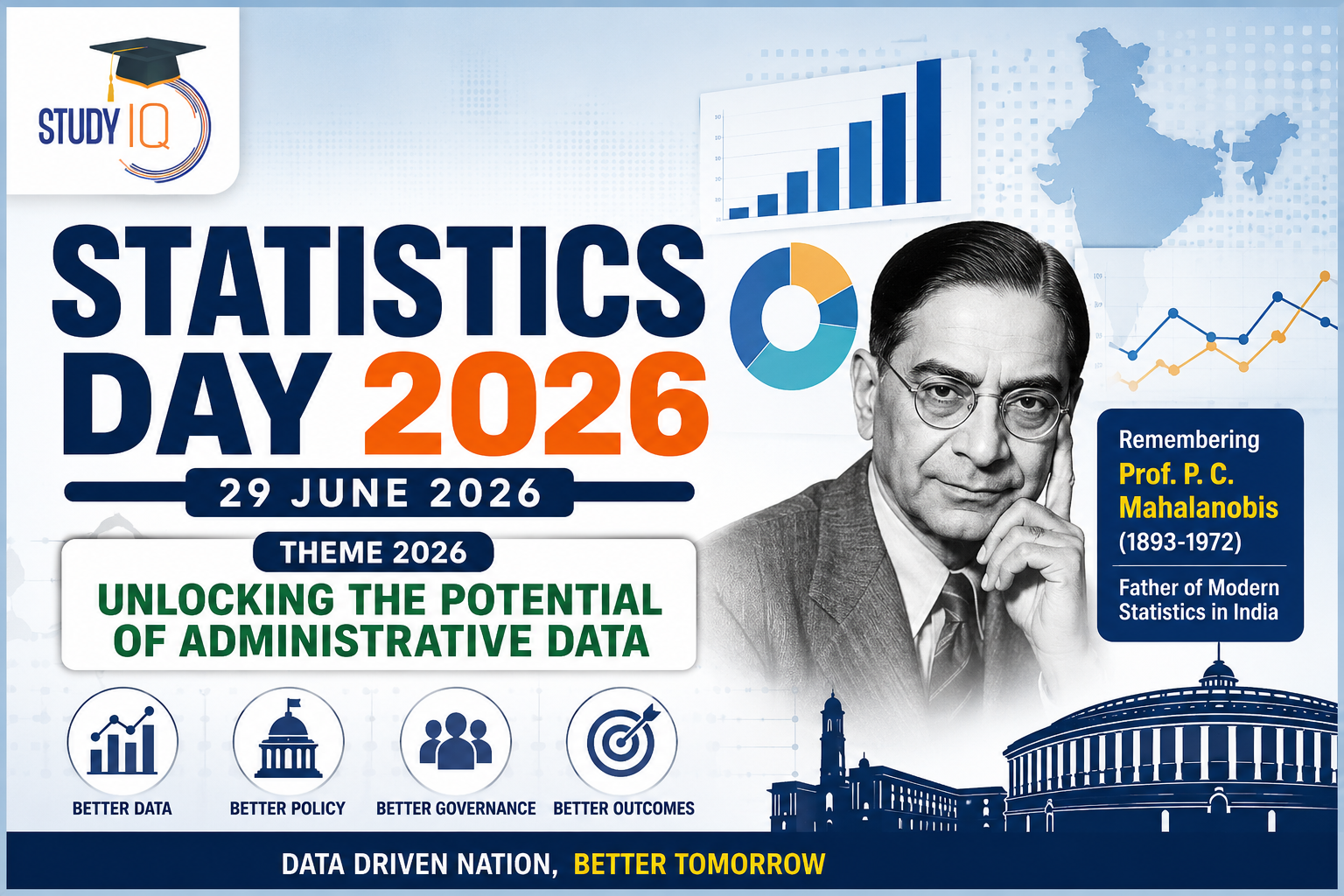
Statistics Day 2026 is being observed across India on 29 June 2026, marking the 20th edition of the annual celebration dedicated to promoting the importance of statistics in governance, economic planning, and evidence-based policymaking. The day commemorates the birth anniversary of Professor Prasanta Chandra Mahalanobis, widely regarded as the father of modern statistics in India.
Organised by the Ministry of Statistics and Programme Implementation (MoSPI) and the National Statistical Office (NSO), the celebration highlights the critical role of official statistics in national development. The 2026 theme, “Unlocking the Potential of Administrative Data,” reflects India’s growing focus on leveraging government-generated data to improve policymaking, public service delivery, and digital governance.
Statistics Day 2026 Highlights
| Particular | Details |
|---|---|
| Date | 29 June 2026 |
| Occasion | 20th Statistics Day |
| Theme | Unlocking the Potential of Administrative Data |
| Started | 2007 |
| Organised by | Ministry of Statistics and Programme Implementation (MoSPI) |
| Coordinated by | National Statistical Office (NSO) |
| Purpose | Promote awareness about statistics and evidence-based policymaking |
What is Statistics Day?
Statistics Day is celebrated every year on 29 June to honour the birth anniversary of Prof. P.C. Mahalanobis (1893–1972). The Government of India instituted the observance in 2007 to recognise his immense contribution to India’s statistical framework and economic planning.
The day seeks to:
- Promote awareness about the importance of statistics.
- Encourage evidence-based policymaking.
- Inspire students to pursue careers in statistics and data science.
- Strengthen India’s official statistical system.
- Recognise the contribution of official statistics to governance and development.
Statistics Day 2026 Theme
Theme: “Unlocking the Potential of Administrative Data”
The theme emphasises the increasing importance of administrative data, which is generated during the routine functioning of government departments.
Examples include:
- GST records
- Income Tax data
- Aadhaar-enabled databases
- Health records
- Education databases
- Social welfare scheme records
- Transport databases
- Civil registration systems
The objective is to improve:
- Data quality
- Interoperability among departments
- Data integration
- Governance frameworks
- Timely statistical outputs
- Public service delivery
Why Administrative Data Matters
Administrative data is emerging as a key pillar of modern governance because it enables governments to generate reliable statistics without relying solely on expensive surveys.
Benefits
- Real-time policy monitoring
- Better targeting of welfare schemes
- Reduced survey costs
- District-level and local-level statistics
- Improved transparency
- Faster decision-making
- Monitoring Sustainable Development Goals (SDGs)
- Better use of Artificial Intelligence and Big Data
As India’s digital ecosystem expands through platforms like Aadhaar, GSTN, Digital Health Mission, and e-Governance initiatives, administrative datasets are becoming increasingly valuable for official statistics.
History of Statistics Day
Statistics Day was officially declared by the Government of India in 2007 to commemorate the birth anniversary of Prof. P.C. Mahalanobis.
Since then, it has been celebrated every year through:
- National seminars
- Conferences
- Student competitions
- Awareness programmes
- Awards recognising excellence in statistics
Who Was Prof. P.C. Mahalanobis?
Professor Prasanta Chandra Mahalanobis (1893–1972) was India’s most influential statistician and one of the architects of India’s planning process.
Major Contributions
- Founded the Indian Statistical Institute (ISI) in 1931.
- Developed the globally renowned Mahalanobis Distance (D² Statistic).
- Established Sankhya, India’s premier statistical journal.
- Introduced scientific sample survey methodology.
- Founded the National Sample Survey (NSS) in 1950.
- Played a central role in India’s Second Five-Year Plan.
- Awarded the Padma Vibhushan in 1968.
His contributions continue to influence statistics, economics, artificial intelligence, machine learning, and public policy worldwide.
National Celebration of Statistics Day 2026
The national celebration is being held at the Dr. Ambedkar International Centre, New Delhi.
Chief Guest
- Dr. P.K. Mishra, Principal Secretary to the Prime Minister
Special Address
- Rao Inderjit Singh, Union Minister of State (Independent Charge), Ministry of Statistics and Programme Implementation
Senior officials from MoSPI, NSO, the National Statistical Commission, academia, and research institutions are also participating.
Major Publications Released
During Statistics Day 2026, MoSPI is releasing several important reports, including:
- Sustainable Development Goals – National Indicator Framework Progress Report 2026
- Data Snapshot on SDGs
- National Indicator Framework 2026
- Labour Market Dynamics in Million-Plus Cities
- Urban Unincorporated Enterprise Landscape
- Handbook on Harmonisation of Datasets
- MoSPI Vision Document 2026–2031
- Transforming Lives: India’s Achievements under the People Dimension of the SDGs
Sukhatme National Award in Statistics
The Sukhatme National Award in Statistics is presented to individuals who have made outstanding contributions to statistics and official statistical systems.
The award honours renowned statistician Prof. P.V. Sukhatme.
India’s Statistical System
India follows a decentralised statistical system.
Central Level
- Ministry of Statistics and Programme Implementation (MoSPI)
- National Statistical Office (NSO)
- Registrar General and Census Commissioner
State Level
- Directorates of Economics and Statistics (DES)
District Level
- District Statistical Offices
Major Statistical Surveys
Some of India’s major statistical surveys include:
- Periodic Labour Force Survey (PLFS)
- Annual Survey of Industries (ASI)
- Household Consumption Expenditure Survey (HCES)
- National Family Health Survey (NFHS)
- Census of India
These surveys support policymaking in employment, manufacturing, health, poverty, education, and population planning.
Why Statistics Day is Important
Statistics Day reinforces the importance of reliable data in governance and national development.
It helps:
- Promote evidence-based policymaking
- Improve transparency and accountability
- Strengthen India’s statistical infrastructure
- Encourage careers in statistics and data science
- Improve monitoring of Sustainable Development Goals
- Support digital governance
- Enhance public understanding of official statistics
In the era of Artificial Intelligence, Digital India, and Big Data, high-quality official statistics have become one of India’s most valuable strategic resources.
Latest UPSC Updates
| Resource | Link |
|---|---|
| UPSC Prelims Result 2026 | Check Here |
| UPSC Exam Calendar 2027 | View Calendar |
| UPSC Question Paper 2026 | Download PDF |
| UPSC Prelims Answer Key 2026 | Check Answer Key |
| UPSC Cut Off 2026 | View Cut Off |
| UPSC Syllabus 2026 | Read Syllabus |
| Daily Current Affairs 2026 | Read Updates |
| StudyIQ UPSC IAS Foundation 2027 (English) | Join Course |
| StudyIQ UPSC IAS Foundation 2027 (Hindi) | Join Course |
| StudyIQ UPSC IAS Foundation 2027 (Bilingual) | Join Course |
 UN Charter Enemy State Clauses: Articles...
 World Tourism Day 2026: Theme, India Tou...
 Anti-Goonda Bill 2026 Explained: Why Pre...












 WhatsApp





