
Table of Contents
Context: The Punjab Chief Minister reopened a century-old hydrological dispute by demanding ₹1.44 lakh crore from Rajasthan.
Punjab’s Argument
- Rajasthan has been using Punjab’s river water for decades
- Punjab now seeks royalty/compensation for water usage
- Claims are based on older agreements and resource ownership
Rajasthan’s Stand
- Water sharing is based on legally binding agreements
- Rajasthan depends heavily on this water for agriculture and drinking needs
- Rejects the idea of paying royalty
Punjab–Rajasthan River Dispute
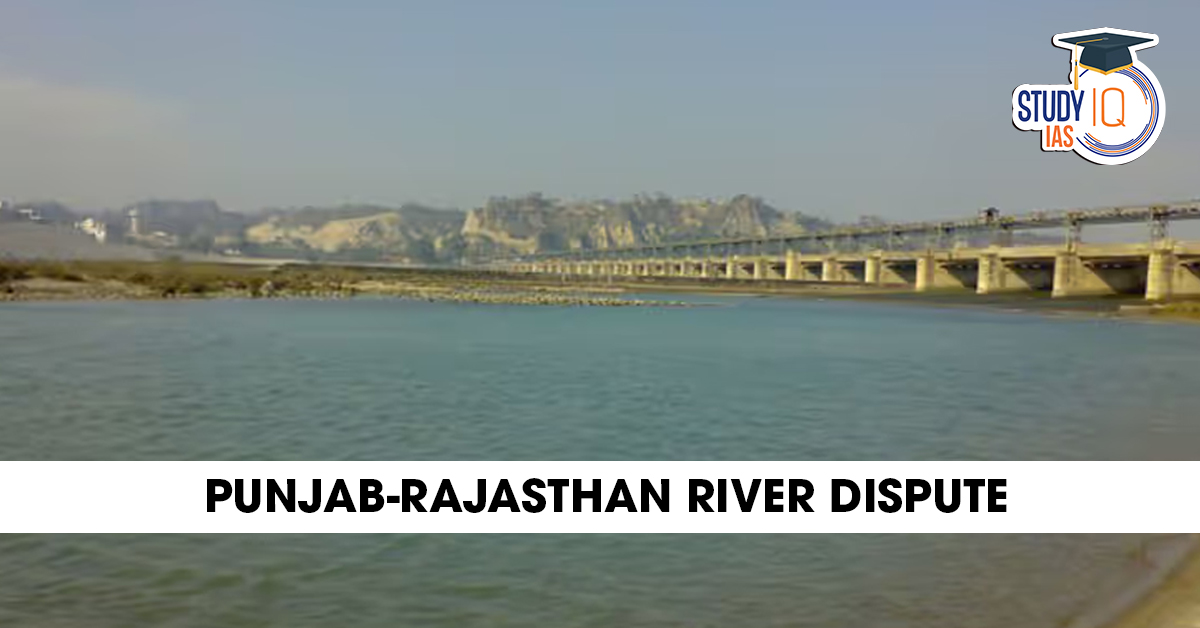
The Punjab–Rajasthan river dispute is a significant interstate water conflict in India centered around the sharing of the Ravi–Beas river waters. Originating from agreements made in the mid-20th century, the issue has resurfaced due to Punjab’s demand for compensation and concerns over water scarcity. The dispute raises important questions about water rights, federal governance, and resource distribution in India.
The 1920 Bikaner Agreement
- The roots of the dispute lie in a commercial arrangement from the 1920s between the Princely State of Bikaner and the British-led Punjab administration.
- Maharaja Ganga Singh of Bikaner sought water for his arid kingdom via the Gang (Bikaner) Canal, originating at the Ferozepur headworks.
- Unlike modern interstate sharing, this was a paid service. Bikaner paid Punjab a royalty based on the total irrigated acreage.
- This payment continued until roughly 1960, when the nature of Indian federalism and international water treaties changed the landscape.
Indus Waters Treaty (IWT)
- The signing of the Indus Waters Treaty between India and Pakistan in 1960 fundamentally altered India’s internal water management.
- Unrestricted Use: India gained full rights over the eastern rivers—Sutlej, Beas, and Ravi.
- National Priority: The Indian government began treating water as a national resource for “arid zone development” rather than a commodity for sale between states.
- End of Royalty: During this transition, the royalty system was discontinued. Rajasthan began receiving water through the newly developed Harike Barrage and the massive Indira Gandhi Canal (IGC) as a matter of state entitlement, not purchase.
1981 Tripartite Agreement: Punjab, Haryana, and Rajasthan
- Under the mediation of Prime Minister Indira Gandhi, a tripartite agreement was signed between Punjab, Haryana, and Rajasthan.
- Out of an estimated 17.17 Million Acre Feet (MAF) of Ravi-Beas water, Rajasthan was allocated 8.6 MAF—the largest share.
- Punjab has long contested this, arguing that Rajasthan is a non-riparian state (the rivers do not flow through it) and should not have a claim superior to the basin state, especially as Punjab’s own water table collapses.
Hydrological Realities: 1960 vs. 2026
- Groundwater Crisis: Punjab now has the highest groundwater extraction rate in India at 36%, compared to the national average of ~60%.
- Increased Canal Usage: Punjab’s canal irrigation coverage has surged from 26.5% in 2022 to 78% by late 2025. This leaves little “surplus” water to fulfill historical 1981 allocations to Rajasthan.
- The Economic Shift: By claiming ₹1.44 lakh crore, Punjab is framing the water diversion as an “economic loss” to its farmers and state exchequer.
| Feature | Sutlej | Beas | Ravi |
| Source | Rakas Lake (Tibet), near Mansarovar. Enters India through Shipki La pass. | Beas Kund near Rohtang Pass (Himachal Pradesh). | Rohtang Pass (Kullu Hills, Himachal Pradesh). |
| Major Tributaries | Spiti, Baspa, Beas (joins at Harike). | Parbati, Hurla, Sainj, Uhl. | Budhil, Nai or Dhona, Seul, Siawa. |
| Key Dams/Projects | Bhakra-Nangal Project, Karcham Wangtoo, Nathpa Jhakri. | Pong Dam (Beas Dam), Pandoh Dam. | Thein Dam (Ranjit Sagar Dam), Chamera Project. |
| Confluence | Joins the Chenab in Pakistan to form the Panjnad. | Joins the Sutlej at Harike (Punjab, India). | Joins the Chenab in Pakistan. |
Background of the Punjab–Rajasthan River Dispute
The Punjab–Rajasthan River Dispute revolves around the waters of the Ravi and Beas rivers, part of the larger Indus river system. After independence and especially post the Indus Waters Treaty (1960) between India and Pakistan, India gained control over these eastern rivers.
In 1955, a major water-sharing agreement allocated Ravi–Beas waters among:
- Punjab
- Rajasthan
- Haryana (later carved out of Punjab in 1966)
Rajasthan, despite being a non-riparian state, was allocated a significant share to support irrigation in its arid regions.
| Key Agreements and Legal Framework |
1955 Water Allocation Agreement
Punjab Reorganisation Act, 1966
Inter-State River Water Disputes Act, 1956
Role of Bhakra Beas Management Board (BBMB)
|
|
Read More Notes |
|
| Environment Notes | Art and Culture Notes |
| Science and Tech | History Notes |
| Geography Notes | Indian Polity Notes |
| General Knowledge | International Relation |
|
Explore StudyIQ Courses |
|

 Approved List of Models and Manufacturer...
 RELIEF Scheme, Key Features, Need, Compo...
 World Day for Glaciers 2026: Date, Theme...








 WhatsApp





