Table of Contents
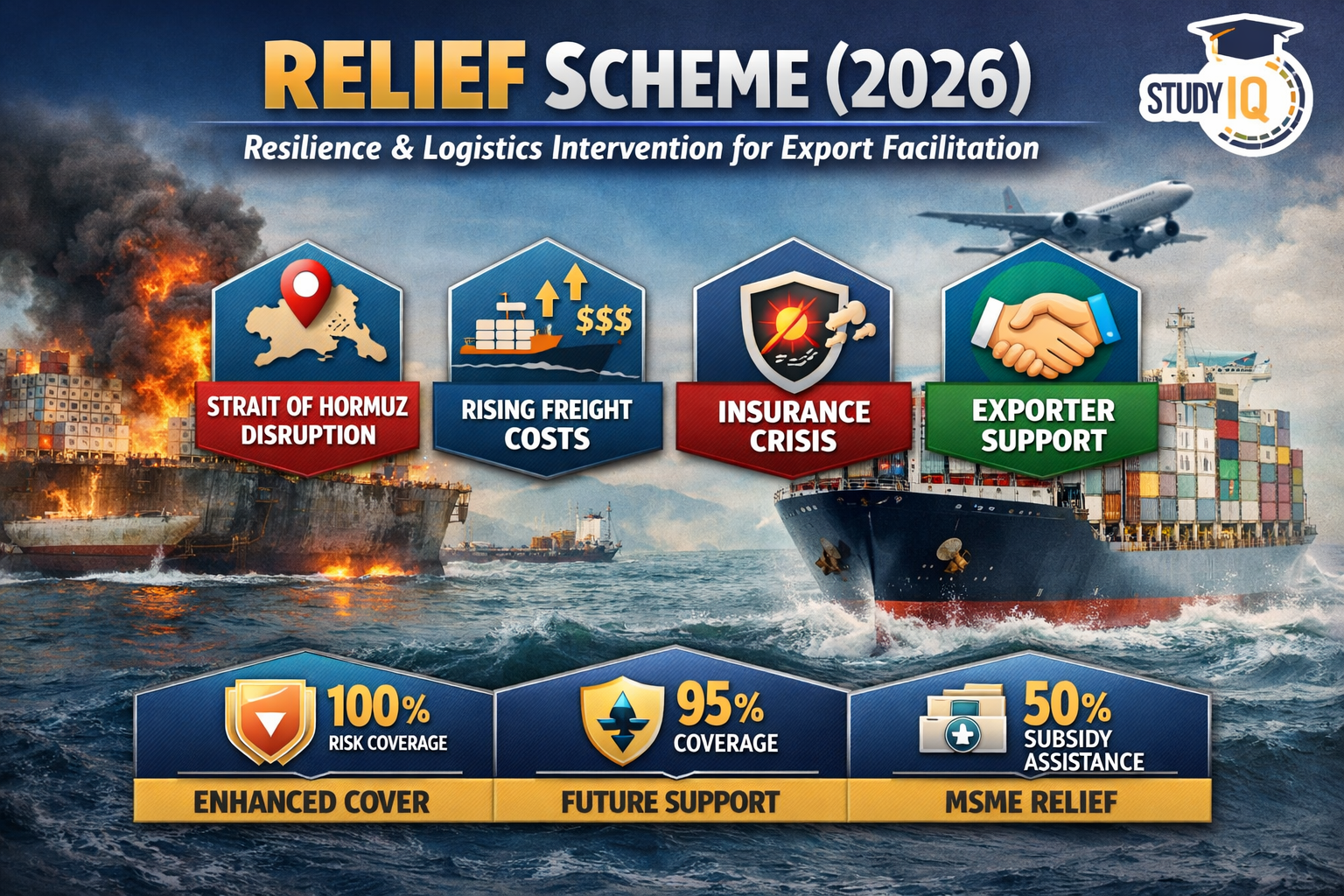
Context: Recently, the Government of India has approved the RELIEF (Resilience & Logistics Intervention for Export Facilitation) scheme to support exporters facing severe maritime disruptions in West Asia.
In the face of the Iran war and the resulting blockage of the Strait of Hormuz and resulting maritime logistics across the Gulf region, the Union Ministry of Commerce and Industry has launched a time-bound targeted intervention called RELIEF – Resilience & Logistics Intervention for Export Facilitation under the Export Promotion Mission (EPM).
About RELIEF Scheme
RELIEF Scheme is aimed at supporting Indian exporters affected by extraordinary freight escalation, heightened insurance premiums and war-related export risks arising from disruptions in the Gulf and wider West Asia maritime corridor. It is a time-bound and targeted intervention launched under the Export Promotion Mission (EPM).
Need for Relief Scheme
The Iran War in the Gulf region has a widespread impact on the maritime shipping sector, leading to widespread impact on Indian exporters. Some of the major challenges to maritime shipping are:
- Chokepoint Status: Strait of Hormuz: 100% collapse in inbound transit; Red Sea: Traffic suppressed by 49% due to kinetic strikes.
- Route Diversions: Shift to Cape of Good Hope, adding 3–7 weeks to transit; surge in “Dark Shipping” (AIS off).
- Freight & Costs: Sea freight: Up 200–300%; Bunker Fuel: Surged from $490 to $1,120/tonne; Air Freight: Spiked 400%.
- Insurance Crisis: War Risk coverage suspended by major insurers; premiums rose from 0.02% to >1.0% of hull value.
- Financial Levies: Emergency Surcharges: $1,800 (20′ dry) to $3,800 (Reefer); new War Risk Surcharges (WRS) applied.
- Stranded Ports & Congestion: JNPA/Kandla: 30,000+ TEUs stranded; Transhipment: 40–55% congestion in Colombo/Singapore hubs.
- Commodity Shocks: Energy: QatarEnergy force majeure on LNG; Agriculture: 400k tonnes of Basmati rice stranded.
- Supply Chain: Container Famine: Empty boxes trapped in Gulf ports; Fertiliser: Global “supply cliff” expected by May.
- Human Impact: Rising Seafarer Abandonment; crews refusing to enter “War Risk Areas” after vessel hits (ONE Majesty).
About RELIEF SCHEME
- RELIEF stands for Resilience & Logistics Intervention for Export Facilitation under the Export Promotion Mission (EPM).
- Nodal Agency: ECGC (Formerly Export Credit Guarantee Corporation of India Ltd.), wholly owned by the Ministry of Commerce & Industry, Government of India.
Objective of RELIEF SCHEME
Time-bound and targeted intervention aimed at supporting Indian exporters affected by extraordinary freight escalation, heightened insurance premiums and war-related export risks arising from disruptions in the Gulf and wider West Asia maritime corridor. RELIEF reflects the Government’s commitment to respond swiftly to external disruptions affecting India’s trade flows.
Eligible Consignments for benefit under the RELIEF Scheme
- Consignments destined to countries in the Gulf region, like the UAE, Saudi Arabia, Kuwait, Israel, Qatar, Oman, Bahrain, Iraq, Iran and Yemen, are meant for both delivery and trans-shipment.
- Covers both eligible past shipments and prospective exports, with a strong focus on MSME support.
Budget: Financial outlay of Rs. 497 Crores under the Mission. ECGC will maintain a dashboard-based monitoring system to enable real-time tracking of claims and fund utilisation.
Review of RELIEF Scheme: EPM Steering Committee to periodically review the operation in light of evolving geopolitical conditions and may recommend calibrated modification, continuation or withdrawal as necessary.
Components of Relief Scheme
There are three complementary components under the RELIEF Scheme.
| Component | Target Group | Benefit under RELIEF Scheme | Period | Benefits to Exporters |
| I. Enhanced Cover | Exporters with existing ECGC cover. | Up to 100% total risk coverage (Top-up over existing cover) | Feb 14 – Mar 15, 2026 | Enhanced protection without additional financial burden |
| II. Future Support | Exporters with upcoming consignments. | Up to 95% risk coverage with Gov. support (Top-up over existing cover) | Mar 16 – Jun 15, 2026 | Sustain exporter confidence
Facilitate continued shipment flows despite logistics uncertainties. |
| III. MSME Relief | Non-ECGC insured MSME exporters. | Up to 50% reimbursement for freight/insurance surcharges. (Ceiling of Rs 50 lakhs per exporter) | Feb 14 – Mar 15, 2026 | Provide timely relief against conflict-related logistics cost escalation. |
RELIEF intervention aims to mitigate immediate logistics disruptions and protect exporter confidence while safeguarding sector-linked employment and reinforcing India’s long-term competitiveness in global trade.
- Mitigate Disruption: Reduce the immediate financial impact of logistics and freight hikes.
- Protect Confidence: Prevent order cancellations and maintain exporter morale.
- Safeguard Jobs: Ensure stability in employment across export-linked sectors.
- Global Competitiveness: Reinforce India’s resilience and reliability in international markets.
Features of RELIEF Scheme
- Enhanced Risk Coverage (Past Shipments): Exporters with existing ECGC cover for shipments between 14 February and 15 March 2026 receive up to 100% risk coverage for additional conflict-linked losses.
- Support for Prospective Exports: For shipments planned between 16 March and 15 June 2026, the government supports up to 95% risk coverage to maintain exporter confidence.
- MSME Reimbursement: Non-insured MSME exporters can claim up to 50% reimbursement (capped at ₹50 lakh per exporter) for extraordinary freight and insurance surcharges incurred during the initial disruption month.
- Regional Scope: Applies to all consignments destined for or transshipped through the UAE, Saudi Arabia, Kuwait, Israel, Qatar, Oman, Bahrain, Iraq, Iran, and Yemen.
- Operational Reliefs: Includes waivers of storage and dwell time charges at ports and procedural relaxations for stranded cargo coordinated by the IMG.
- Real-time Monitoring: ECGC will maintain a dashboard-based system for tracking claims and fund utilisation, with periodic reviews by the EPM Steering Committee.
- Implementation: By ECGC Ltd.
|
Read More Notes |
|
| Environment Notes | Art and Culture Notes |
| Science and Tech | History Notes |
| Geography Notes | Indian Polity Notes |
| General Knowledge | International Relation |
|
Explore StudyIQ Courses |
|
 Kathakali Festival 2026: Theme, History ...
 Kohat Attack 2026: What Happened in Khyb...
 World Bamboo Day 2026: Date, Theme, Hist...







 WhatsApp